
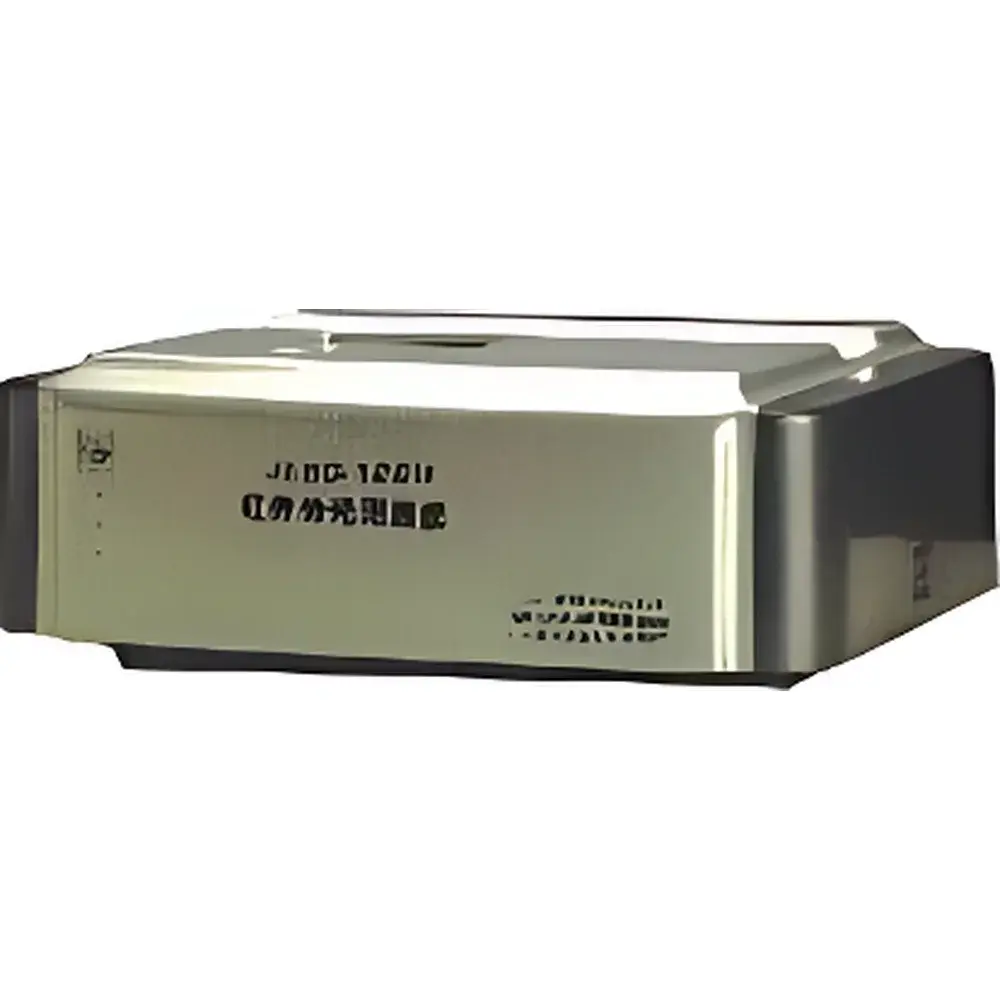
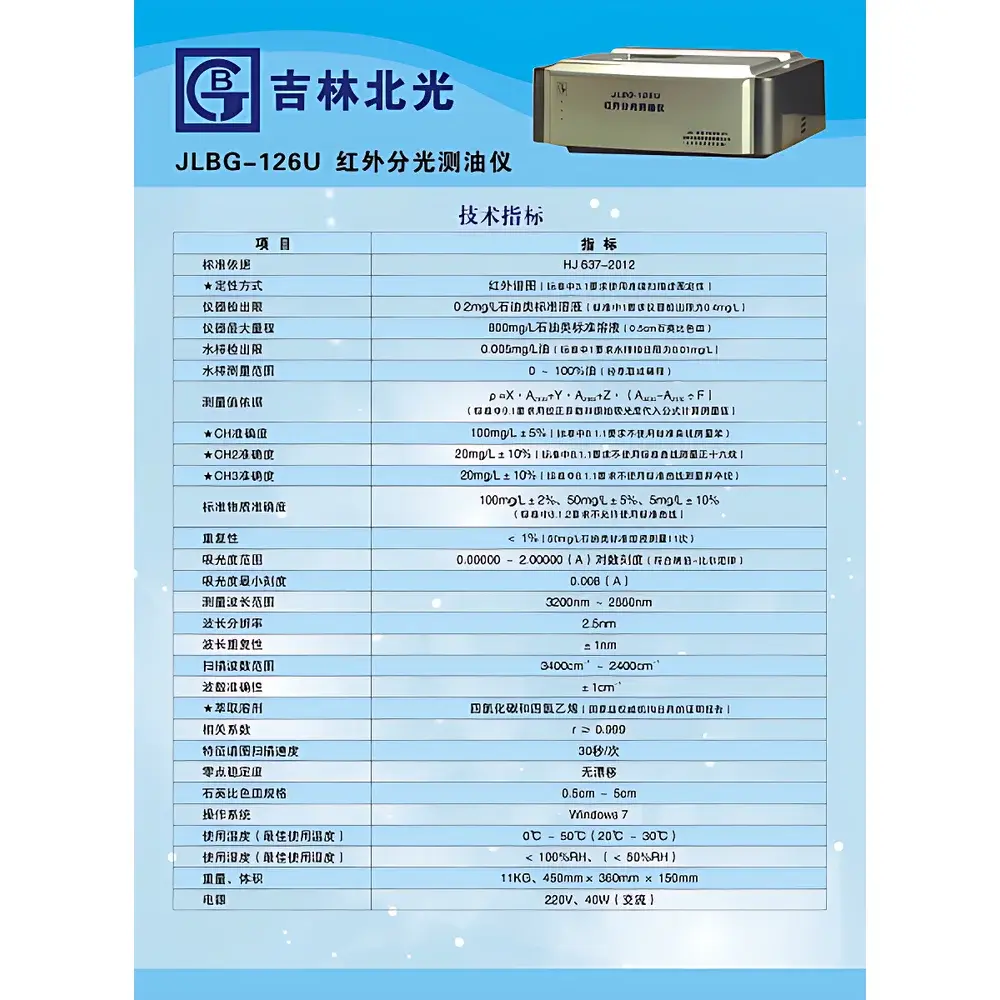
Beiguang JLBG-126U Infrared Spectrophotometric Oil Content Analyzer
| Brand | Beiguang |
|---|---|
| Origin | Jilin, China |
| Manufacturer Type | Authorized Distributor |
| Origin Category | Domestic (China) |
| Model | JLBG-126U |
| Instrument Type | Laboratory Benchtop Analyzer |
| Measurement Principle | Fourier-transform-free Infrared Spectrophotometry (Dispersive Grating-based, Full-spectrum Scanning) |
| Measurement Range | 0 mg/L – 100% oil (w/w or v/v, matrix-dependent) |
| Detection Limit | 0.2 mg/L (as petroleum hydrocarbons in water, per HJ 637–2012 protocol with 1000 mL sample & 25 mL C₂Cl₄ extract, 4 cm pathlength) |
| Accuracy | ±10% (relative error vs. certified reference materials per HJ 637–2012 Annex B) |
| Resolution | 0.1 ppm (digital absorbance resolution at 2930 cm⁻¹) |
| Analysis Cycle Time | 75 seconds per sample (including spectral acquisition, baseline correction, and calculation) |
Overview
The Beiguang JLBG-126U is a laboratory-grade infrared spectrophotometric oil content analyzer engineered for regulatory compliance with China’s national standard HJ 637–2012 for petroleum hydrocarbon quantification in aqueous matrices. Unlike non-dispersive infrared (NDIR) instruments that measure discrete absorbance values at three fixed wavenumbers (2930 cm⁻¹, 2960 cm⁻¹, and 3030 cm⁻¹), the JLBG-126U implements true dispersive infrared spectrophotometry—acquiring continuous, high-fidelity absorbance spectra across the mid-infrared region (2800–3100 cm⁻¹) using a precision grating monochromator and thermoelectrically cooled PbS detector. This full-spectrum capability enables both quantitative analysis and qualitative verification: users can visually inspect spectral features to distinguish aliphatic hydrocarbons (2930/2960 cm⁻¹) from aromatic compounds (3030 cm⁻¹), and critically, identify and exclude spectral interferences from non-petroleum organics such as alcohols, ketones, or esters—substances that produce false-positive responses in NDIR systems.
Key Features
- True full-spectrum scanning (2800–3100 cm⁻¹) with 0.5 cm⁻¹ spectral resolution, supporting spectral validation and interference diagnostics
- Dual solvent compatibility: validated for use with tetrachloroethylene (C₂Cl₄), fully compliant with revised HJ 637–2012 implementation guidelines; CCl₄ operation disabled by firmware to enforce Montreal Protocol adherence
- No standard curve dependency: implements direct calculation per HJ 637–2012 Section 9.1: ρ = X·A2930 + Y·A2960 + Z·(A3030 − A3030/F), eliminating calibration bias from structural mismatch between standard mixtures and real-world oil compositions
- Verified detection limit of 0.2 mg/L in instrument mode—equivalent to 0.4 mg/L in petroleum hydrocarbon standard solution under HJ 637–2012 extraction conditions (1000 mL water / 25 mL C₂Cl₄ / 4 cm cell), satisfying the instrumental sensitivity requirement for method-compliant operation
- High-stability optical train featuring worm-gear-driven monochromator mechanism, reducing mechanical drift and improving wavelength repeatability (< ±0.2 cm⁻¹ over 8-hour operation)
- Aromatic-specific quantification: calibrated response at 3030 cm⁻¹ validated against 100 mg/L benzene and toluene standards per HJ 637–2012 Section 8.1.1, ensuring trace-level aromatic hydrocarbon detection critical for industrial wastewater monitoring
Sample Compatibility & Compliance
The JLBG-126U is designed for aqueous environmental samples—including surface water, groundwater, wastewater effluents, and leachates—following liquid–liquid extraction with tetrachloroethylene per HJ 637–2012. It supports measurement of total petroleum hydrocarbons (TPH) as well as semi-quantitative differentiation of aliphatic vs. aromatic fractions via spectral deconvolution. The instrument conforms to ISO/IEC 17025:2017 general requirements for competence of testing laboratories and is routinely deployed in GLP-compliant environmental testing labs accredited under CNAS (China National Accreditation Service). Its operational logic and calculation engine are aligned with HJ 637–2012’s mandatory equations and exclusion criteria, making it suitable for regulatory reporting to Chinese provincial生态环境 departments. While not FDA 21 CFR Part 11-certified out-of-box, audit-ready data export (CSV, PDF reports with embedded spectral plots and metadata timestamps) supports internal validation for GMP-aligned QA/QC workflows.
Software & Data Management
The embedded Windows-based control software provides real-time spectral visualization, automatic peak identification, and integrated calculation per HJ 637–2012. All raw interferograms (if FT variant) or scanned spectra, absorbance values at key wavenumbers, and final concentration outputs are stored with immutable timestamps, operator ID, and instrument serial number. Data export includes ASCII-compatible CSV files for LIMS integration and PDF reports containing full spectral overlays, baseline correction logs, and calculation audit trails. Software supports user-defined method templates, multi-point QC checks (blanks, duplicates, spikes), and configurable pass/fail thresholds based on relative standard deviation (RSD ≤ 15% for triplicate analysis). No cloud connectivity or remote access is enabled by default—data residency remains local unless explicitly configured by the lab administrator.
Applications
- Regulatory monitoring of petroleum hydrocarbons in municipal and industrial wastewater discharges (per HJ 637–2012 and local discharge permits)
- Environmental site assessment (ESA) and remediation verification at former refinery, storage terminal, or transportation spill sites
- Process water quality control in petrochemical, steelmaking, and metalworking facilities where cutting oils or hydraulic fluids may enter effluent streams
- Research on oil biodegradation kinetics, where spectral evolution (e.g., aromatic depletion vs. aliphatic persistence) must be tracked over time
- Method validation and interlaboratory comparison studies requiring traceable, spectrum-based quantification rather than endpoint absorbance proxies
FAQ
Why does this instrument not use calibration curves?
HJ 637–2012 explicitly prohibits standard curve-based correction for petroleum hydrocarbons due to compositional heterogeneity—real-world oil mixtures differ structurally from the fixed 10:25:65 benzene/isooctane/n-hexadecane reference standard. The JLBG-126U implements the regulation-mandated direct calculation algorithm using instrument-specific coefficients (X, Y, Z, F) derived from independent spectral characterization.
Can the instrument detect aromatic hydrocarbons separately?
Yes. The 3030 cm⁻¹ band is resolved independently and validated against pure benzene and toluene standards. While total petroleum hydrocarbon (TPH) is reported as a composite value, spectral inspection allows estimation of aromatic contribution—critical for toxicity assessment and explosion hazard evaluation.
Is tetrachloroethylene (C₂Cl₄) safe to use with this system?
C₂Cl₄ is the only permitted extraction solvent under current HJ 637–2012 revisions. The JLBG-126U’s optical path and cuvette handling are chemically compatible with C₂Cl₄; no modifications or special maintenance are required beyond standard IR cell cleaning protocols.
How is the 0.2 mg/L detection limit verified?
This is an instrument-level detection limit confirmed by repeated measurement of 0.4 mg/L petroleum hydrocarbon standard solutions (prepared gravimetrically), yielding signal-to-noise ≥ 3:1 under defined extraction and cell-path conditions. It satisfies the HJ 637–2012 requirement that instrument sensitivity must support the method’s 0.01 mg/L reporting limit.
Does the worm-gear monochromator improve long-term calibration stability?
Yes. Compared to legacy gear-driven mechanisms, the worm-gear assembly reduces backlash and thermal hysteresis, maintaining wavelength accuracy within ±0.2 cm⁻¹ over 8 hours without recalibration—essential for unattended batch analysis in routine environmental labs.







