
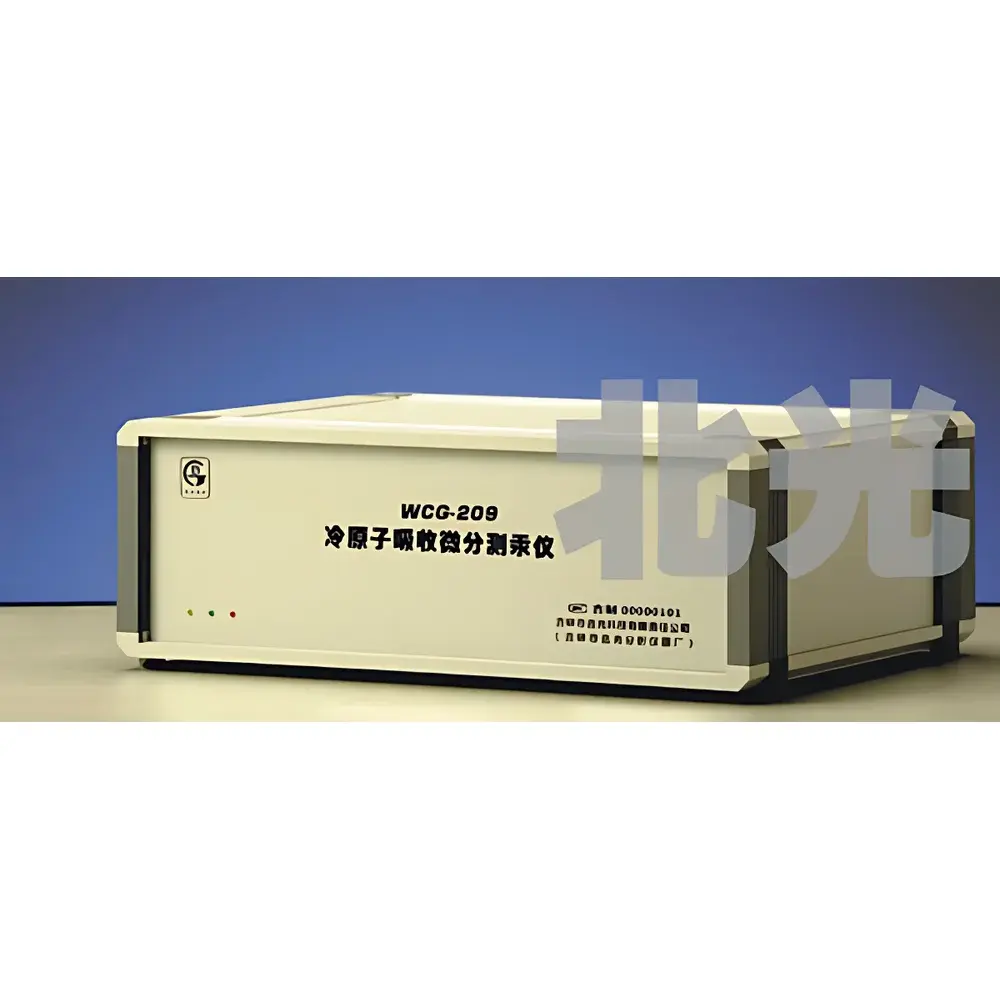
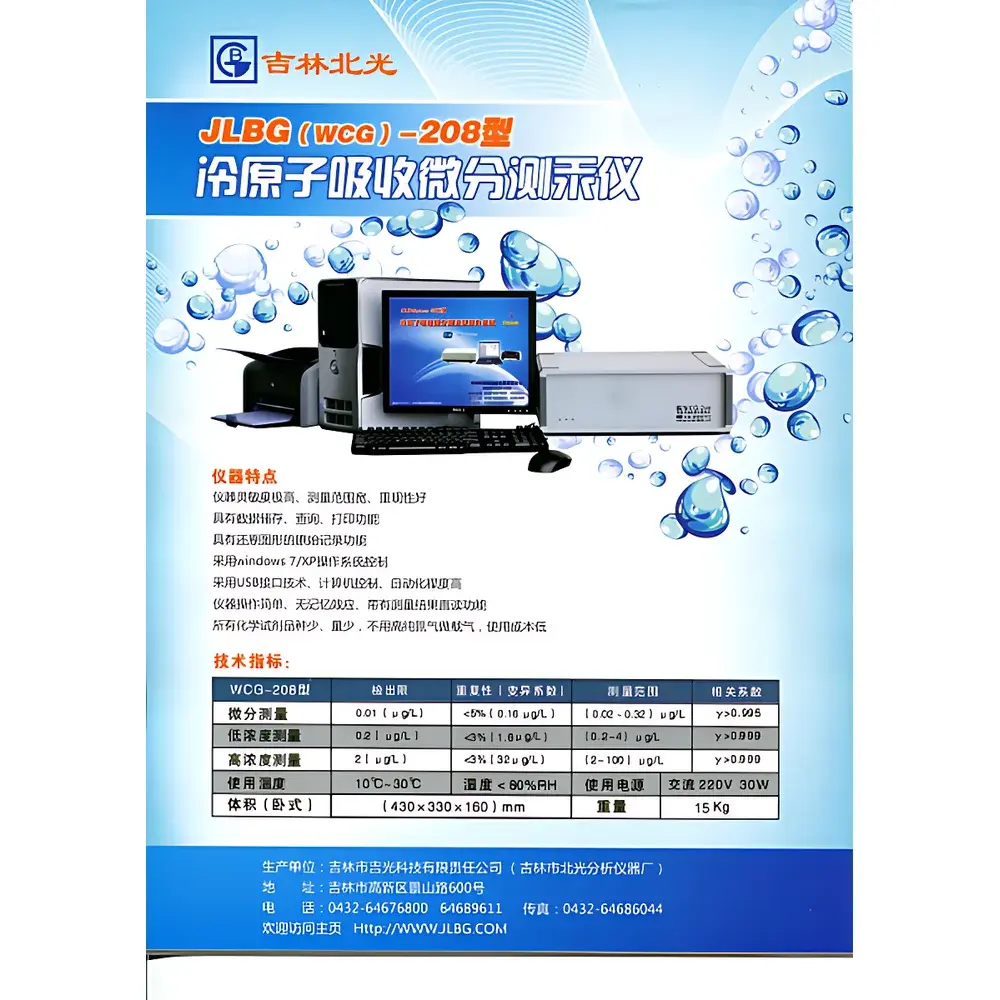
Beiguang JLBG-208 Cold Vapor Atomic Absorption Mercury Analyzer
| Brand | Beiguang |
|---|---|
| Origin | Jilin, China |
| Model | JLBG-208 |
| Instrument Type | Benchtop Laboratory Mercury Analyzer |
| Measurement Principle | Cold Vapor Atomic Absorption Spectrometry (CVAAS) |
| Detection Limit | 0.01 µg/L (differential mode), 0.1 µg/L (standard mode) |
| Repeatability | <3% RSD at 2 µg/L |
| Linearity Error | ±10% |
| Correlation Coefficient | γ > 0.995 (differential), γ > 0.999 (low/high concentration) |
| Power Supply | AC 220 V, 30 W |
| Operating Temperature | 17–30 °C |
| Operating Humidity | 20–80% RH |
| Dimensions (L×W×H) | 42×30×16 cm |
| Net Weight | 15 kg |
Overview
The Beiguang JLBG-208 Cold Vapor Atomic Absorption Mercury Analyzer is a benchtop laboratory instrument engineered for trace-level mercury quantification in aqueous, gaseous, and solid matrices. It operates on the well-established principle of Cold Vapor Atomic Absorption Spectrometry (CVAAS), wherein mercury ions are chemically reduced to elemental mercury vapor, which is then swept into an absorption cell and quantified via 253.7 nm UV absorption. Unlike conventional CVAAS systems, the JLBG-208 incorporates a proprietary differential measurement architecture that enhances signal-to-noise ratio and suppresses baseline drift—enabling sub-part-per-trillion sensitivity without requiring high-purity carrier gases or complex gas purification modules. Its design eliminates memory effects commonly observed in amalgamation-based systems, ensuring reliable carryover-free analysis across heterogeneous sample batches.
Key Features
- Enhanced differential detection mode achieving a validated method detection limit (MDL) of 0.01 µg/L in water—approximately two orders of magnitude lower than standard CVAAS configurations.
- No baseline drift over extended operation; stable photometric response maintained under ambient lab conditions (17–30 °C, 20–80% RH).
- Three calibrated measurement ranges: differential (0.02–0.32 µg/L), low-concentration (0.2–4 µg/L), and high-concentration (2–100 µg/L), each optimized for precision and linearity (γ > 0.995–0.999).
- Integrated USB 2.0 interface enabling full computer control via Windows 2000/XP-compatible software—no external DAQ cards or proprietary hardware drivers required.
- Minimal reagent consumption: utilizes standard sodium borohydride and stannous chloride solutions; no high-purity nitrogen or argon carrier gas needed.
- Onboard data storage with timestamped records, graphical reconstruction of raw absorbance traces, and direct numeric readout of concentration values.
- Compact footprint (42 × 30 × 16 cm) and lightweight chassis (15 kg net) suitable for shared analytical labs or mobile environmental monitoring units.
Sample Compatibility & Compliance
The JLBG-208 supports direct analysis of liquid samples (surface water, groundwater, industrial effluents), acid-digested solids (soils, sediments, biological tissues), and captured gas-phase mercury (via impinger or sorbent trap eluates). Sample introduction is performed manually or semi-automatically using syringe-driven flow control, with optional integration into EPA Method 1631E-compliant digestion workflows. While not pre-certified for regulatory submission, the instrument’s performance characteristics—including repeatability (<3% RSD), linearity (±10% error), and documented correlation coefficients—align with QA/QC requirements outlined in ISO 17294-2, ASTM D3559, and US EPA 245.1. Data output formats support manual audit trail reconstruction, and the system can be configured to meet GLP documentation standards when paired with validated laboratory information management systems (LIMS).
Software & Data Management
The native acquisition software provides real-time spectral visualization, peak integration, calibration curve generation (linear and polynomial), and automated dilution factor application. All measurement parameters—including lamp current, integration time, and reduction delay—are user-configurable and stored per method. Raw absorbance vs. time profiles are retained alongside processed results, enabling retrospective validation of peak shape integrity and interference assessment. Export options include CSV and XML formats compatible with third-party statistical packages (e.g., JMP, Minitab) and LIMS interfaces. Audit-ready reporting includes operator ID, sample ID, date/time stamps, calibration verification points, and system suitability metrics—facilitating compliance with internal quality assurance protocols and external accreditation reviews.
Applications
- Environmental monitoring of mercury in municipal drinking water sources per WHO and EU Drinking Water Directive thresholds (1.0 µg/L).
- Compliance testing of industrial wastewater discharges against national effluent limits (e.g., China’s GB 8978-1996, US EPA NPDES permit requirements).
- Geochemical surveying of mercury-contaminated soils and mine tailings using EPA Method 7471A digestion protocols.
- Occupational health screening of workplace air via cold vapor collection onto gold-coated quartz traps followed by thermal desorption and analysis.
- Research-grade speciation support when coupled with HPLC-CVAAS hyphenation (post-column reduction interface required).
FAQ
What mercury species does the JLBG-208 detect?
The instrument measures total elemental mercury (Hg⁰) after complete chemical reduction; it does not differentiate between inorganic Hg²⁺ and organic methylmercury without prior oxidative digestion.
Is the system compliant with 21 CFR Part 11?
The base configuration does not include electronic signature, role-based access control, or automated audit trails required for FDA-regulated environments; however, these features may be implemented via validated third-party LIMS integration.
Can the JLBG-208 analyze solid samples directly?
No—solid matrices require acid digestion (e.g., HNO₃/H₂SO₄/KMnO₄ or microwave-assisted aqua regia) prior to analysis to ensure quantitative release of bound mercury.
What maintenance is required for long-term stability?
Routine maintenance includes quarterly cleaning of the quartz absorption cell with dilute nitric acid, annual replacement of the mercury lamp (typical lifetime: 1,000–2,000 hours), and biannual verification of reagent delivery tubing integrity.
Does the system support multi-point calibration verification?
Yes—the software allows bracketing calibration checks at up to five concentration levels per batch, with automatic flagging of deviations exceeding user-defined acceptance criteria (e.g., ±10% recovery).





