
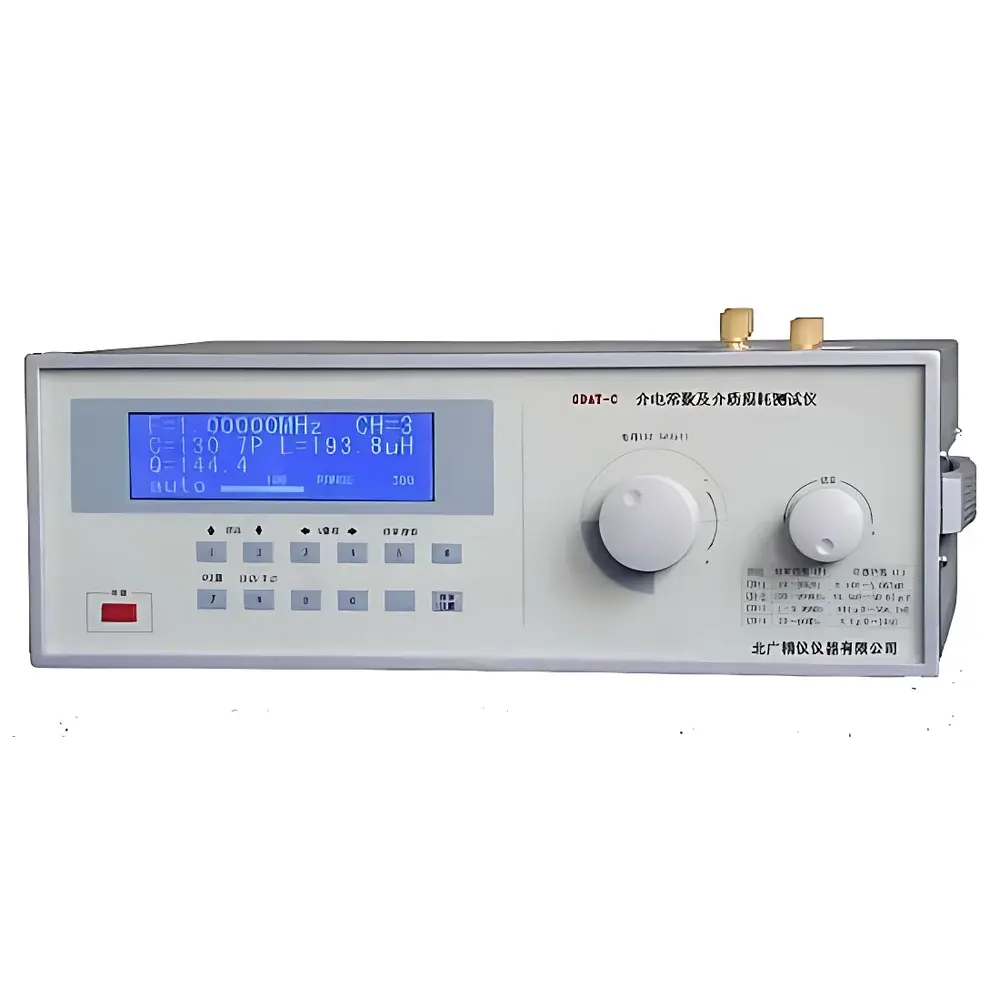
Beijing North Guang Precision Instrument GDAT-A High-Frequency Dielectric Constant and Dissipation Factor Analyzer
| Brand | Beijing North Guang Precision Instrument |
|---|---|
| Origin | Beijing, China |
| Manufacturer Type | Direct Manufacturer |
| Country of Origin | China |
| Model | GDAT-A |
| Pricing | Available Upon Request |
Overview
The Beijing North Guang Precision Instrument GDAT-A is a high-frequency dielectric constant (ε′) and dissipation factor (tan δ) analyzer engineered for precise characterization of insulating materials across solid and liquid phases. It operates on the principle of series/parallel resonance in a calibrated LC circuit, where the test specimen serves as a variable capacitor within a stable, low-loss resonant bridge configuration. By measuring the resonant frequency shift and Q-factor (quality factor) degradation induced by the sample’s complex permittivity, the instrument calculates ε′ and tan δ with traceable accuracy in the 10 kHz to 160 MHz frequency range. Designed for R&D laboratories, quality control departments, and material certification facilities, the GDAT-A supports standardized evaluation of polymer films, ceramic substrates, transformer oils, epoxy resins, and composite laminates under controlled environmental conditions (0–40 °C, <80% RH). Its architecture conforms to fundamental metrological requirements for impedance-based dielectric measurement, enabling compliance-driven reporting in contexts referencing ASTM D150, IEC 60250, and GB/T 1409.
Key Features
- Dual-mode signal generation: DDS (Direct Digital Synthesis) source with frequency coverage from 10 kHz to 160 MHz across four selectable channels (CH1–CH4), offering frequency resolution down to 0.0001 kHz and stability of ±3×10⁻⁵ ±1 digit.
- High-precision capacitance tuning: Two configurations available — sensor-based analog adjustment (GDAT-A) and stepper-motor-driven digital control — both enabling main capacitance tuning from 18–220 pF or 40–500 pF with accuracy of ±1.5 pF (≤150 pF) or ±1% (>150 pF).
- Automated resonance detection: Integrated auto-search algorithms locate the exact resonant point by sweeping either frequency or capacitance, then directly output Q-value, inductance, capacitance, and dissipation factor without manual iterative balancing.
- Q-factor measurement range: 2–1023, with five manually or automatically selectable ranges (30, 100, 300, 1000) and calibrated error limits: ≤7% ±2% of full scale (25 kHz–10 MHz); ≤8% ±2% of full scale (10–160 MHz).
- Digital readout interface: Simultaneous display of frequency, main capacitance, inductance (4.5 nH–140 mH), capacitance (1–205 pF direct; extended via substitution method), Q-value, and pass/fail status against user-defined Q-threshold (5–1000).
- Robust mechanical design: Compact benchtop unit (380 × 132 × 280 mm), 7 kg net weight, 220 V ±10%, 50 Hz ±2.5 Hz input, power consumption ≤25 W.
Sample Compatibility & Compliance
The GDAT-A accommodates flat solid specimens (e.g., discs, sheets, wafers) using standard parallel-plate or coaxial electrode fixtures, and liquids via dedicated temperature-stable immersion cells. It supports measurements per ASTM D150 Annex A1 (liquid dielectrics) and Annex A2 (solid sheet materials), and aligns with IEC 60250 for relative permittivity and dielectric loss determination. While not inherently 21 CFR Part 11 compliant, its digital output and repeatable calibration protocol support integration into GLP/GMP environments when paired with validated data capture workflows. All electrical safety design meets IEC 61010-1 requirements for laboratory measurement equipment.
Software & Data Management
The GDAT-A operates as a standalone instrument with no embedded software stack; however, its digital outputs (frequency, C, Q, L) are compatible with external RS-232 or USB-to-serial interfaces for integration into custom LabVIEW, Python, or MATLAB acquisition scripts. Raw parameter sets can be logged for post-processing, statistical analysis (e.g., batch mean ε′ deviation, tan δ trend vs. frequency), and report generation aligned with internal QA templates. Calibration certificates include traceability to national standards (CNAS-accredited reference labs), and annual verification procedures follow ISO/IEC 17025 guidelines.
Applications
- Quality assurance of insulating varnishes, impregnating resins, and potting compounds used in motor windings and transformers.
- Development and screening of high-frequency PCB substrates (e.g., PTFE, polyimide, ceramic-filled laminates) for 5G RF module applications.
- Characterization of moisture absorption effects in polymer films via tan δ peak shifts at 1–10 MHz.
- Batch consistency testing of silicone oils and synthetic ester coolants in high-voltage equipment.
- Educational use in university materials science labs for teaching complex impedance spectroscopy fundamentals.
FAQ
What frequency ranges does the GDAT-A support for dielectric measurement?
The instrument covers 10 kHz to 160 MHz in four discrete channels, with CH4 extending to 160 MHz for high-frequency ceramic and thin-film characterization.
Can the GDAT-A measure both solid and liquid samples?
Yes — it supports solids via parallel-plate electrodes and liquids using immersion-type test cells; fixture selection determines measurement geometry and field uniformity.
Is calibration traceable to international standards?
Calibration is performed using certified reference capacitors and inductors traceable to CNAS-accredited national metrology institutes, with documentation provided upon request.
Does the system support automated data export?
While the base unit lacks built-in storage, its digital output signals are fully compatible with third-party DAQ systems for real-time logging, CSV export, and integration into LIMS or ELN platforms.
What is the warranty coverage and service response time?
The GDAT-A carries a 24-month parts-and-labor warranty; technical support responds within 2 hours, and on-site service is dispatched within 48 hours for verified hardware faults under warranty terms.
Related Products



