
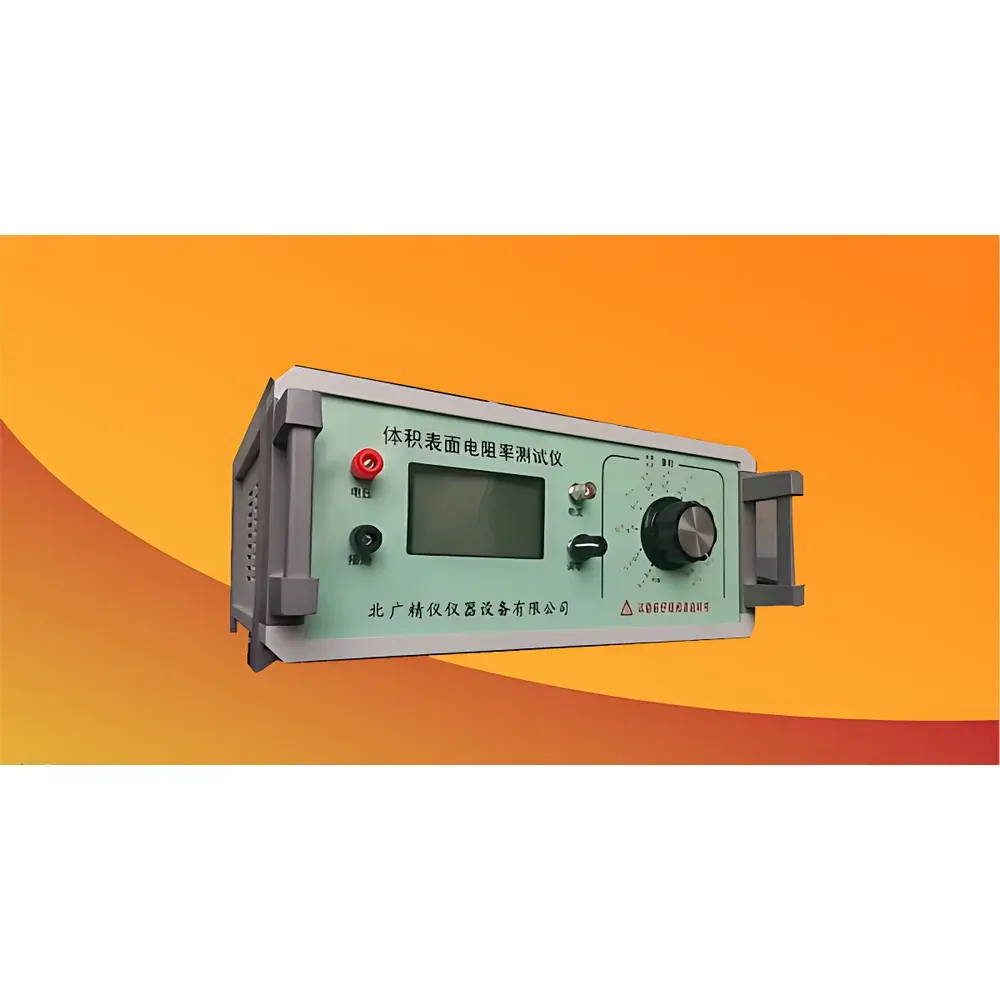
Beijing North Guang Precision Instruments BEST-121 Volume & Surface Resistivity Tester
| Brand | Beijing North Guang Precision Instruments |
|---|---|
| Origin | Beijing, China |
| Manufacturer Type | OEM Manufacturer |
| Product Origin | Domestic (China) |
| Model | BEST-121 |
| Price | USD 1,700 (FOB Beijing) |
Overview
The Beijing North Guang Precision Instruments BEST-121 Volume & Surface Resistivity Tester is a precision electrometric instrument engineered for high-accuracy measurement of electrical resistivity in insulating and antistatic materials. It operates on the fundamental principle of Ohm’s Law (R = V/I), employing simultaneous digital sampling of applied DC test voltage (V) and resulting current (I) across the specimen—followed by real-time A/D conversion and arithmetic computation—to directly display resistivity values in ohms (Ω) or ohm-centimeters (Ω·cm) / ohms per square (Ω/□). Unlike analog high-resistance meters with nonlinear scales and voltage-dependent calibration drift, the BEST-121 utilizes a dual-channel, microcurrent-sensing architecture with guarded electrode interface to eliminate leakage path errors and ensure stable, linear response across its full 14-decade dynamic range. Designed for compliance with international material characterization protocols, it supports standardized test configurations for both volume resistivity (ρv) and surface resistivity (ρs) as defined in ASTM D257, IEC 60093, and GB/T 1410–2006.
Key Features
- Simultaneous digital measurement of voltage and current—enabling direct readout of resistance without manual scaling or coefficient multiplication
- Extended resistance measurement range: 1 × 10⁴ Ω to 1 × 10¹⁸ Ω across ten auto-ranging decades
- Ultra-low current detection capability: 2 × 10⁻⁴ A down to 1 × 10⁻¹⁶ A (0.1 fA), optimized for high-impedance dielectric evaluation
- Six selectable DC test voltages: 10 V, 50 V, 100 V, 250 V, 500 V, and 1000 V (±10% tolerance), configurable per standard requirements
- Integrated guarded three-electrode system support—compatible with ASTM D257-compliant electrodes for unambiguous separation of volume vs. surface conduction paths
- Full-digit LCD display with dual-parameter readout (resistance value + measured current), enabling real-time validation of measurement integrity
- Thermally stabilized circuitry with ambient operating range of −10 °C to +50 °C and ≤90% RH non-condensing
- Compact benchtop form factor (300 × 280 × 150 mm), lightweight (3.0 kg), and low power consumption (~10 W, 220 VAC/50 Hz)
Sample Compatibility & Compliance
The BEST-121 is validated for use with solid dielectrics, elastomers, polymers, coatings, textiles, and composite laminates—including antistatic footwear, ESD flooring, cleanroom garments, and aerospace-grade insulators. Its electrode interface accommodates standard concentric ring (IEC 60093), parallel plate (GB/T 1410), and guarded electrode geometries. The instrument conforms to over 25 national and industry standards, including GB/T 1410–2006 (equivalent to ASTM D257), GB 12014 (antistatic clothing), GB/T 20991–2007 (footwear resistivity), GB 4385–1995 (ESD control), and GJB 105A–1998 (military static control). While not FDA 21 CFR Part 11–certified out-of-box, its audit-ready data logging mode (via optional RS232/USB output) supports GLP/GMP-aligned documentation when integrated into validated laboratory workflows.
Software & Data Management
The BEST-121 operates as a standalone instrument with embedded firmware; no host PC is required for basic operation. Optional communication modules (RS232 or USB-to-serial) enable integration with third-party data acquisition platforms (e.g., LabVIEW, MATLAB, or custom Python scripts) for time-stamped measurement export, batch reporting, and statistical process control (SPC) charting. All displayed readings include automatic timestamping and range identification. For regulated environments, users may implement external electronic lab notebooks (ELN) with metadata tagging (operator ID, sample ID, test voltage, electrode configuration) to satisfy traceability requirements under ISO/IEC 17025 or internal QA procedures.
Applications
- Quality assurance of ESD-sensitive packaging and handling materials in semiconductor manufacturing
- Resistivity validation of conductive polymers, carbon-loaded composites, and nanomaterial-coated substrates
- Routine testing of rubber compounds per GB/T 1692–2008 (vulcanized rubber volume resistivity at 500 V)
- Research-level characterization of thin-film dielectrics, optical coatings, and battery separator membranes
- Dark current assessment in photodetectors and low-noise sensor development
- Compliance verification for ISO 14644–1 cleanroom flooring systems and EN 61340–4–1 electrostatic protection standards
FAQ
What is the difference between volume and surface resistivity measurements?
Volume resistivity (ρv) quantifies bulk material resistance perpendicular to current flow (units: Ω·cm); surface resistivity (ρs) measures lateral conduction along the material interface (units: Ω/□). The BEST-121 uses dedicated electrode switching (Rv/Rs toggle) and guard-ring configuration to isolate each path per ASTM D257.
Does the instrument require periodic calibration traceable to NIST or CNAS?
Yes—annual calibration using certified high-resistance standards (e.g., 109–1014 Ω) is recommended. Beijing North Guang provides factory calibration certificates aligned with CNAS-accredited reference standards.
Can the BEST-121 measure resistivity of liquids or powders?
No—it is designed exclusively for solid, sheet-like or molded specimens with defined geometry and stable electrode contact. Liquid or powder resistivity requires specialized cells and alternative instrumentation (e.g., conductivity meters or impedance analyzers).
Is shielding mandatory during measurement?
Yes—measurements above 1012 Ω must be conducted inside a grounded Faraday cage or shielded enclosure to suppress electromagnetic interference and triboelectric noise.
What safety precautions apply when operating at 1000 V DC?
Operators must observe IEC 61010–1:2010 safety guidelines: avoid contact with exposed terminals, verify grounding before power-up, use only insulated test leads rated ≥CAT II 1000 V, and never short the Rx terminals under voltage.



