
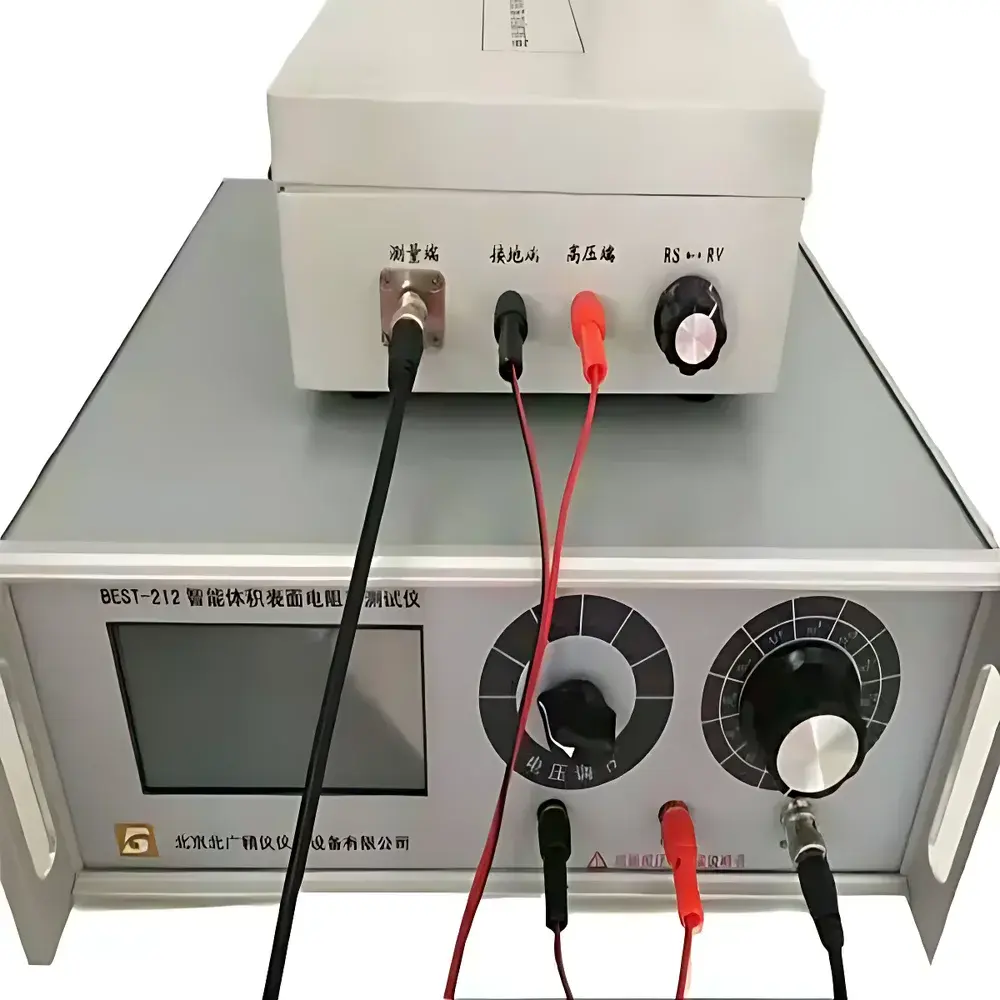
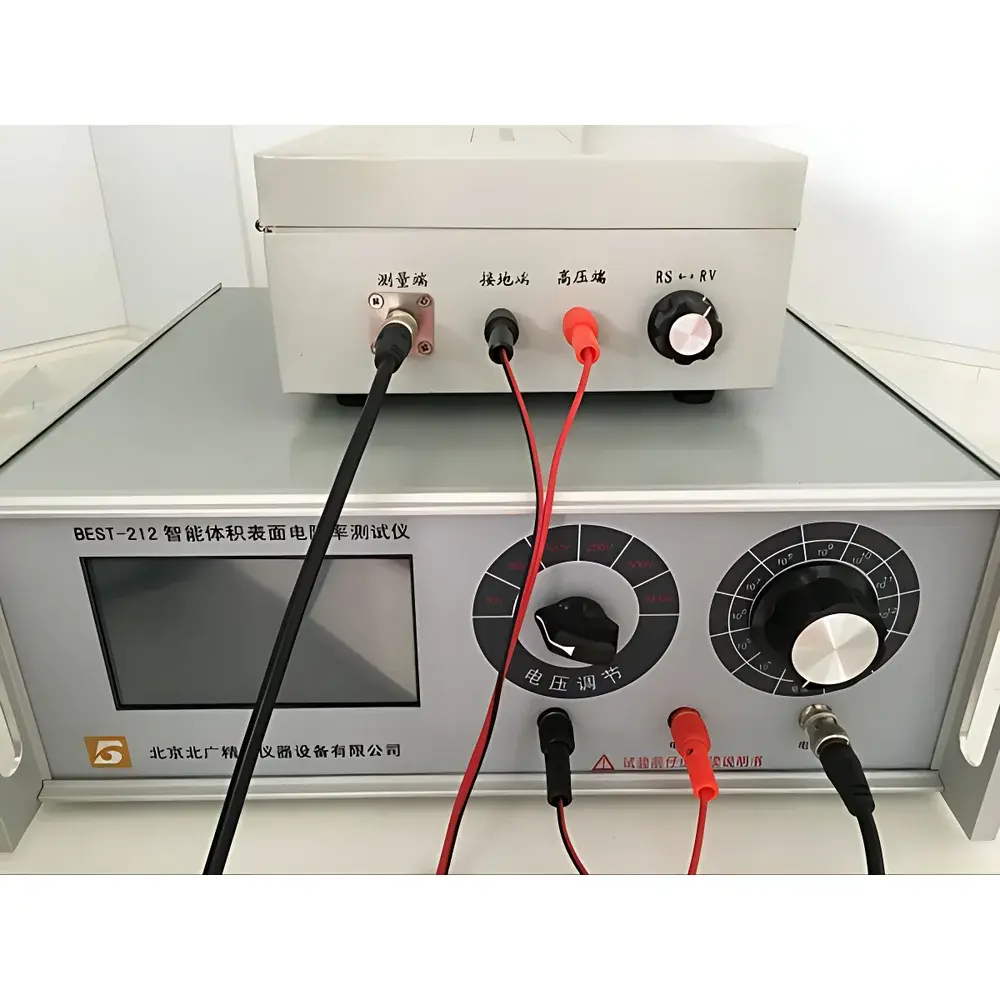
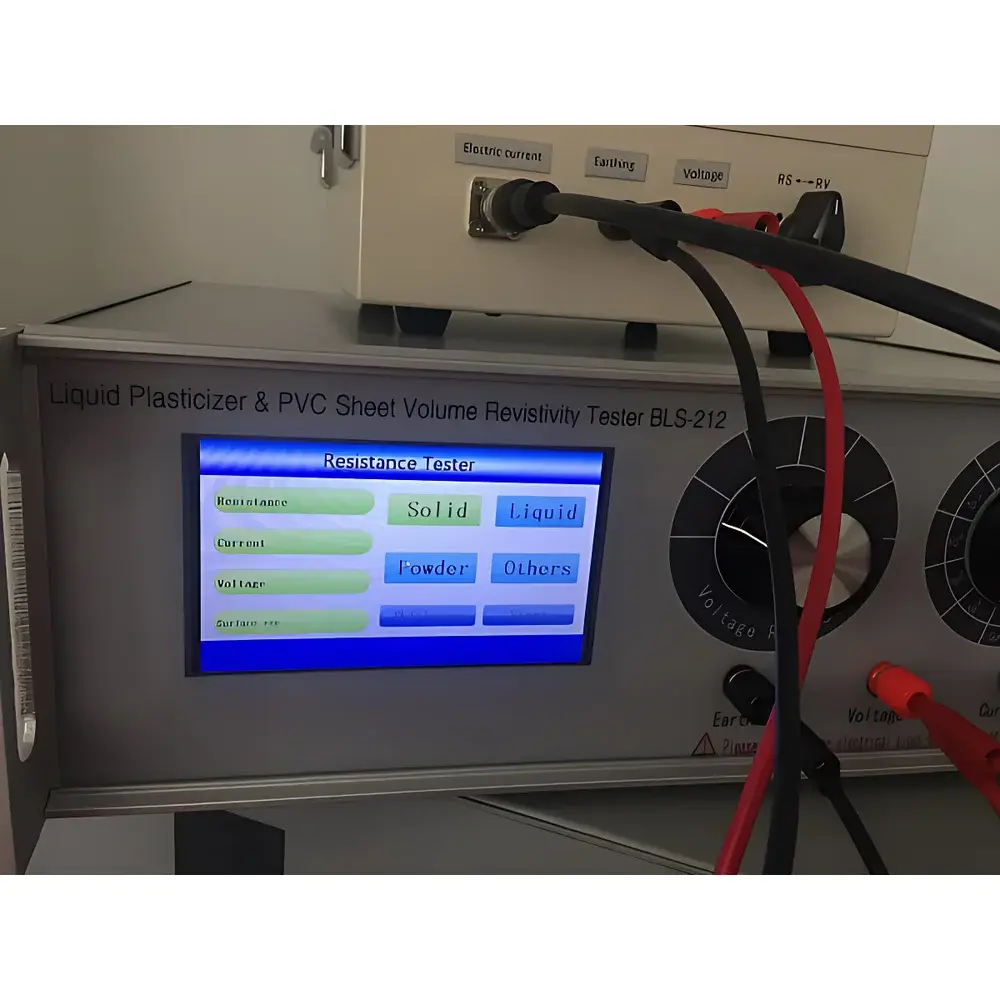
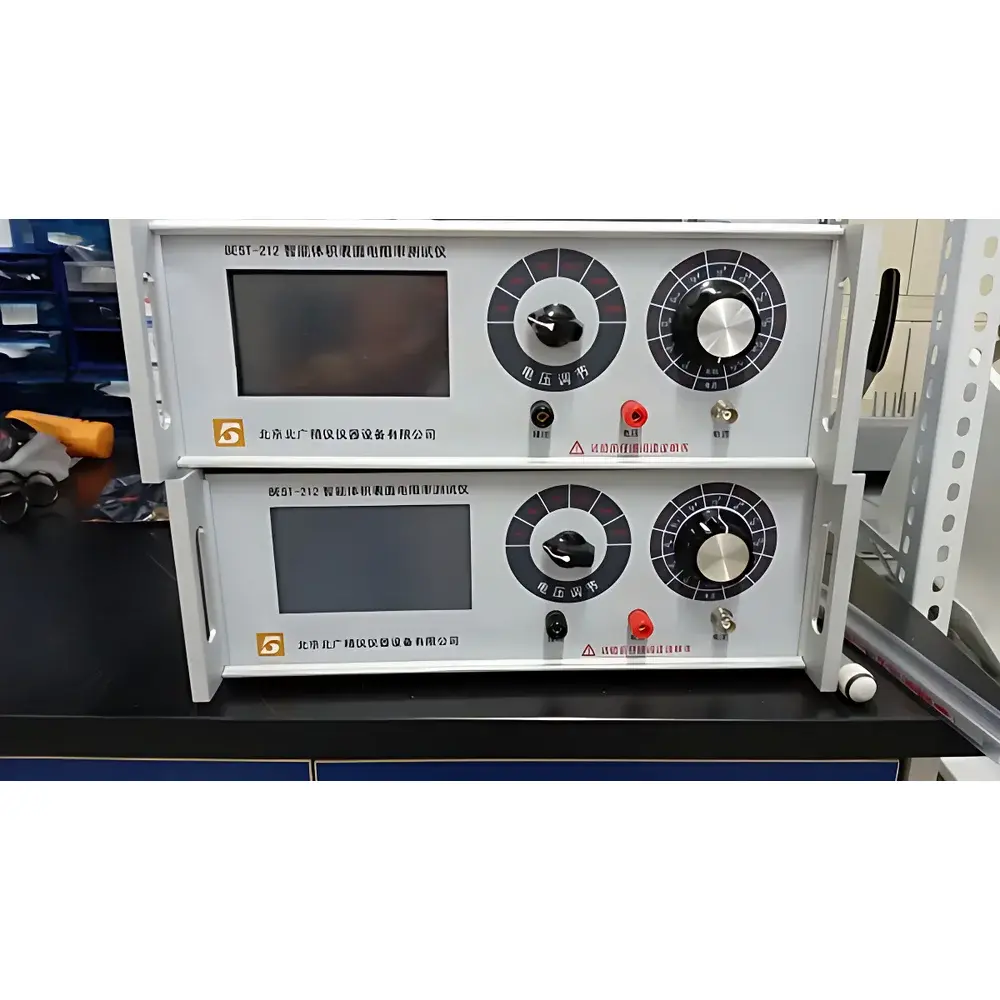
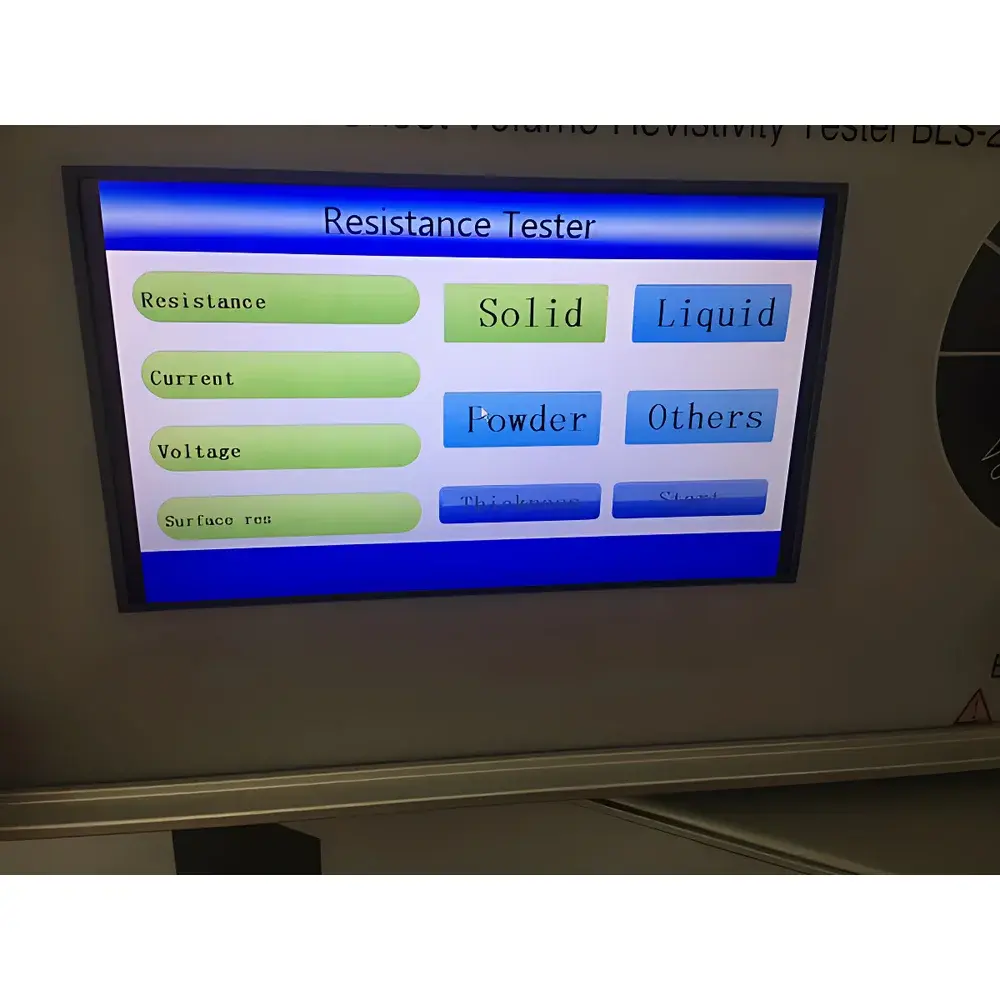
Beijing North Guang Precision Instruments BEST-212 Digital Ultra-High Resistance Meter for Liquids, Solids, and Powders
| Brand | Beijing North Guang Precision Instruments |
|---|---|
| Origin | Beijing, China |
| Manufacturer Type | Direct Manufacturer |
| Country of Origin | China |
| Model | BEST-212 |
| Price | USD 1,950 (FOB Beijing) |
| Resistance Range | 1×10⁴ Ω to 1×10¹⁸ Ω |
| Current Measurement Range | 2×10⁻⁴ A to 1×10⁻¹⁶ A |
| Test Voltages | 100 V / 250 V / 500 V / 1000 V (selectable, DC) |
| Accuracy | ±1% of reading (typical) |
| Display | 3½-digit LED, dual-channel (resistance + current) |
| Power Supply | AC 220 V, 50 Hz, ~5 W |
| Dimensions | 285 mm × 245 mm × 120 mm |
| Weight | 2.5 kg |
Overview
The BEST-212 Digital Ultra-High Resistance Meter is a precision electrometric instrument engineered for accurate, stable, and traceable measurement of electrical resistance and resistivity across insulating and antistatic materials—including liquids, solids, powders, and thin films. Unlike conventional analog megohmmeters relying on fixed-voltage, single-current sensing, the BEST-212 employs simultaneous high-impedance voltage (V) and ultra-low-current (I) acquisition—followed by real-time digital division (R = V/I) via integrated analog-to-digital signal processing. This four-terminal, guarded measurement architecture eliminates nonlinearity errors inherent in mechanical galvanometer-based systems and ensures true ohmic linearity across its full 14-decade range (10⁴ Ω to 10¹⁸ Ω). Designed for compliance-critical environments, it supports programmable DC test voltages (100 V, 250 V, 500 V, 1000 V), enabling standardized evaluation per ASTM D257, IEC 62631-3-1, and GB/T 1410–2006. Its microcurrent sensitivity (down to 10⁻¹⁶ A) and active guarding make it suitable for characterizing leakage currents in dielectrics, dark current in photodetectors, and volume/surface resistivity of functional polymers and liquid electrolytes.
Key Features
- Simultaneous dual-parameter acquisition: true real-time R = V/I computation with no scaling factors or manual correction required
- Four-decade selectable test voltage (100–1000 V DC), each calibrated and traceable to national standards
- Dual 3½-digit LED display showing resistance (Ω) and current (A) concurrently—enabling immediate correlation analysis
- Guarded triaxial input architecture with shielded enclosure (included) to suppress surface leakage and electromagnetic interference
- Auto-ranging with intelligent overload protection: prevents damage during misconfiguration or accidental shorting of Rx terminals
- Low power consumption (<5 W) and compact benchtop form factor (285 × 245 × 120 mm), optimized for QC labs and R&D cleanrooms
- Built-in overcurrent protection circuitry and HV interlock logic to ensure operator safety per IEC 61010-1 CAT II requirements
Sample Compatibility & Compliance
The BEST-212 accommodates diverse sample geometries via interchangeable electrode fixtures—including liquid cells (for conductivity/resistivity of solvents, electrolytes, or colloidal dispersions), concentric ring electrodes (for surface resistivity of coatings and films), and guarded parallel-plate assemblies (for volume resistivity of bulk solids and elastomers). It fully satisfies the electrode configuration, voltage application duration, and environmental conditioning requirements specified in ASTM D257 (Standard Test Methods for DC Resistance or Conductance of Insulating Materials), ISO 3915 (Electrical Resistance of Conductive Plastics), and GB/T 1410–2006 (Test Methods for Volume and Surface Resistivity of Solid Electrical Insulating Materials). All measurements are performed under controlled ambient conditions (23 ± 2 °C, 50 ± 5 % RH), and the instrument’s stability meets GLP audit requirements for raw data integrity and repeatability reporting.
Software & Data Management
While the BEST-212 operates as a standalone bench instrument, its analog output (0–2 V proportional to log₁₀(R)) and TTL-level status signals enable integration into automated test stations using SCPI-compatible DAQ systems. For manual documentation, users may record readings directly from the dual LED display alongside test parameters (voltage, dwell time, electrode type, ambient T/RH). The instrument supports full traceability: each measurement session can be annotated with operator ID, sample ID, and calibration date. Though no proprietary software is bundled, its output format aligns with common LIMS and ELN platforms (e.g., LabWare, Benchling) when paired with external digitizers. All internal firmware adheres to FDA 21 CFR Part 11 principles for audit trail generation where externally logged.
Applications
- Volume and surface resistivity characterization of liquid dielectrics (transformer oils, silicone fluids, battery electrolytes)
- Quality control of antistatic footwear, ESD-safe flooring, and conductive polymer composites per ANSI/ESD S20.20
- Resistivity mapping of semiconductor packaging substrates and printed circuit board laminates
- Dark current quantification in photodiodes and photomultiplier tube validation
- Time-dependent resistivity profiling of aging insulating materials (e.g., crosslinked polyethylene cables)
- Research-grade resistivity screening of nanocomposite dispersions and ion-conducting gels
- Validation of cleaning efficacy on semiconductor wafers via post-rinse resistivity monitoring
FAQ
What is the minimum measurable current, and how is noise suppressed at such low levels?
The BEST-212 achieves 10⁻¹⁶ A resolution using a guarded electrometer amplifier with active shielding, low-leakage PTFE-insulated cabling, and internal Faraday cage design. Measurements below 10⁻¹³ A require use of the supplied shielded enclosure and strict avoidance of electrostatic handling.
Can the instrument measure resistivity of aqueous solutions without electrode polarization error?
Yes—when used with AC-coupled impedance analyzers or with pulsed DC protocols (not built-in but implementable via external trigger), though for standard DC resistivity per ASTM D1169, the 100–1000 V range remains valid for low-conductivity water-based systems (σ < 1 µS/cm).
Is calibration traceable to NIM or other national metrology institutes?
Factory calibration is performed using certified reference resistors traceable to the National Institute of Metrology (NIM), China; full calibration certificates (including uncertainty budgets) are available upon request.
Does the instrument support automatic pass/fail judgment against user-defined limits?
No—the BEST-212 is a measurement-only instrument without embedded decision logic. Pass/fail assessment must be implemented externally via DAQ software or manual comparison against specification thresholds.
What safety certifications does the unit carry?
It complies with IEC 61010-1:2010 (Measurement Category II, Pollution Degree 2) and carries CE marking for EMC and LVD directives. High-voltage terminals are recessed and labeled per IEC 60417-5036.



