
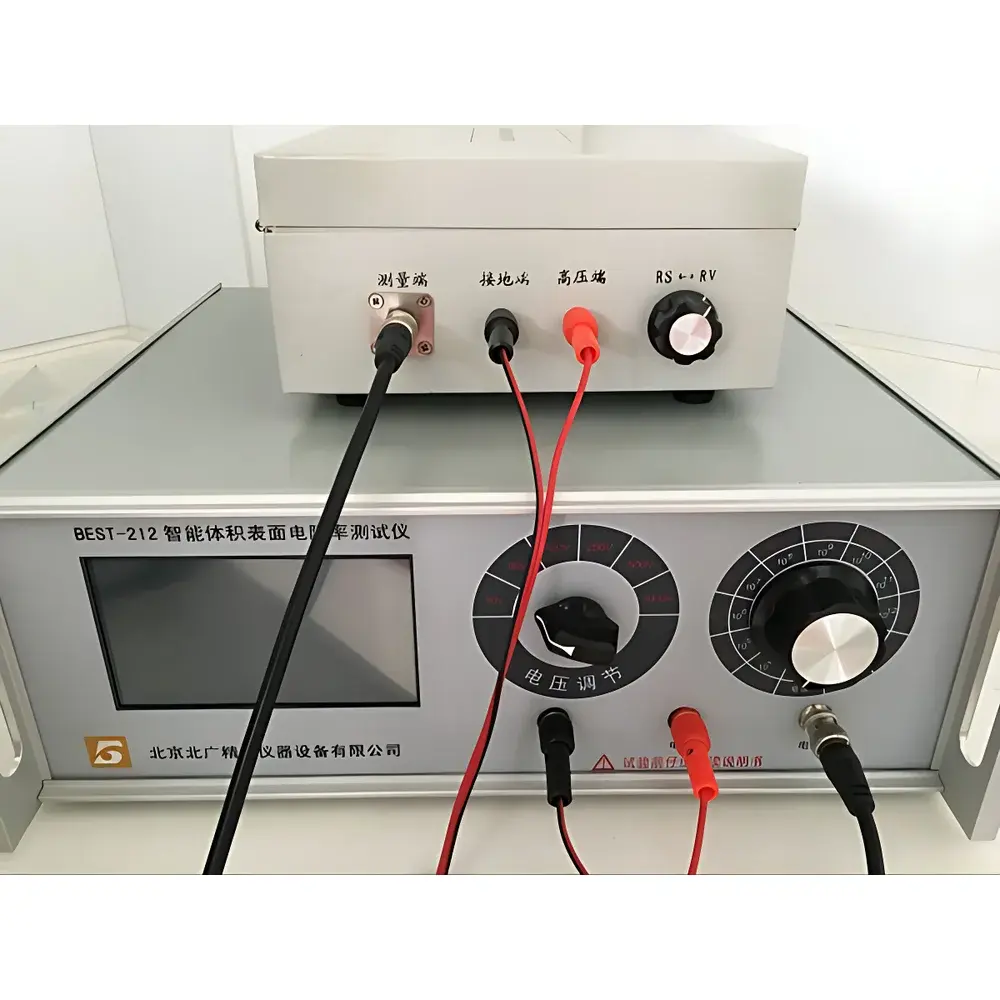
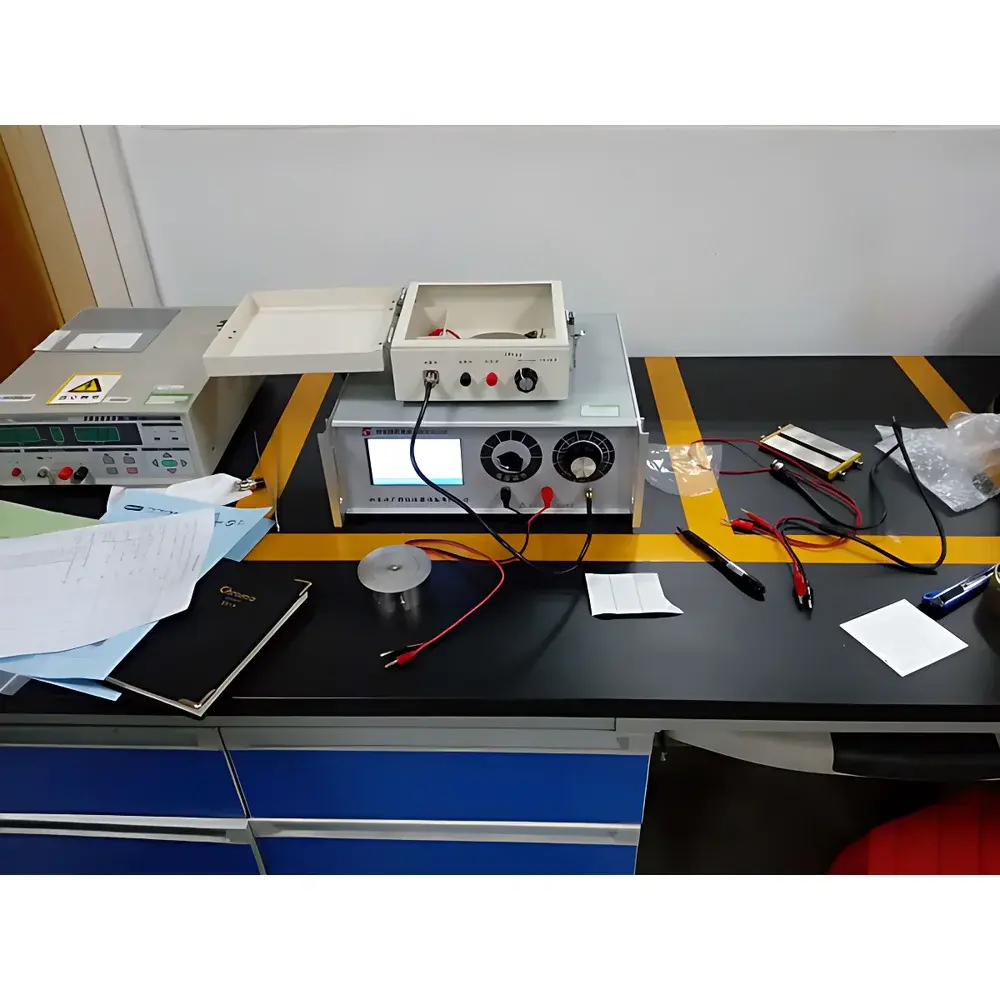
Beijing North Guang Precision Instruments BEST-212 Volume & Surface Resistivity Tester for Polymer Composites
| Brand | Beijing North Guang Precision Instruments |
|---|---|
| Origin | Beijing, China |
| Manufacturer Type | Direct Manufacturer |
| Country of Origin | China |
| Model | BEST-212 |
| Price | USD 2,800 (FOB Beijing) |
| Resistance Range | 1×10⁴ Ω to 1×10¹⁸ Ω |
| Current Measurement Range | 2×10⁻⁴ A to 1×10⁻¹⁶ A |
| Test Voltages | 10 V, 50 V, 100 V, 250 V, 500 V, 1000 V (selectable) |
| Accuracy | ±1% of reading |
| Display | Digital LCD with dual resistance/current readout |
| Dimensions (main unit) | 360 mm × 350 mm × 170 mm |
| Weight | 5 kg |
| Compliance | GB/T 1410–2006, GB/T 1692–2008, GB/T 2439–2001, GB/T 12703.4–2010, ASTM D257–99, IEC 93:1980, EN 1149–1:1995, SJ/T 10694–2006 |
Overview
The Beijing North Guang Precision Instruments BEST-212 Volume & Surface Resistivity Tester is a precision digital electrometer engineered for high-accuracy DC resistivity characterization of polymeric composites, elastomers, insulating films, fibers, powders, and liquid dielectrics. It operates on the fundamental principle of Ohm’s Law (R = V/I), but implements a true four-terminal, dual-sensing architecture that simultaneously acquires voltage across and current through the specimen—eliminating dependency on fixed-voltage assumptions or analog scale nonlinearity. Unlike conventional high-resistance meters relying on passive current-to-voltage conversion, the BEST-212 employs high-stability operational amplifiers, guarded input stages, and low-leakage analog-to-digital conversion to deliver linear, repeatable measurements across 14 decades of resistance (10⁴ Ω to 10¹⁸ Ω) and 12 decades of current (10⁻⁴ A to 10⁻¹⁶ A). Its design conforms to the core metrological requirements of standardized resistivity testing in rubber, plastic, and electrostatic control applications—including volume resistivity (ρᵥ), surface resistivity (ρₛ), insulation resistance, and leakage current quantification under controlled DC bias.
Key Features
- True dual-parameter acquisition: Simultaneous digital measurement of applied test voltage and specimen current enables direct calculation of resistance without scaling factors or range-dependent corrections.
- Programmable test voltages: Six discrete DC output levels (10 V, 50 V, 100 V, 250 V, 500 V, 1000 V) selectable via front-panel interface—fully compliant with ASTM D257–99 and GB/T 1410–2006 voltage selection protocols.
- Guarded tri-electrode configuration support: Compatible with standard three-electrode fixtures (e.g., concentric ring electrodes per ASTM D257 Annex A2) to isolate surface conduction and enable accurate volume resistivity determination.
- Low-noise, high-input-impedance circuitry: Input impedance >10¹⁶ Ω ensures minimal loading error during ultra-high-resistance measurement; guard shielding reduces stray capacitance and environmental leakage paths.
- Dual-display functionality: Real-time simultaneous readout of resistance (Ω) and current (A) on a backlit LCD—facilitating rapid validation of measurement integrity and detection of unstable or noisy signals.
- Compact benchtop form factor: 360 mm × 350 mm × 170 mm footprint with integrated handle and 5 kg mass—designed for integration into QC labs, R&D workstations, and production line testing stations.
Sample Compatibility & Compliance
The BEST-212 accommodates solid sheets, molded plaques, extruded profiles, granular polymers, conductive pastes, and viscous gels using interchangeable electrode assemblies—including parallel-plate, concentric-ring, and needle-type fixtures. Its measurement methodology satisfies the physical definitions and procedural rigor of key international standards: GB/T 1410–2006 (equivalent to IEC 60093:1980) for volume/surface resistivity of solid insulating materials; GB/T 2439–2001 (aligned with ISO 3915:1991) for conductive/antistatic rubber and thermoplastics; EN 1149–1:1995 for electrostatic dissipative protective clothing; and ASTM D257–99 for general-purpose DC resistance testing of insulators. All test configurations support GLP-aligned documentation when paired with external data logging systems, and the instrument’s stable calibration traceability meets requirements for internal audit readiness under ISO/IEC 17025 environments.
Software & Data Management
While the BEST-212 operates as a stand-alone electrometer with full local control, its RS-232 serial interface enables bidirectional communication with host PCs running custom or third-party data acquisition software (e.g., LabVIEW, MATLAB, or Python-based scripts). Raw voltage, current, and calculated resistance values can be timestamped and exported in CSV format for statistical process control (SPC), trend analysis, or regulatory submission packages. Although the unit does not include built-in 21 CFR Part 11-compliant electronic signatures or audit trail functionality, its deterministic analog front-end and repeatable digital output make it suitable for use within validated workflows where manual entry into LIMS or ELN platforms is permitted. Calibration records—traceable to national metrology institutes (e.g., China Academy of Metrology, CAM)—are provided upon request and conform to ISO/IEC 17025 Clause 6.5.
Applications
- Quality assurance of carbon-black–filled EPDM, silicone, and TPU compounds used in ESD-safe gaskets and seals.
- Development and specification verification of antistatic packaging films (e.g., LDPE/LLDPE blends with migratory additives).
- Resistivity profiling of conductive polymer nanocomposites (e.g., graphene- or CNT-loaded thermoplastics) across processing conditions.
- Validation of static-dissipative flooring systems per ANSI/ESD S7.1 and IEC 61340–4–1.
- Insulation resistance screening of wire jacketing materials (PVC, XLPE, ETFE) prior to cable assembly.
- Research-grade characterization of ion-conductive hydrogels and solid polymer electrolytes in battery R&D laboratories.
FAQ
Does the BEST-212 comply with ASTM D257–99 and GB/T 1410–2006?
Yes—the instrument implements all mandatory voltage selection steps, electrode geometry requirements, and stabilization timing protocols defined in both standards.
Can it measure both volume and surface resistivity on the same sample?
Yes—when used with a three-electrode fixture (e.g., guarded electrode system), the BEST-212 supports independent volume and surface resistivity calculations per GB/T 1410–2006 Annexes A1 and A2.
Is calibration traceable to national standards?
Calibration certificates issued by accredited laboratories (e.g., China Institute of Metrology, CIC) are available upon request, with uncertainty budgets reported per ISO/IEC 17025.
What is the typical warm-up time before achieving specified accuracy?
Less than 30 minutes at ambient temperature (23 ± 2 °C, RH <65 %)—no pre-heating required.
Does the unit include a Faraday cage or shielding enclosure?
A dedicated 200 mm × 200 mm × 100 mm shielded test chamber is supplied as standard to minimize electromagnetic interference during sub-picoampere measurements.





