
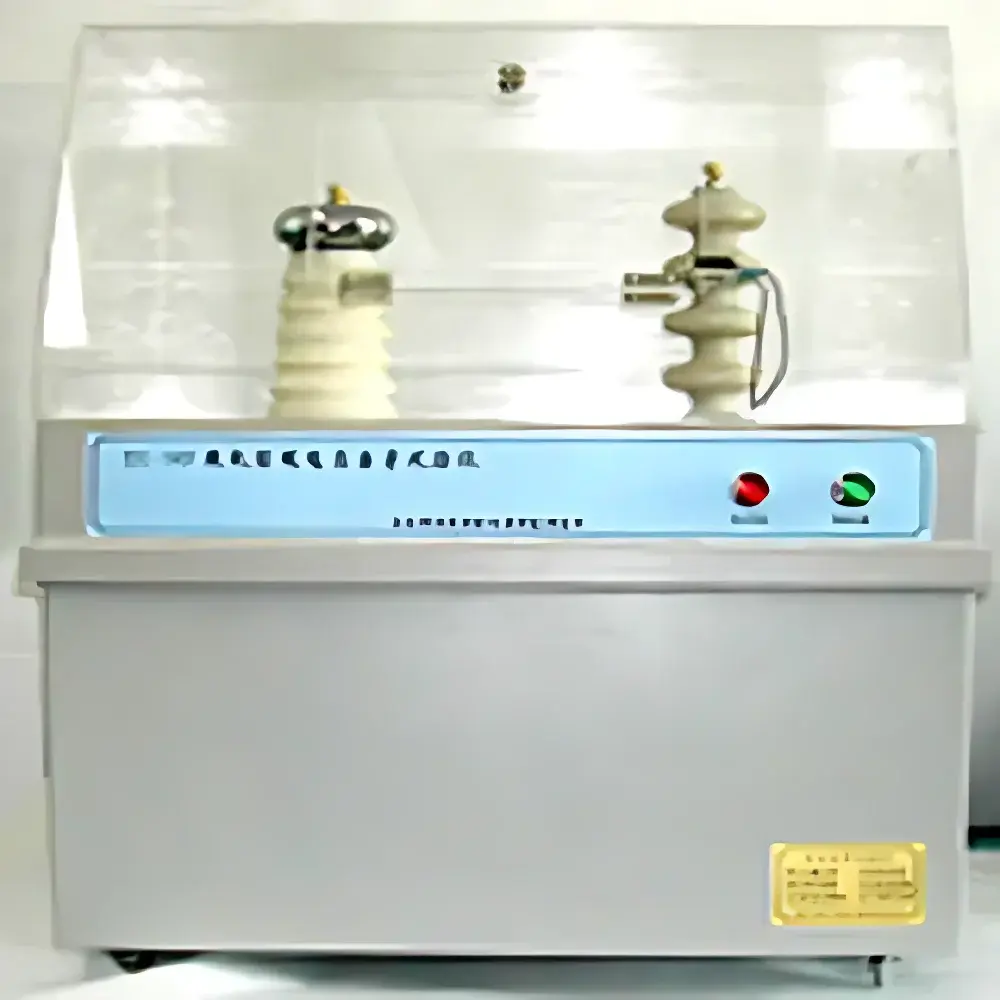
Beijing North Guang Precision Instruments BDJC-30KV Dielectric Strength Tester for Solid Insulating Materials
| Brand | Beijing North Guang Precision Instruments |
|---|---|
| Origin | Beijing, China |
| Manufacturer Type | Direct Manufacturer |
| Model | BDJC-30KV |
| Breakdown Voltage Range | 0–50 kV (AC), 0–70 kV (DC) |
| Input Voltage | AC 220 V ±10%, 50 Hz ±1% |
| Power Rating | 3 kVA |
| Voltage Accuracy | ≤1% |
| Rise Rate Options | 100–5000 V/s (adjustable) |
| Current Resolution | mA-level |
| Compliance | GB/T 1408.1–2006, GB/T 1695–2005, GB/T 3333, ASTM D149, IEC 60243-1 |
| Safety Protections | Overvoltage, overcurrent, short-circuit, leakage, door interlock, zero-position reset, emergency high-voltage cutoff |
Overview
The Beijing North Guang Precision Instruments BDJC-30KV Dielectric Strength Tester is an engineered solution for determining the short-time dielectric strength and voltage breakdown characteristics of solid insulating materials under power-frequency (48–62 Hz) or DC stress conditions. Based on the principle of controlled voltage ramping across standardized electrode configurations, the system measures the critical electric field at which catastrophic insulation failure—characterized by a rapid, irreversible increase in conduction current and collapse of applied voltage—occurs within the bulk or along the surface of the test specimen. Designed in strict accordance with GB/T 1408.1–2006, ASTM D149, and IEC 60243-1, the instrument supports both AC and DC test modes—including stepwise (gradient), continuous ramp, and hold-type (dielectric withstand) protocols—to accommodate material qualification, R&D validation, and quality assurance workflows in polymer, elastomer, ceramic, glass, and composite manufacturing environments.
Key Features
- Microprocessor-controlled digital voltage regulation with non-contact solid-state transformer excitation—eliminating mechanical gear-driven variacs and ensuring repeatable, jitter-free voltage rise profiles.
- Programmable rise rates from 100 V/s to 5000 V/s, compliant with standard-specified tolerances and configurable per test sequence to match material response dynamics.
- Real-time oscillographic acquisition: simultaneous logging of applied voltage, leakage current, and time-stamped event markers enables precise identification of pre-breakdown phenomena (e.g., partial discharge onset, surface tracking) and unambiguous distinction between bulk breakdown and flashover.
- Multi-color overlay plotting for comparative analysis across up to 10 sequential tests; statistical evaluation of median breakdown voltage (kV) or dielectric strength (kV/mm) per ISO/IEC 17025-compliant reporting conventions.
- Integrated hardware safety architecture: electromagnetic relay-based 0.05 s circuit interruption upon current threshold exceedance, redundant overvoltage clamping, interlocked test chamber door, and automatic zero-voltage reset prior to test initiation.
- User-accessible software password protection, audit-trail-enabled parameter modification logging, and conditional result flagging (valid/invalid) to support GLP-aligned laboratory practices.
Sample Compatibility & Compliance
The BDJC-30KV accommodates rigid and semi-rigid sheet, film, rod, and molded specimens conforming to electrode geometries specified in GB/T 1408.1 (e.g., cylindrical brass electrodes with 25 mm diameter and 2 mm edge radius). Compatible substrate classes include thermoplastics (e.g., PE, PP, PET), thermosets (epoxy, phenolic), elastomers (silicone rubber, EPDM), ceramics (alumina, porcelain), glass, mica tapes, insulating varnishes, and laminated composites. Testing may be conducted in ambient air or immersed in standardized insulating oils (e.g., ASTM D877-compliant mineral oil) per GB/T 10580–2003 preconditioning requirements. All electrical safety circuits meet EN 61010-1:2010 (Measurement Category II, Pollution Degree 2) and incorporate earth-leakage detection per IEC 61000-4-5 surge immunity standards.
Software & Data Management
The proprietary Windows-based control suite provides full IEC 62304-classified firmware operation with deterministic real-time sampling (≥10 kHz ADC resolution). Test data—including raw voltage/current waveforms, calculated dielectric strength values, electrode gap measurements, environmental metadata (temperature/humidity), and operator annotations—are stored in encrypted SQLite databases with SHA-256 integrity verification. Export options include CSV, PDF (with embedded calibration certificate traceability), and XML formats compatible with LIMS integration. Software supports 21 CFR Part 11-compliant electronic signatures, user role-based access control (admin/operator/auditor), and automated generation of test reports meeting ISO/IEC 17025 clause 7.8 documentation requirements. Calibration certificates are issued by CNAS-accredited metrology institutes traceable to NIM (National Institute of Metrology, China).
Applications
This tester serves core functions across industrial and academic laboratories: incoming raw material screening per supplier specifications; formulation optimization in polymer compounding and coating development; aging studies (thermal, UV, humidity) per IEC 60216; qualification of encapsulants and potting compounds for high-voltage electronics; validation of insulating barriers in EV battery modules and renewable energy inverters; and compliance verification for UL 746C, IEC 60601-1 (medical device insulation), and IEC 61851-23 (EV charging systems). Its dual AC/DC capability supports both legacy grid-component testing and emerging wide-bandgap semiconductor packaging evaluation.
FAQ
What distinguishes dielectric breakdown from surface flashover during testing?
Breakdown involves irreversible conduction through the bulk material, evidenced by carbonized channels visible post-test; flashover occurs along the specimen-air interface without bulk penetration and is identified via absence of internal damage and repeatable voltage recovery below 50% of initial breakdown level.
Can the system perform step-stress (multi-level) voltage testing per ASTM D149 Annex A2?
Yes—the software supports programmable hold durations at intermediate voltages and automatic progression to next step upon timeout or current threshold breach.
Is third-party calibration documentation included with shipment?
Each unit ships with a factory-issued calibration certificate traceable to NIM, plus optional CNAS-accredited recalibration services available at 12-month intervals.
How is electrode alignment verified prior to testing?
The standard configuration includes precision-ground parallel-plate electrodes with concentricity tolerance ≤0.05 mm; optional spherical or needle electrodes are supplied with dimensional certification reports.
Does the system meet electromagnetic compatibility (EMC) requirements for use in shared laboratory spaces?
Yes—conducted and radiated emissions comply with CISPR 11 Group 1 Class B limits; built-in ferrite-filtered power input and shielded HV cabling minimize cross-talk with adjacent instrumentation.



