
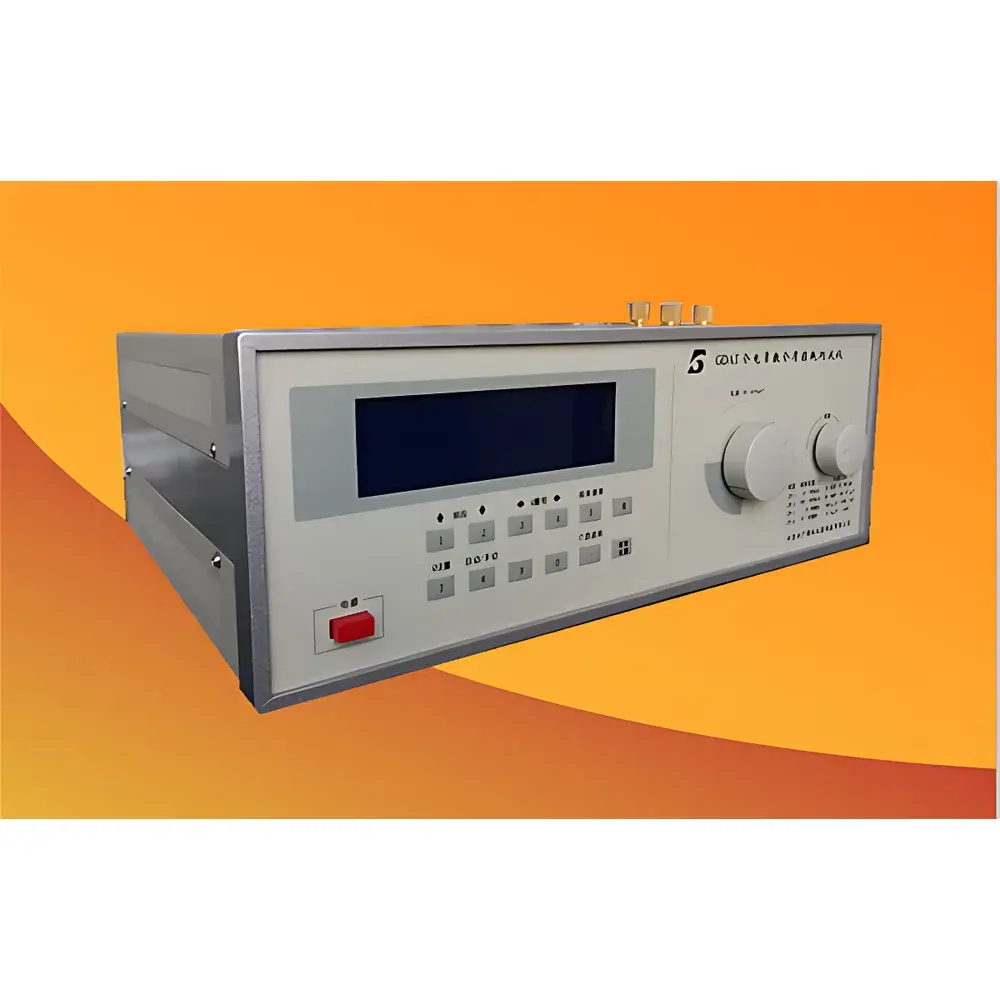
Beijing North Guang Precision Instruments gDAT-A High-Frequency & Power-Frequency Dielectric Constant and Loss Tangent Analyzer
| Brand | Beijing North Guang Precision Instruments |
|---|---|
| Origin | Beijing, China |
| Manufacturer Type | Direct Manufacturer |
| Product Category | Domestic |
| Model | gDAT-A |
| Price | USD 2,800 (FOB) |
Overview
The Beijing North Guang Precision Instruments gDAT-A High-Frequency & Power-Frequency Dielectric Constant and Loss Tangent Analyzer is a dual-mode precision measurement system engineered for the standardized characterization of dielectric properties in insulating materials across both industrial power-frequency (50 Hz) and high-frequency (10 kHz–160 MHz) regimes. It integrates two complementary, standards-compliant measurement architectures: (1) a shielded Schering bridge subsystem (BQS-37a high-voltage bridge) for low-frequency dielectric loss (tan δ) and permittivity (εr) determination per GB/T 1409–2006, IEC 60250, and ASTM D150; and (2) a digitally controlled series-resonant Q-meter subsystem (GDAT high-frequency Q-meter) with BH916 precision parallel-plate test fixture for high-frequency measurements per GB/T 1409–2006 Annex A and IEC 60250 Clause 6. The system operates on fundamental physical principles—capacitive voltage division and phase-sensitive null detection in the Schering bridge mode, and resonant impedance analysis via Q-factor quantification in the GDAT mode—ensuring traceable, physics-based results that reflect actual material behavior under service-relevant electric field conditions.
Key Features
- Dual-mode architecture supporting both power-frequency (50 Hz ± 0.5%) and high-frequency (10 kHz–60 MHz or 200 kHz–160 MHz selectable ranges) dielectric testing within a single integrated platform
- BH916 precision parallel-plate test fixture with Φ50 mm electrodes, micrometer-driven spacing adjustment (0–15 mm range, 1 µm resolution), and calibrated digital thickness readout for direct sample thickness input into εr calculation
- GDAT high-frequency Q-meter featuring direct digital synthesis (DDS) signal generation, frequency stability ≤1 × 10⁻⁶, and full-digitized LCD interface displaying real-time Q, L, C, f, and resonance trend indicator
- BQS-37a Schering bridge with built-in 0–2500 V digitally regulated high-voltage source, 100 pF low-loss reference capacitor (tan δ < 5 × 10⁻⁵), dual-shielded construction, and auto-tracking guard electrode to suppress stray capacitance and leakage currents
- Integrated tan δ computation engine eliminating manual interpolation from printed charts—automated calculation of tan δ and εr based on measured Q, C, f, and geometric parameters
- LKI-1 inductor set (9 units) optimized for Q-meter operation across full frequency range, ensuring high-Q resonance and measurement sensitivity ≥2 × 10⁻⁴ (at 1 MHz)
Sample Compatibility & Compliance
The gDAT-A accommodates solid dielectric sheets, films, and molded specimens with thicknesses from 0.1 mm to 15 mm and lateral dimensions ≥Φ50 mm. Electrode configuration complies with ASTM D150 Type I (parallel-plate) and IEC 60250 Section 4.2 requirements. Measurement uncertainty adheres to GB/T 1409–2006 specified tolerances: capacitance accuracy ±0.5% ±2 pF (Cx = 40–20,000 pF); tan δ accuracy ±1.5% tan δx ± 0.0001 (0–1 range). System design incorporates double electrostatic shielding, grounded guard terminals, and EMI-suppressed cabling to meet IEC 61000-4-3 immunity requirements. All high-voltage components conform to GB 5654 and IEC 60060-1 for partial discharge-free operation up to 2.5 kV AC RMS.
Software & Data Management
While the gDAT-A operates as a standalone benchtop instrument without external PC dependency, its GDAT module embeds an onboard microprocessor executing ISO/IEC 17025-aligned data handling routines. Raw Q, C, f, and Δd values are timestamped and stored in non-volatile memory with audit-trail capability. Export-ready ASCII reports include measurement date/time, operator ID (manually entered), environmental conditions (user-input T/RH), calibration certificate ID, and traceable calculation steps per GB/T 1409 Annex B. The system supports GLP-compliant documentation: all balance adjustments, zeroing events, and HV ramp sequences are logged with sequence counters. No proprietary drivers or closed-format binaries are used—data export occurs via RS-232 serial interface using standard SCPI-like command syntax for integration into LIMS or QA databases.
Applications
This analyzer serves quality control laboratories and R&D centers evaluating polymeric insulation (e.g., epoxy resins, silicone rubber, polyimide films), ceramic substrates (Al2O3, AlN), transformer oils (per IEC 60247), and aerospace-grade composites. Typical use cases include: verification of batch-to-batch consistency in cable jacketing compounds per IEEE 400.2; screening of high-k dielectrics for RF packaging; validation of moisture ingress effects on PCB laminates (IPC-TM-650 2.6.3); and qualification of space-grade thermal control coatings per ECSS-Q-ST-70-02C. Its dual-frequency capability enables correlation studies between low-field polarization mechanisms (dipolar, interfacial) and high-field conduction losses—critical for predicting long-term aging behavior in HVDC converter station components.
FAQ
What standards does the gDAT-A comply with?
It fully implements GB/T 1409–2006, IEC 60250, ASTM D150, GB 5654, and IEC 60060-1 for both high-frequency Q-meter and power-frequency Schering bridge operation.
Can the system measure liquids or powders?
No—it is configured exclusively for solid sheet/film specimens using the BH916 parallel-plate fixture. Liquid measurement requires optional cup-type electrodes (not included).
Is FDA 21 CFR Part 11 compliance supported?
The embedded data logger provides electronic signatures, audit trails, and immutable records meeting core Part 11 requirements; however, full validation documentation must be performed by the end-user per their internal SOPs.
What is the maximum recommended test voltage for the BQS-37a bridge?
2.5 kV AC RMS at 50 Hz, with continuous monitoring of bridge arm currents per specified limits (e.g., ≤15 mA in 10 kΩ range).
How is calibration maintained across frequency bands?
Factory calibration includes NIST-traceable verification at 50 Hz, 1 MHz, 10 MHz, and 100 MHz using certified reference capacitors and loss standards; annual recalibration is recommended per ISO/IEC 17025 clause 5.10.



