
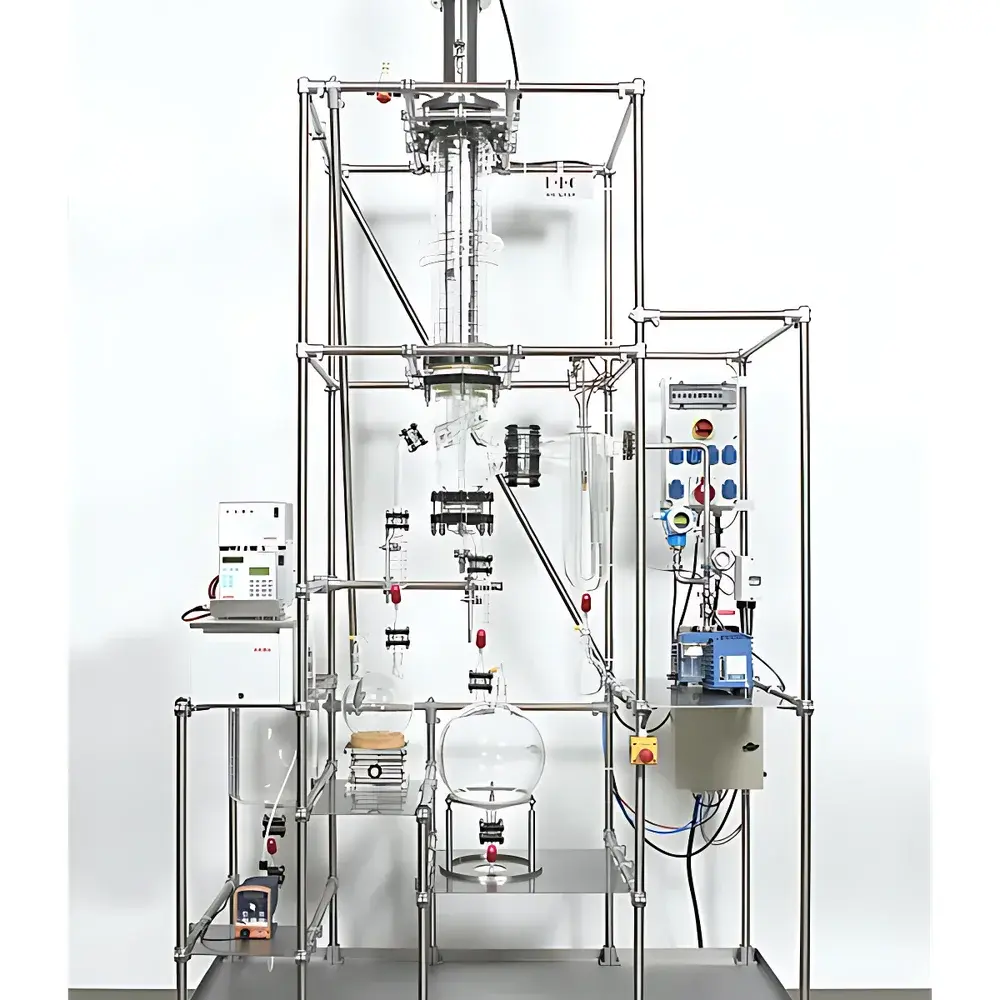
Beijing STKJ SPDL Series Molecular Distillation Instrument
| Brand | STKJ |
|---|---|
| Origin | Beijing, China |
| Manufacturer Type | Authorized Distributor |
| Country of Origin | China |
| Model | SPDL-15 / SPDL-20 / SPDL-30 |
| Feed Rate | 3–9 kg/h |
| Effective Evaporation Area | 0.15–0.3 m² |
| Evaporator Internal Diameter | 280 mm |
| Condenser Surface Area | 0.58 m² |
| Collecting Flasks | 3 units |
| Construction Material | Borosilicate Glass 3.3 (DIN ISO 3585) with Optional Nickel-Based Alloy (e.g., Hastelloy C-276) and Tantalum Components |
| Maximum Evaporation Temperature | 250 °C |
| Minimum Operating Pressure | 0.001 mbar |
| Heating Method | External Oil Bath |
| Film Formation System | Self-Cleaning Roller-Type Wiper System |
Overview
The Beijing STKJ SPDL Series Molecular Distillation Instrument is a high-vacuum, short-path thermal separation system engineered for gentle, high-selectivity purification of thermally sensitive, high-boiling, or highly viscous compounds. Operating under ultra-low pressure (down to 0.001 mbar), it exploits the difference in mean free path between molecules—enabling separation based on molecular weight and vapor pressure rather than boiling point alone. Unlike conventional distillation, molecular distillation occurs in the free-molecular flow regime where collisions between vapor molecules are negligible, minimizing thermal degradation and ensuring exceptional product integrity. The SPDL series is particularly suited for applications requiring metal-free contact surfaces—such as pharmaceutical intermediates, natural vitamin E, fish oil concentrates (EPA/DHA), cannabinoids, fragrances, and specialty polymers—where catalytic side reactions or corrosion from stainless steel would compromise yield, purity, or regulatory compliance.
Key Features
- Corrosion-resistant construction using borosilicate glass 3.3 (DIN ISO 3585) for all primary process-contact surfaces—including evaporator body, condenser, feed and collection zones—ensuring chemical inertness and optical clarity for real-time process observation.
- Optional critical components (wiper blades, feed nozzles, internal supports) fabricated from nickel-based alloys (e.g., Hastelloy C-276) or tantalum, enabling reliable operation with strongly acidic, halogenated, or oxidizing feedstocks that rapidly degrade standard stainless steel.
- Self-cleaning roller-type wiper system ensures uniform, thin-film formation (< 0.1 mm thickness) across the heated evaporation surface—even for highly viscous or fouling-prone materials—enhancing mass transfer efficiency and reducing residence time at elevated temperature.
- Modular three-flask collection configuration allows sequential fractionation under constant vacuum, supporting multi-stage purification protocols without breaking vacuum or interrupting operation.
- Oil-bath heating system provides precise, homogeneous temperature control up to 250 °C with ±1 °C stability, coupled with integrated cooling for the condenser (typically −10 °C to +5 °C) to maintain optimal condensation efficiency across the full 0.58 m² condensing surface.
- Scalable platform architecture: SPDL-15 (0.15 m²), SPDL-20 (0.20 m²), and SPDL-30 (0.30 m²) models share identical design principles and material specifications—facilitating method transfer from lab-scale optimization to pilot production.
Sample Compatibility & Compliance
The SPDL instrument accommodates feed materials ranging from low-viscosity oils to semi-solid waxes, provided they exhibit measurable vapor pressure above 0.001 mbar at ≤250 °C. It is routinely employed for purification of heat-labile actives compliant with ICH Q5C (stability of biotechnological products), USP (plastic packaging systems), and ISO 13485-aligned processes. While the base unit is not intrinsically certified for GMP manufacturing, its fully traceable component materials (glass batch certificates, alloy mill test reports), absence of lubricants or elastomers in the vapor path, and compatibility with validated cleaning procedures (e.g., using ethanol or acetone followed by high-vacuum bake-out) make it suitable for GLP-compliant R&D and preclinical batch preparation. Documentation packages—including material declarations, dimensional drawings, and vacuum performance curves—are available upon request to support regulatory submissions.
Software & Data Management
The SPDL series operates via a dedicated industrial-grade controller with dual-display interface (local HMI + optional remote PC connection via RS485/Modbus RTU). Real-time logging includes vacuum level (capacitance manometer), evaporator and condenser temperatures, oil bath setpoint and actual, feed pump speed, and total runtime. All parameters are timestamped and stored internally for ≥30 days; data export is supported via USB flash drive in CSV format. Audit trails comply with ALCOA+ principles (Attributable, Legible, Contemporaneous, Original, Accurate, Complete, Consistent, Enduring, Available), satisfying foundational requirements for FDA 21 CFR Part 11 readiness when paired with user-defined SOPs and electronic signature protocols.
Applications
- Purification of polyunsaturated fatty acids (PUFAs) from marine oils—removing cholesterol, heavy metals, and oxidation byproducts while preserving cis-configuration integrity.
- Isolation of tocopherols and tocotrienols from deodorizer distillates, achieving >95% assay purity without thermal racemization.
- Deacidification and decolorization of crude biodiesel feedstocks prior to transesterification.
- Recovery and concentration of fragrance volatiles (e.g., ionones, damascones) from botanical extracts with minimal olfactory profile alteration.
- Removal of residual monomers and catalysts from silicone prepolymers and acrylic oligomers used in medical device coatings.
- Separation of cannabinoid fractions (CBD, CBG, Δ8-THC) from crude hemp extract under oxygen-free, low-residence-time conditions.
FAQ
What vacuum level is required for effective molecular distillation?
A base pressure of ≤0.001 mbar (1 × 10⁻³ mbar) is essential to achieve mean free path lengths significantly exceeding the evaporator-to-condenser distance (~30–50 mm), thereby ensuring true molecular flow conditions.
Can the SPDL system be integrated into an existing vacuum infrastructure?
Yes—the instrument is equipped with a standardized KF-40 vacuum flange and is compatible with common two-stage rotary vane pumps and secondary diffusion or turbomolecular pumping stages for ultimate pressure enhancement.
Is operator training included with purchase?
STKJ provides comprehensive installation qualification (IQ) documentation and on-site startup support, including hands-on operation, film formation optimization, and routine maintenance protocols.
How is cleaning validated between batches?
Cleaning efficacy is verified through visual inspection (glass transparency), residual solvent analysis (GC-FID), and blank runs monitored by vacuum recovery rate and condensate appearance—protocols documented per user-defined cleaning validation master plan.
Does the SPDL series support continuous feed operation?
All SPDL models feature precision-controlled peristaltic or gear-type feed pumps with adjustable flow rates (3–9 kg/h range), enabling stable continuous operation under steady-state vacuum and temperature conditions.
Related Products



