
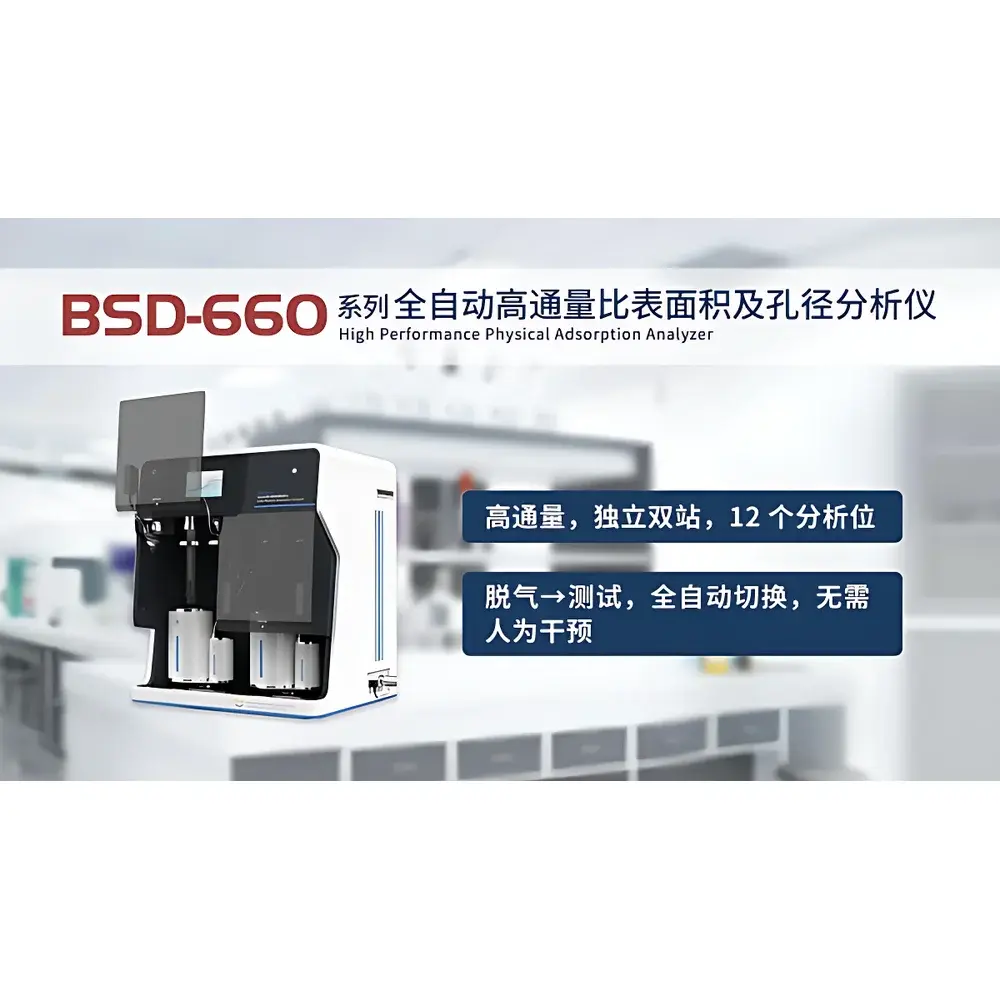
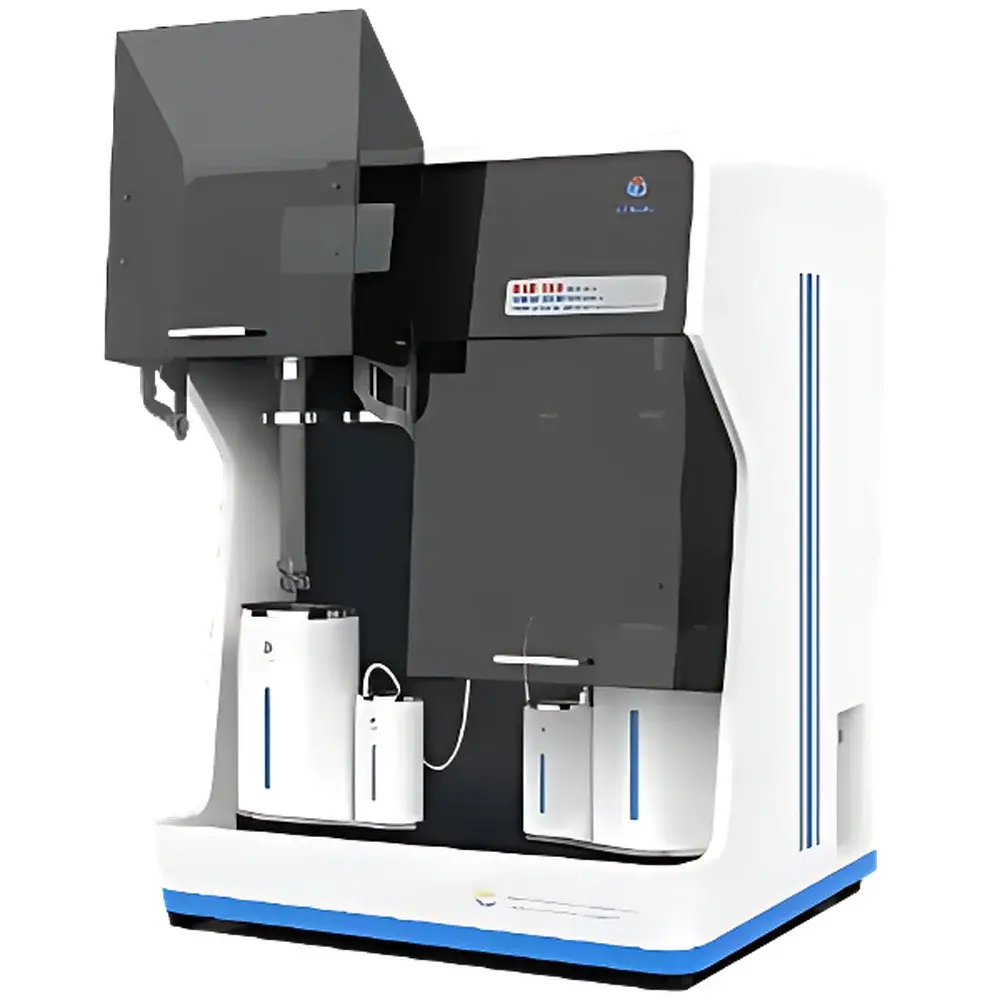
Beishide BSD-660M High-Throughput Specific Surface Area and Pore Size Analyzer
| Key | Brand: Beishide Instrument |
|---|---|
| Origin | Beijing, China |
| Manufacturer Type | Manufacturer |
| Product Category | Domestic |
| Model | BSD-660M |
| Instrument Type | Specific Surface Area and Pore Size Analyzer |
| Measurement Principle | Static Volumetric Method |
| Number of Analysis Stations | 12 |
| Pore Size Range | 0.35–500 nm |
| Pressure Range | down to 1 × 10⁻⁹ Pa |
| Analytical Theory | Static Gravimetric/Volumetric Adsorption |
| Repeatability | ≤0.01% RSD (on certified reference materials) |
Overview
The Beishide BSD-660M is a high-throughput, fully automated specific surface area and pore size analyzer engineered for precision physical adsorption characterization of porous solids. It operates on the static volumetric principle—measuring gas adsorption/desorption isotherms at controlled equilibrium pressures using high-stability pressure transducers and calibrated reference volumes. Designed for laboratories requiring rapid turnaround without compromising metrological rigor, the BSD-660M supports concurrent analysis of up to 12 samples across microporous (<2 nm), mesoporous (2–50 nm), and macroporous (50–500 nm) regimes. Its architecture integrates ultra-high vacuum capability (down to 1 × 10⁻⁸ Pa with optional dual molecular pump configuration), helium-free dead volume calibration, and intelligent thermal management—making it particularly suitable for demanding applications in catalysis research, battery electrode development, MOF/COF characterization, and pharmaceutical excipient qualification.
Key Features
- Modular high-throughput design: Configurable analysis station count (3/6/9/12) enables scalable throughput without hardware reconfiguration.
- Fully automated workflow: Integrated sample preparation and measurement sequence—including programmable degassing, helium pycnometry, adsorption isotherm acquisition, and desorption scanning—executed under unified software control.
- Helium contamination mitigation: Implements sequential protocol—helium measurement of thermal dead volume → vacuum heating degassing → nitrogen or argon adsorption testing—to eliminate helium retention artifacts in micropore analysis.
- Pressure-controlled temperature ramping (Patent ZL.XXXXXXX.2): Dynamically adjusts furnace temperature based on real-time pressure feedback during degassing, preventing sample fluidization and mass loss from volatile or low-density powders.
- Auto-switching degas/test station architecture (Patent ZL.XXXXXXX.8): Motorized elevation system relocates degas furnaces and Dewar cryostats to align with respective sample tubes—eliminating manual tube transfer and enabling unattended overnight operation.
- Ultra-high vacuum performance: Base pressure of 1 × 10⁻² Pa standard; upgradeable to 1 × 10⁻⁸ Pa via dual-stage molecular pumping for enhanced sensitivity in sub-nanometer pore detection.
Sample Compatibility & Compliance
The BSD-660M accommodates standard 6–12 mm OD glass sample tubes and supports a broad range of solid materials—including activated carbons, zeolites, metal–organic frameworks (MOFs), silica gels, alumina catalysts, lithium-ion battery cathodes/anodes, and pharmaceutical powders. All analytical protocols conform to ISO 9277 (gas adsorption for specific surface area), ISO 15901-1/-2 (pore size distribution by gas adsorption), and ASTM D3663 (surface area of activated carbon). Data integrity meets GLP/GMP requirements with full audit trail logging, user access controls, and electronic signature support compliant with FDA 21 CFR Part 11 when operated with validated software configurations.
Software & Data Management
Control and analysis are performed via Beishide’s proprietary ADSORB-X software suite, featuring intuitive workflow navigation, real-time pressure/temperature monitoring, and embedded ISO-compliant calculation modules (BET, t-plot, DFT/NLDFT kernel libraries, BJH, HK, DA, and QSDFT models). Raw isotherm data export supports .csv and .txt formats; processed reports include uncertainty propagation per IUPAC recommendations. The system logs all instrument parameters, environmental conditions, and operator actions with timestamped entries—enabling full traceability for regulatory submissions and inter-laboratory comparison studies.
Applications
- Catalyst development: Quantification of active surface area, pore accessibility, and diffusion-limiting pore structures in heterogeneous catalysts.
- Energy storage materials: Evaluation of electrode porosity, electrolyte wetting behavior, and cycling-induced structural degradation in Li-ion/Si-anode systems.
- Pharmaceutical formulation: Surface energetics assessment of excipients and APIs to predict flowability, compaction behavior, and dissolution kinetics.
- Environmental sorbents: Performance benchmarking of activated carbons and biochars for VOC capture, heavy metal sequestration, and CO₂ adsorption capacity.
- Advanced ceramics & composites: Correlation of sintering parameters with final microstructure via BET surface area and pore network topology analysis.
FAQ
What gases are supported for adsorption analysis?
Nitrogen (77 K), argon (87 K), krypton (77 K), and carbon dioxide (273 K) are fully supported; custom isotherm protocols may be configured for other adsorbates.
Is the system compatible with ISO/ASTM-certified reference materials?
Yes—calibration and validation procedures follow NIST-traceable standards including SiO₂ (Cab-O-Sil), graphite, and activated carbon reference samples.
Can the BSD-660M perform cyclic adsorption–desorption testing?
Yes—automated multi-cycle isotherm acquisition enables long-term stability assessment of adsorbent materials under repeated exposure conditions.
What vacuum level is required for accurate micropore analysis?
For pores below 1 nm, a base pressure ≤1 × 10⁻⁸ Pa is recommended; the dual-molecular-pump option ensures reliable data acquisition in the relative pressure range P/P₀ < 1 × 10⁻⁶.
How does the system ensure reproducibility across multiple operators?
Standardized method templates, password-protected parameter locking, and automatic degas endpoint detection minimize operator-dependent variability—achieving ≤1% RSD on certified reference materials under routine operation.



