
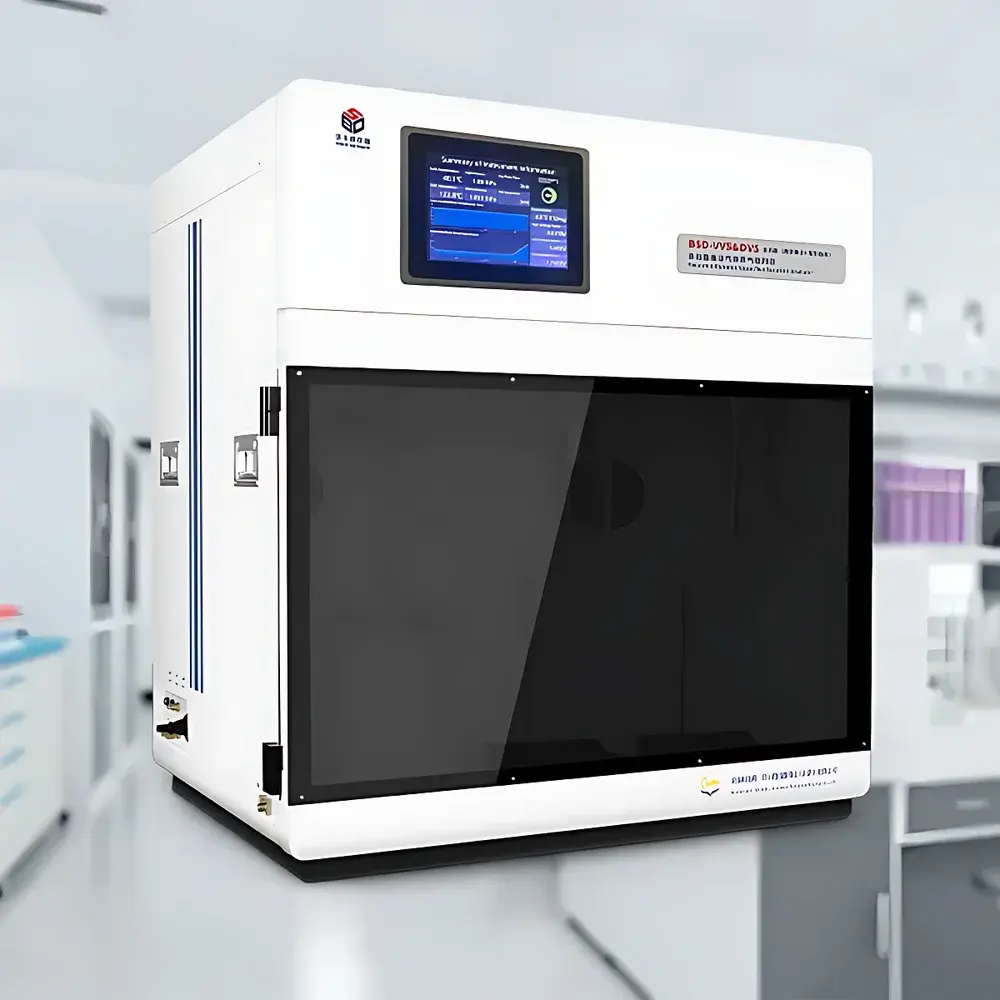
Beishide BSD-VVS&DVS4 Multi-Station Gravimetric Vapor Sorption Analyzer
| Brand | Beishide Instrument |
|---|---|
| Origin | Beijing, China |
| Manufacturer Type | Direct Manufacturer |
| Instrument Type | Static & Dynamic Vapor Sorption Analyzer |
| Mass Range | 1 µg / 5000 mg |
| Mass Resolution | 1 µg / 5000 mg (optional 0.1 µg / 500 mg) |
| Temperature Control Range | –5 °C to 150 °C (±0.1 °C accuracy, liquid bath) |
| Relative Humidity (RH) Range | 0.1–98% P/P₀ |
| RH Accuracy | ±0.1 °C over full gas-path isothermal zone (room temperature to 60 °C) |
Overview
The Beishide BSD-VVS&DVS4 is a high-precision, multi-station gravimetric vapor sorption analyzer engineered for quantitative characterization of solid–vapor interactions under controlled temperature and partial pressure conditions. It operates on the fundamental principle of microgravimetric measurement—detecting mass changes in real time as vapors (e.g., H₂O, ethanol, CO₂, alkenes, and other non-corrosive species) adsorb onto or desorb from solid samples. Unlike volumetric or manometric systems, this instrument employs a calibrated industrial microbalance with sub-microgram resolution to directly quantify sorption uptake, enabling rigorous thermodynamic and kinetic analysis without assumptions about gas compressibility or dead volume calibration. Designed for research laboratories and QC environments requiring high reproducibility across heterogeneous sample sets, the BSD-VVS&DVS4 supports both static (equilibrium isotherm) and dynamic (kinetic rate) measurement modes—including constant-pressure, constant-temperature, variable-temperature, and cyclic sorption protocols. Its dual-pump vacuum architecture, fully isothermal gas path, and patented reagent condensation recovery system ensure low background contamination, high long-term stability, and minimal reagent consumption—critical for extended lifetime testing and regulatory-compliant data acquisition.
Key Features
- Multi-position configuration: 4 or 8 independent analysis stations operating simultaneously under identical thermal and humidity conditions—enabling statistical evaluation of batch-to-batch variability and accelerated screening of material libraries.
- Ultra-high-resolution microbalance: Factory-calibrated industrial balance with 1 µg resolution over 5000 mg range (0.1 µg option available); 2–5× wider dynamic range than conventional single-station instruments, improving sample representativeness and reducing weighing uncertainty.
- Full-system isothermal control: Integrated liquid-bath temperature regulation (–5 °C to 150 °C, ±0.1 °C) coupled with heated gas-path segments (RT to 60 °C, ±0.1 °C) to eliminate condensation and ensure true equilibrium vapor activity at the sample surface.
- Dual-vapor generation methods: “Static evaporation” for ultra-low P/P₀ (<2%) measurements and “carrier-gas mixing” for rapid, precise RH modulation across 0.1–98% P/P₀; optional NH₃/SO₂ compatibility with corrosion-resistant flow components.
- Advanced vacuum architecture: Dual-pump system comprising high-vacuum mechanical pump + dedicated vapor pump (programmable purge function); optional imported turbomolecular pump (base pressure <1×10⁻⁶ torr) for ultra-low residual vapor background during degassing and low-P/P₀ isotherm acquisition.
- Intelligent degassing module: Vacuum or ambient-pressure thermal treatment (RT–400 °C, ±0.1 °C), 32-segment programmable ramping with real-time mass monitoring and visual confirmation of sample stabilization—supporting GLP-aligned documentation of activation completeness.
Sample Compatibility & Compliance
The BSD-VVS&DVS4 accommodates powders, granules, monoliths, fibers, and thin films—provided they are thermally stable within the operational temperature window and chemically inert toward selected vapors. It complies with core ASTM standards including ASTM D6886 (water vapor sorption of polymers), ASTM E104 (standard practice for maintaining constant relative humidity), and ISO 12219-2 (interior air quality testing). When configured with audit-trail-enabled software and electronic signature modules, the system meets FDA 21 CFR Part 11 requirements for regulated pharmaceutical and biomedical applications. All humidity and temperature calibrations are traceable to NIST-certified references, and float correction is implemented via three validated methodologies: theoretical buoyancy calculation, blank-position background subtraction, or full background curve interpolation—ensuring compliance with ISO 15901-2 (physisorption) and IUPAC recommendations for sorption data reporting.
Software & Data Management
The proprietary Beishide SorptionStudio™ platform provides intuitive workflow-driven operation—from method setup and real-time mass/temperature/RH monitoring to automated isotherm fitting and kinetic modeling. Raw data are stored in HDF5 format with embedded metadata (user ID, timestamp, calibration history, environmental logs). Built-in analysis modules support BET surface area (single-point and multi-point), Langmuir modeling, DR and HK micropore analysis, BJH mesopore distribution, and diffusion coefficient estimation via Fickian or non-Fickian models. Export options include CSV, Excel, and PDF reports compliant with internal QA templates or external peer-review submission standards. For enterprise deployment, optional integration with LIMS via RESTful API enables centralized data governance and automated report archiving aligned with ISO/IEC 17025 laboratory accreditation requirements.
Applications
This instrument serves critical roles across materials science, pharmaceutical development, catalysis, and energy storage. In battery R&D, it quantifies moisture uptake kinetics in solid electrolytes and cathode coatings—directly informing shelf-life predictions and cell assembly protocols. For pharmaceutical solids, it characterizes hygroscopicity, deliquescence thresholds, and amorphous content via water sorption hysteresis—supporting QbD-based formulation design per ICH Q5C and Q8(R2). Catalyst researchers apply it to assess pore-blocking behavior under hydrocarbon or polar vapor exposure, while polymer scientists use it to correlate sorption-induced swelling with mechanical property degradation. Additional use cases include MOF stability screening, zeolite selectivity profiling, and membrane permeability benchmarking—all leveraging its ability to resolve subtle differences in sorption affinity, capacity, and relaxation time across multiple samples under rigorously matched conditions.
FAQ
What vapor species can be tested besides water?
The system supports organic vapors (e.g., ethanol, acetone, toluene), CO₂, light alkanes/alkenes, and—when equipped with optional corrosion-resistant components—NH₃ and SO₂.
Is automatic background subtraction available during dynamic sorption runs?
Yes: the instrument performs concurrent blank-position measurement on every cycle, enabling real-time buoyancy and drift correction without interrupting sample analysis.
How does the reagent recovery system reduce operational cost?
Its patented condensation trap captures and recirculates evaporated solvent, extending 120 mL reagent volume usage by up to 3.5× compared to open-loop systems—particularly impactful for expensive or hazardous organics.
Can the system perform long-term cyclic aging tests?
Absolutely: the fully automated sequence engine supports unattended operation over weeks, with programmable sorption/desorption cycles, intermediate degassing steps, and temperature ramps—all logged with full audit trail integrity.
What level of technical support is provided for method development?
Beishide offers application-specific protocol consulting, including isotherm model selection guidance, kinetic fitting validation, and SOP drafting aligned with ISO, ASTM, or internal quality standards.



