
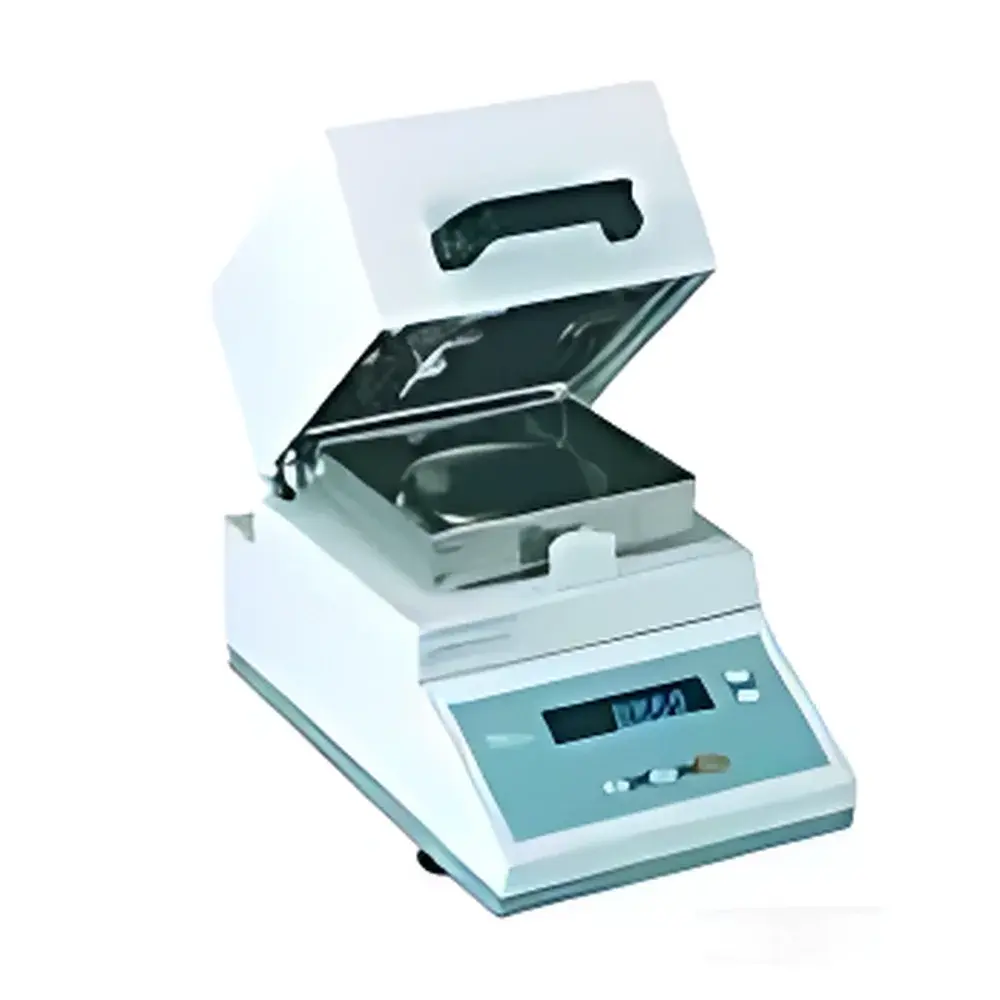
BEL TOP RAY 160 Infrared Moisture Analyzer
| Origin | Italy |
|---|---|
| Manufacturer Type | Authorized Distributor |
| Origin Category | Imported Instrument |
| Model | TOP RAY 160 |
| Pricing | Available Upon Request |
| Maximum Sample Capacity | 160 g |
| Readability | 0.001 g |
| Repeatability | ±0.0005 g |
| Moisture Range | 0.01–100.00% (w/w) |
| Temperature Range | 50–160 °C (adjustable in 1 °C increments) |
| Heating Source | Dual Heraeus quartz halogen lamps |
| Heating Chamber Material | Full stainless steel (AISI 304) |
| Power Supply | 230 V ±15%, 50/60 Hz |
| Drying Accuracy | ±1% (relative to reference method, e.g., Karl Fischer or loss-on-drying per ASTM E1868) |
Overview
The BEL TOP RAY 160 Infrared Moisture Analyzer is a high-precision, thermogravimetric moisture determination system engineered for rapid, reproducible quantification of moisture content in solid and semi-solid samples across pharmaceutical, food, chemical, and materials science laboratories. Operating on the principle of infrared halogen heating coupled with real-time mass loss monitoring, the instrument applies controlled thermal energy to drive off volatile components—primarily water—while continuously measuring sample mass via an integrated high-resolution analytical balance. The resulting mass loss is automatically converted into moisture percentage using user-defined or standardized calculation algorithms. Unlike conventional oven-drying methods requiring hours, the TOP RAY 160 achieves typical drying cycles in under 5 minutes, significantly accelerating QC throughput without compromising metrological integrity. Its design complies with fundamental requirements of ASTM E1868 (Standard Test Method for Determining Moisture Content of Solid Waste by Thermogravimetric Analysis), ISO 712 (Cereals and cereal products — Determination of moisture content), and supports method validation under GLP and GMP frameworks.
Key Features
- High-stability dual Heraeus quartz halogen lamps delivering uniform, controllable radiant heat across the entire sample surface—minimizing thermal gradients and ensuring consistent drying kinetics.
- Full AISI 304 stainless-steel heating chamber resistant to corrosion, thermal fatigue, and residue buildup—optimized for long-term operational reliability and ease of cleaning.
- Integrated 0.001 g readability analytical balance with automatic internal calibration and drift compensation, enabling repeatability of ±0.0005 g under standard environmental conditions.
- Precise temperature control from 50 °C to 160 °C in 1 °C increments; ramp time from 50 °C to 100 °C is approximately 60 seconds, facilitating rapid method development and optimization.
- Intuitive graphical LCD interface with multilingual support (English, Italian, German, French, Spanish), pre-programmed drying profiles, and customizable end-point criteria (time-based, slope-based, or manual stop).
- Robust architecture compliant with IEC 61000-4 electromagnetic compatibility standards and CE marking for safe operation in regulated laboratory environments.
Sample Compatibility & Compliance
The TOP RAY 160 accommodates heterogeneous matrices including powders, granules, pellets, pastes, and thin films—with maximum sample load up to 160 g. It is routinely deployed for moisture analysis of active pharmaceutical ingredients (APIs), excipients, lyophilized products, dairy powders, starches, polymers, and mineral ores. All measurement outputs are traceable to SI units via internal mass calibration routines. The instrument supports documentation practices aligned with FDA 21 CFR Part 11 requirements when used with validated software configurations—including electronic signatures, audit trails, and data export in CSV or PDF formats. Method transfer and verification follow USP and EP 2.5.12 guidelines.
Software & Data Management
While the standalone unit operates independently via its embedded firmware, optional PC connectivity (RS-232 or USB) enables integration with laboratory information management systems (LIMS) and enterprise quality management software (QMS). Data logging includes timestamped records of initial mass, final mass, drying curve (mass vs. time), temperature profile, moisture %, and residual dry matter %. Exported datasets retain full metadata—operator ID, method name, sample ID, ambient conditions (if external sensors are interfaced), and calibration history—for regulatory review and statistical process control (SPC) analysis.
Applications
- Pharmaceutical QC: Release testing of tablets, capsules, and bulk powders per compendial moisture limits.
- Food Industry: Monitoring shelf-life-critical moisture levels in cereals, snacks, coffee, and pet food formulations.
- Chemical Manufacturing: Verification of drying efficacy in catalysts, pigments, and specialty salts.
- Academic Research: Kinetic modeling of dehydration processes and comparative studies against reference methods (e.g., Karl Fischer titration).
- Materials Science: Characterization of hygroscopic behavior in battery electrode slurries and polymer composites.
FAQ
What is the recommended maintenance schedule for the quartz lamps and balance system?
Lamp replacement is advised every 12–18 months under continuous daily use; balance internal calibration should be performed at startup and after major environmental shifts (e.g., temperature >5 °C change).
Can the TOP RAY 160 be validated for GMP compliance?
Yes—when operated with documented SOPs, calibrated reference weights, and traceable environmental monitoring, it meets IQ/OQ/PQ requirements for moisture testing in regulated environments.
Is method equivalence to AOAC or ISO reference procedures established?
Method correlation studies per ISO 5725-2 demonstrate mean bias ≤±0.3% relative to AOAC 950.46 (gravimetric oven method) for representative food and pharma matrices.
Does the instrument support automatic shutdown or cooling delay after analysis?
Yes—user-configurable post-run cooldown delay (0–30 min) prevents thermal shock to the balance and ensures operator safety before sample removal.
How is moisture resolution defined, and what factors influence accuracy?
Moisture resolution is 0.01%; accuracy of ±1% reflects combined uncertainty from balance precision, temperature uniformity, sample homogeneity, and endpoint detection algorithm—validated per EURACHEM/CITAC Guide CG4.
Related Products




