
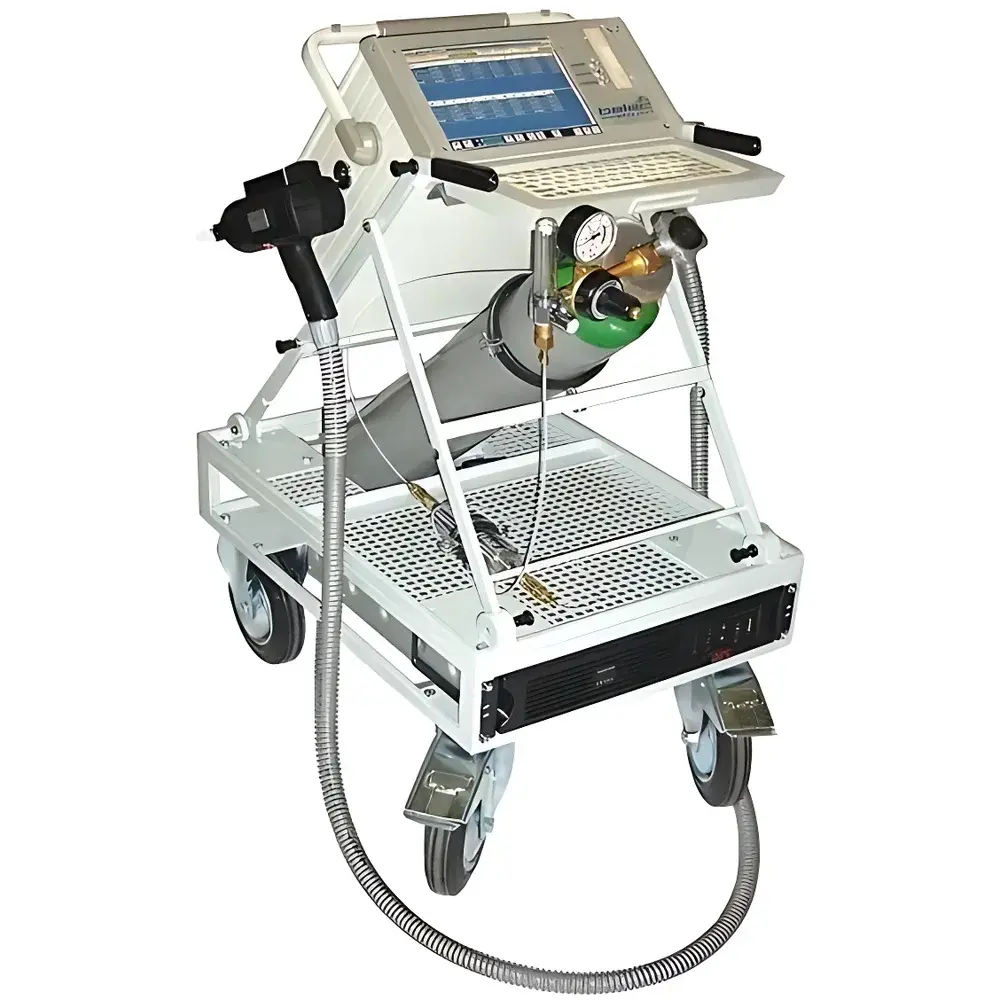
Belec Compact-Port Portable Direct-Reading Optical Emission Spectrometer
| Brand | Belec |
|---|---|
| Origin | Germany |
| Model | Belec Compact-Port |
| Instrument Type | Portable / Mobile |
| Excitation Method | Spark |
| Detector Type | Photomultiplier Tube (PMT) |
| Focal Length | 750 mm |
| Grating Grooves | 3600 lines/mm |
| Wavelength Range | 120–780 nm |
| Number of Channels | 18 |
| Weight | 17 kg |
| Optional Spark Probes | Argon “Special” Probe, Argon “Dedicated” Probe, Air Probe |
| Multi-Matrix Capability | Up to 6 base materials with 36 total elemental channels |
| Software | Belec proprietary analysis software (10+ language options, including full Chinese UI) |
| Hybrid Configuration | Compatible with external spark stand for benchtop operation |
Overview
The Belec Compact-Port is a rigorously engineered portable direct-reading optical emission spectrometer (OES) designed for high-precision elemental analysis of metallic alloys in field and workshop environments. Based on the fundamental principle of spark-induced atomic emission spectroscopy, the instrument generates controlled micro-spark discharges on conductive sample surfaces, exciting atoms into higher energy states; subsequent relaxation emits characteristic wavelengths captured and resolved by a high-resolution Czerny-Turner optical system. With a 750 mm focal length Paschen-Runge mounting and 3600 lines/mm holographic grating, the Compact-Port delivers exceptional spectral dispersion and peak separation across a broad UV-VIS range (120–780 nm), enabling reliable quantification of light elements—including carbon (C), phosphorus (P), and sulfur (S)—critical for quality control in steel, aluminum, copper, and nickel-based alloys.
Key Features
- Ultra-portable architecture: Total system mass of only 17 kg enables rapid deployment on-site without dedicated infrastructure or vibration-isolation tables.
- Dual-mode operational flexibility: Functions as a handheld unit with interchangeable spark probes—or integrates seamlessly with an optional external spark stand for stable benchtop analysis, supporting both mobile and fixed-lab workflows.
- Robust PMT-based detection: Eighteen discrete photomultiplier tube channels provide high signal-to-noise ratio, long-term gain stability, and low drift—essential for reproducible calibration transfer between laboratories.
- Multi-matrix analytical capability: Supports up to six independent base-material calibrations (e.g., Fe, Al, Cu, Ni, Ti, Mg) with configurable channel assignments; total elemental coverage extends to 36 channels via hardware expansion.
- Intuitive human-machine interface: Integrated resistive touchscreen display with real-time spectrum visualization, live intensity monitoring, and one-touch result export.
- Modular probe ecosystem: Three certified spark probe variants—argon-purged “Special”, argon-purged “Dedicated”, and ambient-air—allow optimized excitation for diverse sample geometries, surface conditions, and regulatory requirements (e.g., ISO 11577, ASTM E415).
Sample Compatibility & Compliance
The Compact-Port accommodates flat, curved, and irregularly shaped metallic samples ≥10 mm in diameter and ≥3 mm in thickness. Surface preparation follows standardized grinding protocols (ISO 14284, ASTM E1184). Its spark excitation meets IEC 61000-4-3 immunity requirements for electromagnetic compatibility in industrial settings. All calibrations are traceable to NIST SRM reference materials, and analytical reports include full metadata (operator ID, timestamp, environmental temperature/humidity, argon purity log). The system supports audit-ready documentation per GLP and GMP frameworks, with optional 21 CFR Part 11-compliant software modules available for regulated manufacturing environments.
Software & Data Management
The Belec proprietary analysis software provides full method development, calibration management, and statistical process control (SPC) tools. It features automated background correction, inter-element interference correction (IEC), and matrix-matched standardization. Data export complies with ASTM E1382 and ISO/IEC 17025 reporting formats (CSV, XML, PDF). Multi-language support includes English, German, French, Spanish, Italian, Japanese, Korean, Russian, Arabic, Portuguese, and Simplified Chinese—ensuring consistent operation across global technical teams. Internal storage retains ≥10,000 analysis records with time-stamped audit trails; USB 3.0 and Ethernet interfaces enable secure network integration and remote diagnostics.
Applications
- On-site positive material identification (PMI) for piping, pressure vessels, and structural components per ASME B31.3 and API RP 578.
- Scrap sorting and alloy verification at recycling facilities and foundry intake points.
- In-process quality assurance during hot/cold rolling, extrusion, and forging operations.
- Failure analysis labs requiring rapid elemental mapping of fracture surfaces or weld zones.
- Educational use in metallurgy and materials science curricula, where hands-on OES training must comply with laboratory safety standards (e.g., ANSI Z87.1 eye protection, NFPA 51B spark containment).
FAQ
Does the Compact-Port require external argon gas supply for all analyses?
Yes—argon purging is mandatory for C, P, S, and other UV-emitting elements (below 190 nm); air-mode operation is limited to alloying elements emitting above 190 nm (e.g., Cr, Ni, Mn, Cu).
Can calibration curves be transferred between different Compact-Port units?
Yes—calibration files are instrument-independent when generated using certified reference materials and identical spark parameters; cross-unit reproducibility is typically ±0.02 wt% for major elements under controlled lab conditions.
Is the system compatible with LIMS integration?
Yes—via ASTM E1382-compliant XML output or OPC UA server interface (optional add-on), supporting bidirectional data exchange with enterprise laboratory information management systems.
What maintenance intervals are recommended for the optical system?
Optical chamber purge integrity should be verified quarterly; PMT gain recalibration is advised every 2000 sparks or biweekly in high-throughput environments; grating cleaning requires certified optics technicians and is scheduled per ISO 10110 standards.





