
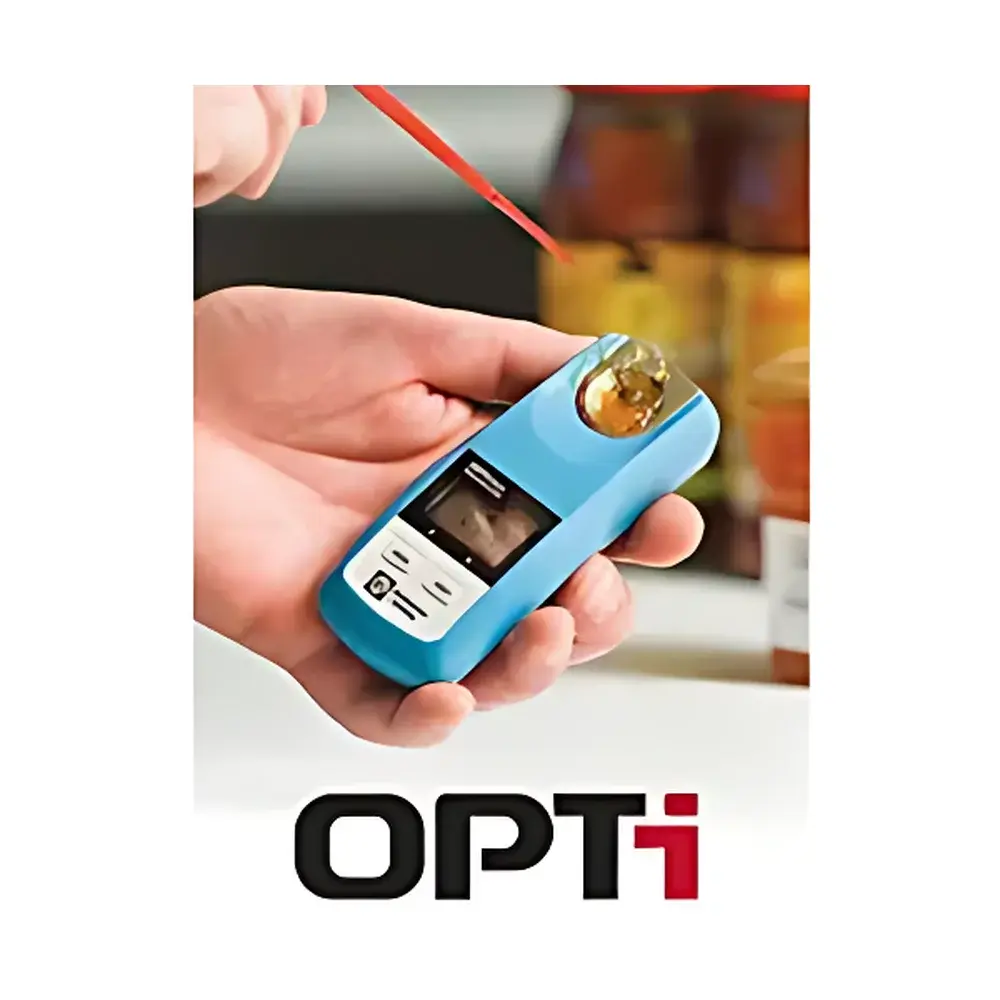
Bellingham + Stanley OPTi Food Industry Digital Handheld Refractometer
| Brand | Bellingham + Stanley (B+S) |
|---|---|
| Country of Origin | United Kingdom |
| Model | OPTi Food Industry |
| Compliance | BS EN ISO 9001:2000, UKAS, CE |
| IP Rating | IP65 |
| Calibration | Pure water zero-point calibration |
| Temperature Compensation | Automatic (ATC) |
| Prism Design | Shallow-base, cleanable, no dead zones |
| Ergonomics | Human-engineered handheld form factor |
| Application Scope | Brix, RI, % Salt, % Urea, % Starch, Alcohol Probable (AP), Oechsle (DE/CH), KMW, °Baumé, ABV, °Plato |
Overview
The Bellingham + Stanley OPTi Food Industry Digital Handheld Refractometer is a precision optical instrument engineered for rapid, field-deployable measurement of refractive index and derived concentration parameters in liquid and semi-liquid samples. Based on the fundamental principle of Snell’s Law, the device measures the angle of light refraction at the sample-prism interface to determine the refractive index (RI), which correlates linearly with solute concentration under controlled temperature conditions. Its integrated Automatic Temperature Compensation (ATC) system—calibrated to the standard 20 °C reference—ensures metrological consistency across ambient operating temperatures from 10 °C to 40 °C without manual recalibration. Designed specifically for food and beverage quality assurance workflows, the OPTi delivers traceable, repeatable results compliant with international standards including BS EN ISO 9001:2000 and validated for use in GLP- and GMP-aligned environments where audit-ready documentation is required.
Key Features
- Pure UK-manufactured optical assembly with fused quartz prism and high-stability LED illumination source ensuring long-term photometric stability and minimal drift.
- Ergonomic, one-handed operation with non-slip rubberized grip and intuitive push-button interface optimized for glove-compatible use in production-floor or outdoor sampling conditions.
- Shallow-depth prism chamber minimizes residual sample retention and eliminates cleaning blind spots—critical for viscous or particulate-laden matrices such as fruit pulps, wort, or dairy concentrates.
- IP65-rated polycarbonate housing provides resistance to ingress of dust and low-pressure water jets, supporting rigorous sanitation protocols (e.g., CIP rinse cycles) and extended field deployment.
- Dual-scale models support simultaneous display of two industry-standard units (e.g., °Brix and % Alcohol Probable), reducing operator error and eliminating manual conversion tables.
- Factory-calibrated using NIST-traceable sucrose and sodium chloride reference solutions; zero-point verification performed exclusively with deionized water per ISO 21527-1 and AOAC 932.12 guidelines.
Sample Compatibility & Compliance
The OPTi is validated for direct analysis of aqueous-based solutions across food manufacturing sectors—including fruit juice, wine must, beer wort, milk, whey, brine, syrup, and fermentation broths. It accommodates samples with suspended solids up to 5 µm particle size without clogging, provided they are homogenized prior to application. All optical path components comply with EU RoHS Directive 2011/65/EU and FDA 21 CFR Part 11–ready firmware supports electronic signature logging when paired with B+S-certified data export modules. Device certification includes UKAS-accredited test reports for measurement uncertainty (k=2) across all configured scales, meeting requirements for ISO/IEC 17025-compliant laboratories.
Software & Data Management
While the OPTi operates as a standalone instrument, optional USB-C connectivity enables seamless integration with Bellingham + Stanley’s RefraLink™ PC software (v4.2+). This platform supports automated batch logging, statistical process control (SPC) charting, user-defined pass/fail limits, and export to CSV, PDF, or LIMS-compatible XML formats. Audit trails record operator ID, timestamp, calibration status, and environmental temperature—fully satisfying FDA 21 CFR Part 11 and EU Annex 11 data integrity mandates. Firmware updates are delivered via secure HTTPS portal with SHA-256 signature verification.
Applications
- Wine production: Real-time monitoring of grape maturity (°Oechsle, °KMW), fermentation progress (ABV, °Baumé), and final alcohol prediction (AP).
- Brewing QA: Simultaneous measurement of original extract (°Plato) and potential alcohol yield in wort and finished beer.
- Dairy processing: Rapid assessment of lactose content in whey, total solids in cream, and salinity in cheese brines.
- Confectionery & soft drinks: Brix verification of syrups, invert sugar solutions, and flavor concentrates within ±0.2 °Brix tolerance.
- Agricultural co-ops: Field-level ripeness testing of tomatoes, citrus, and stone fruits using calibrated Brix-to-sugar-conversion curves.
- Pharmaceutical excipient QC: Verification of glycerin, propylene glycol, and sucrose syrup concentrations per USP and Ph. Eur. 2.2.22.
FAQ
Does the OPTi require periodic recalibration by an external lab?
No—routine recalibration is performed in-house using deionized water at ambient temperature. Annual UKAS traceable verification is recommended but not mandatory for non-regulated applications.
Can the device measure opaque or highly colored samples?
Yes, provided the sample forms a continuous optical film over the prism surface. Turbid samples (e.g., unfiltered cider) should be centrifuged or filtered (0.45 µm) to avoid scattering artifacts.
Is temperature compensation active during battery-powered operation?
Yes—ATC functionality remains fully operational across the entire 3.0–4.2 V battery voltage range and is unaffected by power source.
What is the prism cleaning protocol for sticky samples like honey or molasses?
Use lint-free wipes moistened with isopropyl alcohol (≥99%), followed by distilled water rinse and air-drying. Avoid abrasive cloths or acetone.
Are scale conversions (e.g., Brix to ABV) embedded in firmware or applied externally?
All dual-scale conversions are hard-coded per internationally accepted empirical formulas (e.g., Balling, Fehling, ASBC Table 1) and do not rely on external lookup tables.





