
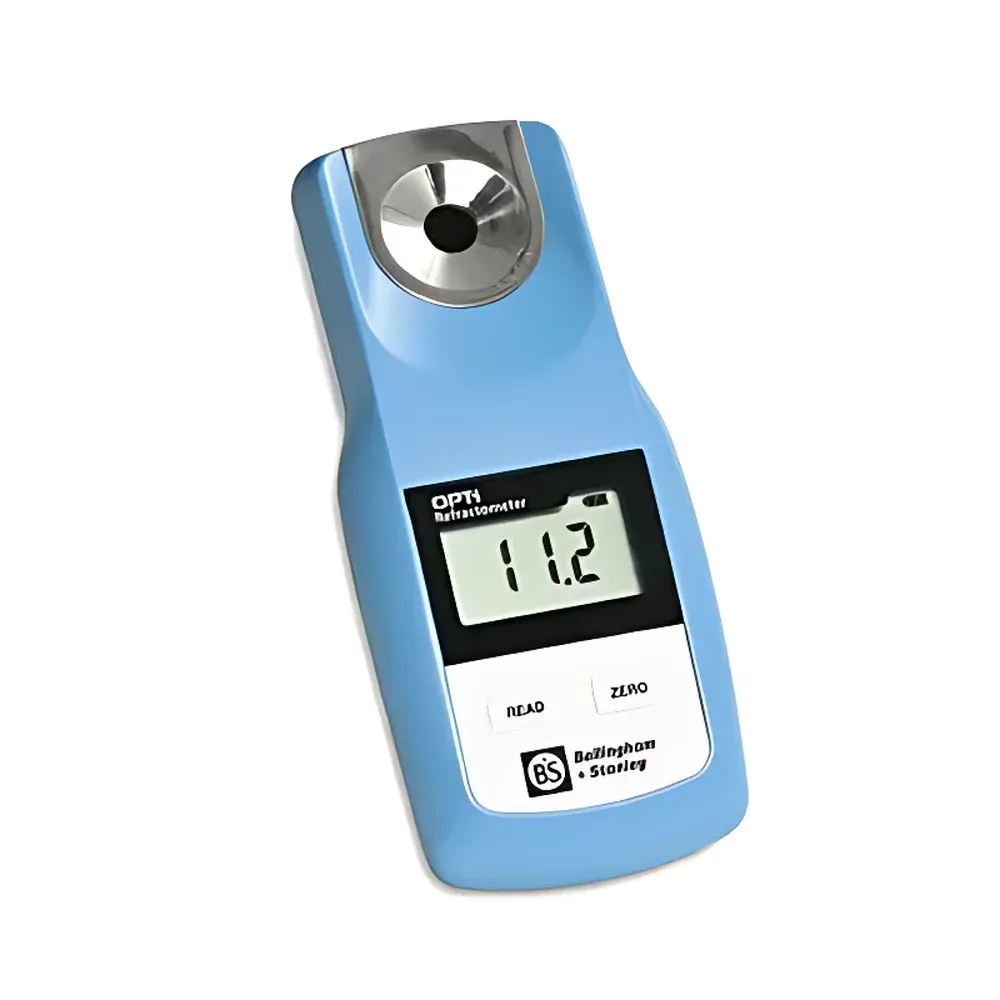
Bellingham + Stanley OPTi RI1.42 Digital Handheld Refractometer
| Brand | Bellingham + Stanley |
|---|---|
| Origin | United Kingdom |
| Model | RI1.42 |
| Measurement Range | 1.33–1.42 RI |
| Resolution | 0.0001 RI |
| Accuracy | ±0.0003 RI |
| ATC | Yes |
| IP Rating | IP65 |
| Calibration | Pure water zero-point calibration |
| Prism Design | Shallow-angle prism for residue-free cleaning |
| Compliance | BS EN ISO 9001:2000, UKAS, CE |
Overview
The Bellingham + Stanley OPTi RI1.42 Digital Handheld Refractometer is a precision optical instrument engineered for rapid, field-deployable measurement of refractive index (RI) in liquid and semi-liquid samples. Based on the principle of total internal reflection at the sample-prism interface, the device determines RI by detecting the critical angle shift induced by changes in sample density—directly correlating with solute concentration, purity, or composition. Designed and manufactured entirely in the United Kingdom, this instrument inherits over a century of B+S expertise in optical metrology and adheres to rigorous metrological traceability standards. Its compact form factor, robust mechanical architecture, and real-time automatic temperature compensation (ATC) make it suitable for use in demanding environments—including humid production floors, outdoor field sites, and mobile quality control labs—without sacrificing measurement fidelity.
Key Features
- UK-manufactured optical assembly with fused quartz prism and high-stability LED light source ensuring long-term photometric repeatability
- Ergonomic, one-handed grip design optimized for extended operation and reduced operator fatigue during repetitive sampling
- Shallow-angle prism geometry minimizes sample retention and eliminates dead zones—enabling efficient cleaning with minimal solvent volume
- IP65-rated enclosure provides full protection against dust ingress and low-pressure water jets, supporting operation in wet or corrosive industrial settings
- Dual-scale capability (single or dual RI scale configuration available per unit) facilitates cross-compatibility with legacy workflows and multi-parameter reporting requirements
- Integrated ATC system (10–40 °C operating range) applies real-time correction using a high-resolution thermistor embedded adjacent to the prism surface
- Zero-point calibration using deionized water (nD20 = 1.3330) ensures traceable baseline alignment without external reference standards
Sample Compatibility & Compliance
The OPTi RI1.42 is validated for aqueous solutions, syrups, glycols, pharmaceutical excipients, juice concentrates, and other transparent to slightly turbid liquids with viscosity ≤ 500 mPa·s. It is not intended for highly volatile, strongly acidic/basic, or particulate-laden samples without prior filtration. All units are supplied with UKAS-accredited calibration documentation and conform to BS EN ISO 9001:2000 quality management requirements. The optical path and housing materials comply with EU RoHS Directive 2011/65/EU and meet CE marking essential health and safety requirements. While not inherently 21 CFR Part 11 compliant, audit-ready calibration logs and user-defined calibration timestamps support GLP/GMP-aligned recordkeeping when integrated into validated laboratory information management systems (LIMS).
Software & Data Management
This handheld model operates as a standalone instrument with no embedded data logging or Bluetooth/Wi-Fi connectivity. All measurements are displayed in real time on a high-contrast LCD screen with backlighting for low-light conditions. Users manually record results alongside batch identifiers, ambient temperature, and calibration status. For regulated environments, integration with external digital notebooks or LIMS is achieved via standardized manual entry protocols. Optional accessories include a calibrated reference standard set (certified RI values traceable to NPL), protective carrying case with humidity indicator, and prism cleaning kit containing lint-free wipes and optical-grade isopropanol.
Applications
- Food & Beverage: Brix estimation in fruit juices, sugar concentration in syrups, honey adulteration screening, and dairy product consistency verification
- Pharmaceutical Manufacturing: Excipient concentration checks in liquid formulations, API solution density validation, and cleaning verification rinse water analysis
- Chemical Processing: Glycol concentration monitoring in heat transfer fluids, solvent purity assessment, and polymer solution formulation control
- Agricultural Field Testing: Sap solute potential estimation in horticulture, fertilizer solution strength verification, and post-harvest produce quality grading
- Academic Research: Teaching tool for optical property fundamentals; supporting undergraduate physics and analytical chemistry curricula
FAQ
What is the recommended calibration frequency for routine use?
Daily calibration before first use is advised when operating under variable thermal conditions; otherwise, calibration before each measurement series is sufficient for stable ambient environments.
Can the instrument measure samples below 10 °C or above 40 °C?
No—the ATC functionality is specified only between 10 °C and 40 °C. Measurements outside this range require external temperature equilibration and manual correction using published temperature-Ri coefficients.
Is the prism surface scratch-resistant?
The prism is fabricated from optical-grade BK7 glass with a hard-coated anti-scratch surface; however, abrasive particles or improper wiping may cause micro-scratches affecting edge detection accuracy.
Does the device support custom scale programming?
No—scale definitions are factory-programmed per model variant (e.g., RI-only or RI/Brix dual scale); firmware modification is not supported.
How is measurement uncertainty determined for a given reading?
Total uncertainty incorporates ±0.0003 RI instrument accuracy, ±0.0001 RI resolution limit, and ±0.0002 RI contribution from ATC residual error—yielding a combined expanded uncertainty (k=2) of ≤ ±0.0007 RI under nominal conditions.




