
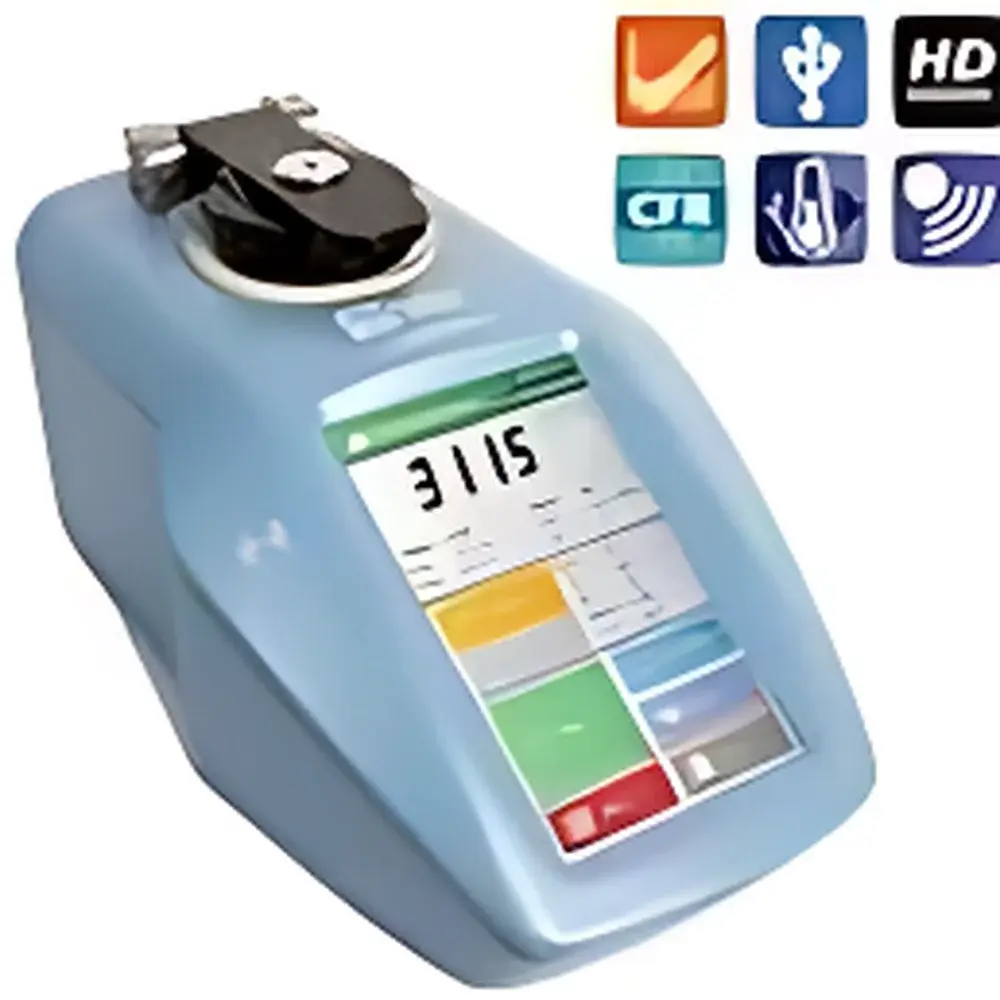
Bellingham + Stanley RFM300+ Series Automated Desktop Refractometer
| Brand | Bellingham + Stanley |
|---|---|
| Origin | United Kingdom |
| Model | RFM300+ |
| Type | Benchtop Refractometer |
| Temperature Control | Peltier-based |
| Digital Display | Yes |
| Prism Material | Synthetic Sapphire |
| Light Source | LED (≥100,000 hr lifetime) |
| Data Storage | >700 measurements |
| Compliance | GLP/GMP, USP <731>, Ph. Eur., BP |
| Interface | RS232 |
Overview
The Bellingham + Stanley RFM300+ Series Automated Desktop Refractometer is a precision optical instrument engineered for high-reproducibility refractive index (nD) measurement across diverse industrial and pharmaceutical laboratories. It operates on the principle of total internal reflection at the sample-prism interface, where the critical angle of refraction is optically detected via a high-stability LED light source and linear CCD array. The instrument’s core architecture integrates a thermoelectric (Peltier) temperature control system—capable of active cooling and heating—to maintain sample temperature within ±0.1 °C of user-setpoint (typically 10–50 °C), ensuring compliance with standardized test conditions defined in ISO 21748, ASTM D1218, and pharmacopoeial monographs (USP , Ph. Eur. 2.2.12, BP Appendix XVII). Designed for routine QC/QA workflows, the RFM300+ delivers rapid, operator-independent analysis without manual calibration drift or mechanical alignment sensitivity.
Key Features
- Integrated Peltier temperature regulation with SMART thermal stability detection—automatically delays measurement until sample temperature deviation remains ≤±0.05 °C for ≥3 seconds, eliminating premature readings.
- Synthetic sapphire prism with large, shallow sampling well (depth <1.2 mm) and wide aperture—enabling uniform film formation for viscous, particulate-laden, or non-homogeneous samples including fruit pulps, polymer emulsions, and uncured resins.
- Dual-scale digital display (refractive index nD and concentration % w/w or °Brix) with real-time unit switching; no manual conversion required.
- Chemical-resistant, IP65-rated housing with sealed electronics—resistant to common solvents, cleaning agents, and high-humidity environments typical of production labs and cleanrooms.
- Sample protection cover with integrated pressure mechanism—ensures consistent optical contact while preventing accidental prism contamination or scratching during measurement.
- Long-life, low-heat LED illumination (rated ≥100,000 hours) providing stable spectral output without warm-up delay or intensity decay over time.
Sample Compatibility & Compliance
The RFM300+ accommodates both homogeneous liquids (e.g., syrups, beverages, glycols) and challenging heterogeneous matrices—including suspensions, gels, and high-viscosity industrial resins—without requiring filtration or dilution. Its shallow prism geometry minimizes trapped air bubbles and improves wetting behavior for non-Newtonian fluids. All firmware and data handling routines are designed to meet Good Laboratory Practice (GLP) and Good Manufacturing Practice (GMP) requirements: each stored result includes timestamp, operator ID (optional), temperature reading, instrument serial number, and pass/fail status against configurable acceptance criteria. Audit trails comply with FDA 21 CFR Part 11 when used with validated third-party LIMS integration via RS232.
Software & Data Management
Internal memory retains ≥700 full measurement records with metadata (date/time, temperature, nD, concentration, user ID). Data export is supported via RS232 serial interface to PCs running terminal emulation software or custom SPC platforms. Optional B+S RefractoLink™ PC software enables automated report generation (PDF/CSV), statistical process control charting (X̄–R, Cpk), and batch-level traceability aligned with ISO/IEC 17025 documentation standards. Firmware supports user-defined calibration curves per material class (e.g., sucrose, sodium chloride, ethylene glycol), with dual-point verification capability.
Applications
The RFM300+ serves as a primary analytical tool in food & beverage QC (Brix monitoring in juices, jams, dairy), pharmaceutical excipient verification (glycerin, propylene glycol assays), chemical manufacturing (solvent purity, resin solids content), and academic research (polymer solution thermodynamics, colloidal stability studies). Its robustness and Peltier-enabled temperature flexibility make it suitable for environmental testing labs performing ASTM D7279 (crude oil API gravity estimation) and ISO 12937 (water-in-crude determination via refractive index correlation).
FAQ
Does the RFM300+ require periodic recalibration with certified refractive index standards?
Yes—annual verification using NIST-traceable liquid standards (e.g., distilled water at 20 °C, nD = 1.3330; bromonaphthalene, nD = 1.6580) is recommended per ISO/IEC 17025 Clause 6.5. Calibration certificates are generated internally and exportable.
Can the instrument measure samples below 10 °C or above 50 °C?
No—the Peltier module is rated for 10–50 °C operational range; external thermostatic baths are required for out-of-range measurements.
Is the sapphire prism replaceable by the end user?
Prism replacement requires factory recalibration and optical alignment; B+S recommends authorized service centers for maintenance.
What is the minimum sample volume required for reliable measurement?
Approximately 0.5 mL is sufficient to fully cover the 18 mm × 10 mm sapphire surface; excess volume is contained by the integrated overflow channel.
Does the RFM300+ support network connectivity (Ethernet/Wi-Fi)?
No—it features RS232 only; Ethernet or USB-serial adapters may be used with compatible drivers, but are not validated under GMP conditions.



