
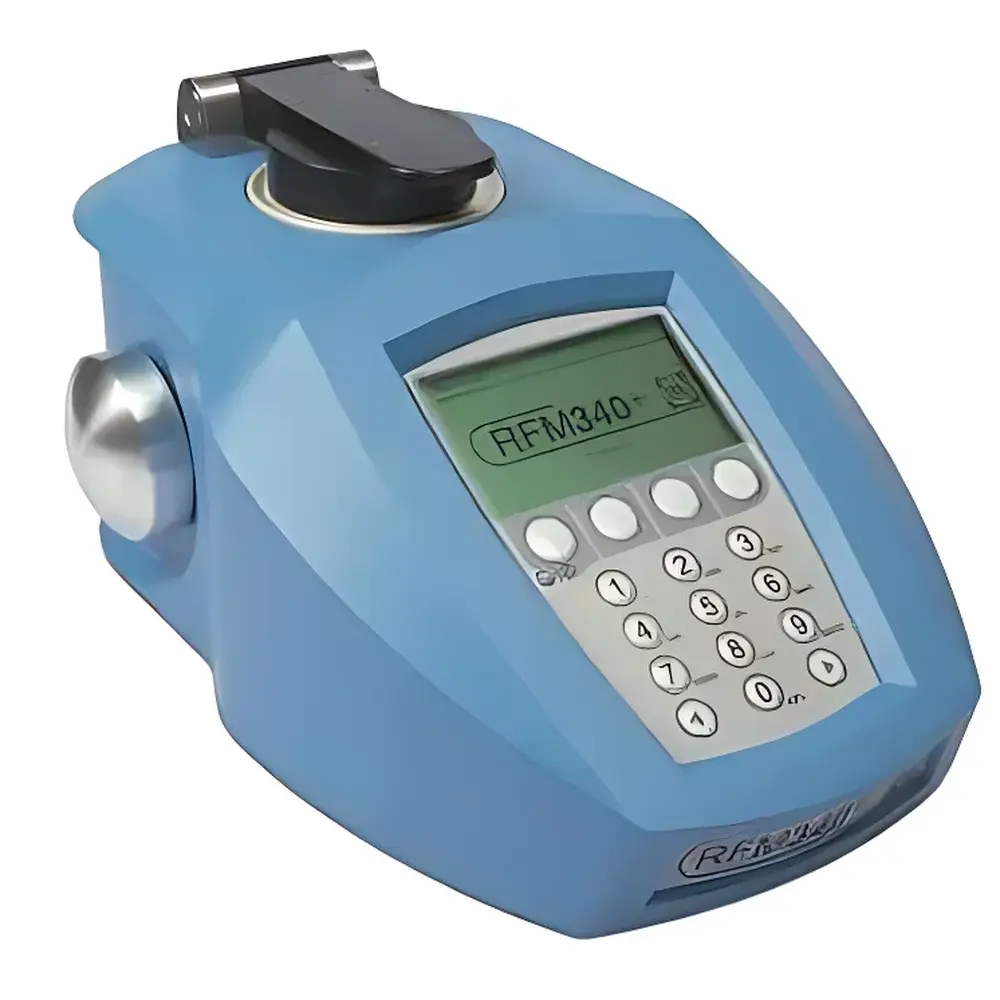
Bellingham + Stanley RFM300 Series Digital Refractometer
| Brand | Bellingham + Stanley |
|---|---|
| Origin | United Kingdom |
| Manufacturer Type | Authorized Distributor |
| Product Origin | Imported |
| Model | RFM300 Digital Refractometer |
| Pricing | Available Upon Request |
Overview
The Bellingham + Stanley RFM300 Series Digital Refractometer is a precision optical instrument engineered for high-accuracy, temperature-sensitive measurement of refractive index (nD) across liquid and semi-liquid samples. Based on the principle of total internal reflection at the prism–sample interface, the RFM300 employs a high-stability LED light source and a calibrated sapphire or BK7 glass measuring prism to determine refractive index with repeatability better than ±0.0002 nD. Designed and manufactured in the UK by Bellingham + Stanley—a pioneer in optical metrology since 1922—the RFM300 series integrates decades of empirical refinement in Abbe-type refractometry with modern digital signal processing and intuitive touchscreen operation. Unlike analog handheld units, the RFM300 features active temperature control integration capability, ensuring compliance with ISO 21748, ASTM D1218, and USP requirements for temperature-dependent refractive index measurements. Its robust mechanical architecture and traceable calibration—certified against UKAS-accredited reference standards and aligned with NIST and PTB reference materials—make it suitable for regulated laboratory environments operating under GLP or GMP frameworks.
Key Features
- Digital Abbe-type optical design with high-resolution CCD detection and automatic edge recognition for precise critical angle determination
- Integrated temperature sensor (PT1000) with real-time compensation; supports external Peltier or recirculating water bath coupling (e.g., Julabo F25) for ISO-compliant thermal stabilization (±0.1 °C)
- Multi-parameter output: refractive index (nD), Brix (% w/w), sodium chloride (% w/w), specific gravity (20/20 °C), and custom concentration scales via user-defined calibration curves
- Large color touchscreen interface with multilingual support (English, German, French, Spanish, Chinese) and password-protected method management
- USB and RS-232 connectivity for instrument control, data export (CSV, TXT), and integration into LIMS or MES platforms
- CE-marked, RoHS-compliant construction with IP20-rated enclosure for benchtop use in controlled laboratory settings
Sample Compatibility & Compliance
The RFM300 accommodates aqueous solutions, syrups, fruit juices, brines, glycols, hydrocarbon oils (RFM390 variant), epoxy resins, and polymer precursors—provided samples are optically clear or lightly turbid (transmittance >70% at 589 nm). Viscosity range extends up to ~500 mPa·s; highly viscous or particulate-laden samples require pre-filtration or dilution. Each RFM300 unit ships with UKAS-certified calibration verification using certified sucrose and NaCl reference standards traceable to NPL (National Physical Laboratory, UK). The instrument meets ISO 2859-1 sampling plan requirements for routine QC and supports audit-ready electronic records compliant with FDA 21 CFR Part 11 when paired with validated software configurations.
Software & Data Management
The RFM300 operates standalone but is fully compatible with B+S’ optional RefractoLink PC software (v4.2+), enabling method archiving, statistical process control (SPC) charting, trend analysis, and automated report generation (PDF/Excel). All measurement events—including operator ID, timestamp, temperature, raw nD, and applied conversion algorithm—are stored with immutable audit trails. Data encryption, role-based access control, and electronic signature support align with ALCOA+ principles for data integrity in pharmaceutical and food safety applications.
Applications
- Food & Beverage: Brix quantification in soft drinks, jams, dairy concentrates, and wine must; salt content validation in pickled products and sauces
- Pharmaceuticals: Excipient concentration monitoring (e.g., glycerol, propylene glycol), syrup density verification per Ph. Eur. 2.2.37
- Chemical Manufacturing: Quality release testing of ethylene glycol antifreeze, industrial solvents, and surfactant blends
- Petrochemicals (RFM390): Refractive index profiling of lubricating oils, transformer fluids, and unsaturated polyester resins per ASTM D1218 and DIN 51423
- Academic Research: Solvent purity assessment, polymer solution thermodynamics, and binary mixture phase behavior studies
FAQ
What temperature control options are supported?
The RFM300 includes an integrated PT1000 sensor and accepts external temperature regulation via 0–10 V analog input or digital handshake protocols compatible with Julabo, Huber, and Lauda recirculating chillers.
Can the RFM300 measure non-aqueous samples?
Yes—particularly the RFM390 model, optimized for hydrophobic matrices including mineral oils, silicone fluids, and epoxy monomers, with extended nD range up to 1.6500.
Is calibration traceable to national standards?
Each instrument is supplied with a UKAS-accredited calibration certificate referencing NPL-traceable sucrose and NaCl standards; field recalibration kits (B+S Part No. CAL-KIT-RFM300) are available.
Does the system support 21 CFR Part 11 compliance?
When operated with RefractoLink v4.2+ under validated IT infrastructure, full electronic record integrity, audit trail, and electronic signature functionality are enabled.
What maintenance is required?
Daily prism cleaning with lens-grade tissue and reagent-grade isopropanol; annual verification of temperature sensor accuracy and optical alignment recommended per B+S Service Bulletin SB-RFM300-2023.



