
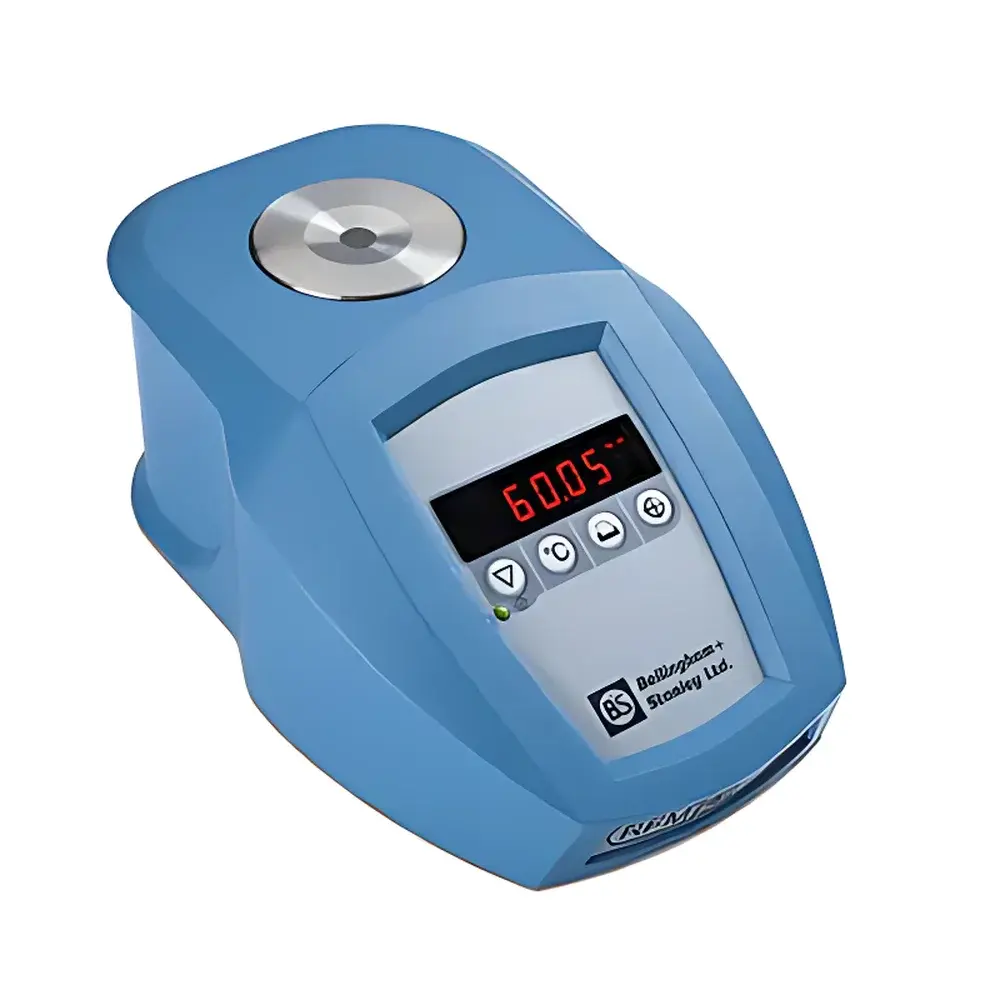
Bellingham + Stanley RFM700 Series Automated Digital Refractometer
| Brand | Bellingham + Stanley |
|---|---|
| Origin | United Kingdom |
| Model | RFM700 |
| Measurement Scale | °Brix (0–95 %°Brix, model-dependent) |
| Resolution | 0.01–0.1 %°Brix |
| Accuracy | ±0.04–±0.1 %°Brix |
| Temperature Compensation | ICUMSA, AG Liquids, or user-defined |
| Light Source | LED at 589 nm, >100,000 hr lifetime |
| Prism Material | Synthetic sapphire |
| Compliance | ASTM D5006, BS EN ISO 9001:2000, CE, UKAS-accredited design |
| Interface | RS232 serial output |
| Enclosure | Chemical-resistant, IP-rated waterproof housing |
Overview
The Bellingham + Stanley RFM700 Series Automated Digital Refractometer is a precision optical instrument engineered for rapid, repeatable measurement of refractive index and derived concentration parameters—including °Brix, specific gravity, salinity, and mass fraction—in liquid samples. Based on the principle of total internal reflection at a solid-liquid interface, the RFM700 employs a temperature-stabilized LED light source (589 nm, sodium-D line equivalent) incident upon a high-purity synthetic sapphire prism. The critical angle of refraction is detected by a linear photodiode array and converted into a digital refractive index value via factory-calibrated algorithms traceable to NIST-certified standards. Designed for routine operation in industrial QC laboratories and production environments, the RFM700 integrates robust thermal management, automatic temperature compensation, and ergonomic sample handling—ensuring metrological consistency across shifts and operators without recalibration.
Key Features
- High-stability 589 nm LED light source with >100,000-hour operational lifetime—eliminates lamp replacement cycles and spectral drift associated with halogen or sodium-vapor sources
- Synthetic sapphire measuring prism: chemically inert, scratch-resistant, and thermally stable; shallow prism well enables rapid cleaning and minimizes residual carryover between samples
- Automatic temperature compensation (ATC) with selectable algorithms: ICUMSA (for sucrose solutions), AG Liquids (for general aqueous systems), or fully user-definable polynomial coefficients per application
- IP-rated waterproof enclosure constructed from corrosion-resistant polymer housing—validated for exposure to organic solvents, acids, and caustic cleaning agents common in food & beverage processing
- RS232 serial interface compliant with EIA/TIA-232-F standard; supports direct integration with LIMS, MES, and SCADA systems using ASCII-based command protocols
- Onboard memory stores up to 1,000 measurement records with timestamp, operator ID, and temperature metadata—exportable via serial link for audit-ready data archival
Sample Compatibility & Compliance
The RFM700 accommodates aqueous and low-viscosity organic solutions typical of food, beverage, pharmaceutical, and chemical manufacturing—e.g., fruit juices, syrups, wort, brines, glycol solutions, and ethanol-water mixtures. It is not intended for highly viscous, turbid, or suspended-phase samples without prior filtration or dilution. All RFM700 instruments are manufactured under a quality management system certified to BS EN ISO 9001:2000 and bear CE marking for conformity with EU electromagnetic compatibility (2014/30/EU) and low-voltage (2014/35/EU) directives. Design validation includes compliance with ASTM D5006–22 (“Standard Test Method for Determination of Refractive Index of Liquid Hydrocarbons”), enabling use in petroleum-related applications where refractive index correlates with hydrocarbon composition. Units shipped to regulated environments support GLP/GMP documentation requirements through configurable audit trails and electronic signature readiness (when paired with validated host software).
Software & Data Management
While the RFM700 operates as a standalone instrument with intuitive front-panel controls, its RS232 interface enables seamless bidirectional communication with third-party data acquisition platforms. Raw output includes refractive index (nD), °Brix, temperature (°C), and status flags—all transmitted in fixed-field ASCII format. For laboratories requiring enhanced traceability, Bellingham + Stanley provides optional PC-based configuration utilities that log measurements to CSV or XML files, generate calibration reports per ISO/IEC 17025 guidelines, and support instrument verification against reference sucrose standards (e.g., NIST SRM 84d). All firmware updates are delivered via signed binary packages with version-controlled release notes—maintaining integrity for FDA 21 CFR Part 11–aligned environments when deployed with appropriate system validation protocols.
Applications
- Food & Beverage: Real-time monitoring of sugar content in juice concentrates, soft drink syrups, honey, and dairy-based beverages per ICUMSA methods
- Brewing & Distilling: Wort density assessment pre-fermentation; alcohol estimation post-distillation via refractive index correlation models
- Pharmaceutical Manufacturing: Excipient concentration verification in oral solutions and syrup formulations per USP and Ph. Eur. 2.2.12
- Chemical Process Control: Glycol concentration in heat-transfer fluids; salinity in desalination feed streams; solvent purity screening
- Academic Research: Teaching optical principles of refraction; validating empirical correlations between nD and solute concentration in physical chemistry labs
FAQ
What calibration standards are recommended for daily verification?
NIST-traceable sucrose reference solutions (e.g., 10.00 %°Brix and 50.00 %°Brix) are recommended for routine performance checks. Calibration intervals should align with ISO/IEC 17025–defined uncertainty budgets and process criticality.
Can the RFM700 measure non-aqueous samples such as essential oils or hydrocarbons?
Yes—provided the sample is optically clear and homogeneous at the measurement temperature. Users must select the appropriate ATC algorithm or disable compensation and apply manual correction factors based on published nD–temperature coefficients.
Is the instrument suitable for GMP-regulated environments?
The RFM700 supports GMP compliance when integrated into a validated system architecture: its serial output enables full electronic record generation, and firmware supports time-stamped audit logs. Formal qualification (IQ/OQ/PQ) must be performed per site-specific protocols.
How often does the sapphire prism require cleaning or maintenance?
Cleaning is required after each sample change. Due to the shallow prism geometry and chemical resistance of sapphire, a single rinse with deionized water followed by lint-free wipe is typically sufficient—no polishing or re-coating is necessary over the instrument’s service life.
Does the RFM700 comply with FDA 21 CFR Part 11 requirements?
The instrument itself is Part 11–capable at the data output level. Full compliance requires implementation of procedural controls (e.g., access restrictions, electronic signatures) and validation of the entire data chain—including host software, storage media, and backup procedures—as defined in your organization’s SOPs.





