
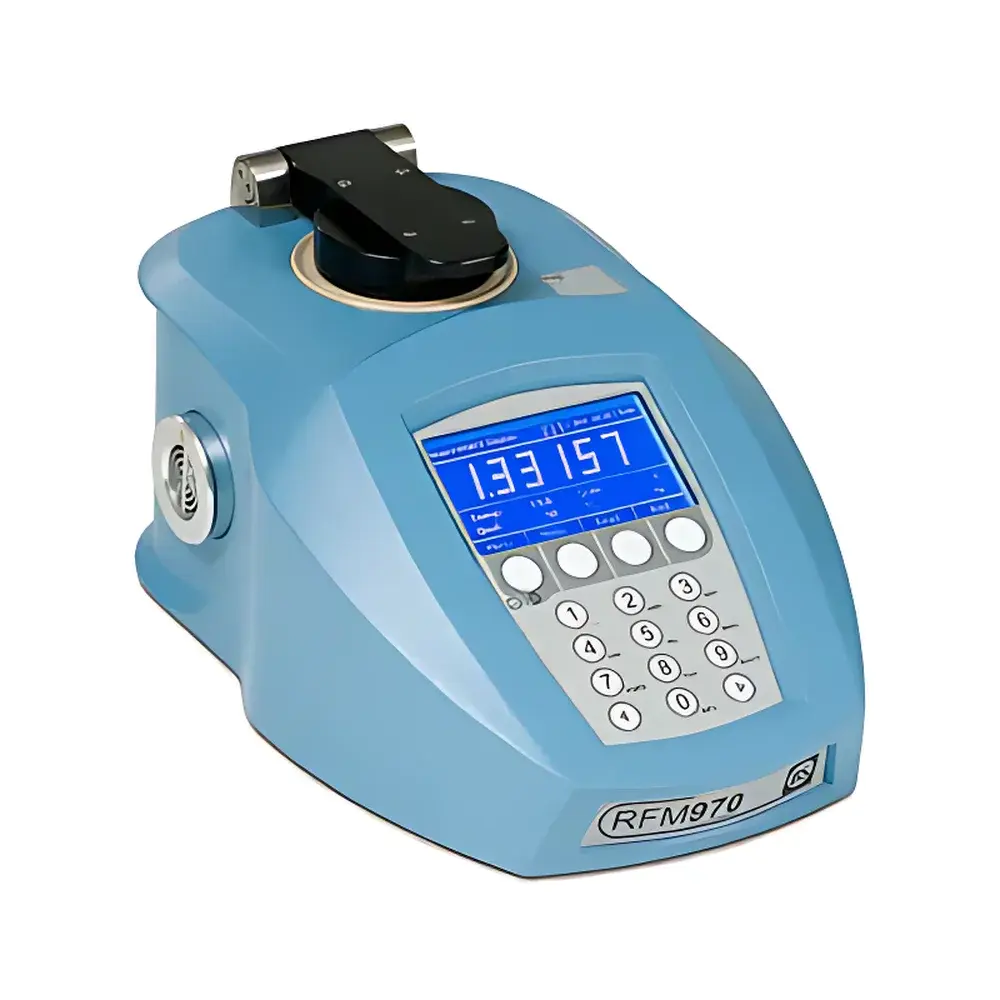
Bellingham + Stanley RFM970/960 Fully Automated Digital Refractometer
| Brand | Bellingham + Stanley |
|---|---|
| Origin | United Kingdom |
| Model | RFM970 / RFM960 |
| Refractive Index Range | 1.30–1.70 |
| Brix Range | 0–100 °Brix |
| RI Resolution | 0.00001 (RFM970), 0.0001 (RFM960) |
| Brix Resolution | 0.01 (RFM970), 0.1 (RFM960) |
| RI Accuracy | ±0.00002 (RFM970), ±0.0001 (RFM960) |
| Brix Accuracy | ±0.02 (RFM970), ±0.1 (RFM960) |
| Temperature Control | Peltier element with SMART stability algorithm |
| Wavelength | 589.3 nm (Na-D line equivalent) |
| Light Source | Long-life LED (>100,000 h) |
| Custom Scales | Up to 100 user-editable scales |
| Data Storage | 700 measurement records with GLP/GMP-compliant audit trail |
| Compliance | OIML R20, ASTM D5006/D1747/D2140/D1218, USP <731>, EP 2.2.12, BP Appendix XVII, FDA 21 CFR Part 11, ISO 9001:2000, UKAS, CE |
Overview
The Bellingham + Stanley RFM970/960 Fully Automated Digital Refractometer is a high-precision optical instrument engineered for rigorous laboratory and industrial quality control environments. Based on the principle of total internal reflection at a defined wavelength (589.3 nm, calibrated to sodium D-line equivalence), it measures the refractive index (RI) of liquid and semi-liquid samples with exceptional repeatability and traceability. Designed as the direct successor to the RFM800 series, the RFM970/960 platform integrates advanced temperature stabilization, automated sample handling, and regulatory-compliant data management to meet the evolving demands of pharmaceutical, food & beverage, chemical, and fragrance manufacturing sectors. Its extended RI range (1.30–1.70) accommodates high-refractive-index formulations—such as concentrated syrups, essential oils, polymer solutions, and active pharmaceutical ingredient (API) suspensions—that exceed the operational limits of conventional benchtop refractometers.
Key Features
- High-resolution measurement capability: RFM970 delivers RI resolution of 0.00001 and Brix resolution of 0.01; RFM960 provides RI resolution of 0.0001 and Brix resolution of 0.1—enabling differentiation between closely related formulations in QC release testing.
- Peltier-based temperature control with SMART stability logic: The system monitors thermal equilibrium in real time and initiates measurement only after sample temperature deviation falls within ±0.02 °C of setpoint—eliminating drift-related inaccuracies common in ambient-dependent instruments.
- Automated prism protection and sample actuation: A motorized sample cover applies consistent, reproducible pressure to the sample-prism interface, ensuring optimal optical coupling while preventing prism scratching and contamination.
- Multi-layer security architecture: Integrated RFID user authentication and PIN-based access control restrict instrument operation and method editing to authorized personnel—supporting role-based workflow segregation required under GMP Annex 11 and FDA 21 CFR Part 11.
- Dual-interface connectivity: Equipped with both parallel (Centronics) and RS232 serial ports for seamless integration into LIMS, MES, or SCADA systems without requiring proprietary middleware.
- Comprehensive calibration traceability: Factory-calibrated against NIST-traceable sucrose standards; supports two-point calibration with user-defined reference materials per application-specific SOPs.
Sample Compatibility & Compliance
The RFM970/960 accepts aqueous, organic, and viscous samples—including ethanol/water mixtures, glycerol-based formulations, essential oil distillates, and high-solids fruit concentrates—without requiring dilution or pre-filtration in most cases. Its robust sapphire prism and chemically resistant sample stage tolerate exposure to aggressive solvents (e.g., acetone, chloroform, toluene) and caustic cleaning agents. Regulatory compliance extends across international metrological and pharmacopoeial frameworks: certified to OIML R20 for legal metrology applications; validated per ASTM D5006 (aviation fuels), D1747 (ethylene glycol antifreeze), D2140 (asphalt), and D1218 (hydrocarbon solvents); aligned with USP , European Pharmacopoeia 2.2.12, and British Pharmacopoeia Appendix XVII for concentration determination of APIs and excipients. All firmware and data handling routines conform to FDA 21 CFR Part 11 requirements for electronic records and signatures, including full audit trail logging, operator attribution, and immutable timestamping.
Software & Data Management
Internal firmware supports GLP/GMP-compliant data integrity by recording every measurement event—including date/time stamp, operator ID (via RFID or PIN), method name, calibration status, temperature reading, and raw RI/Brix values—with no editable fields post-acquisition. The instrument stores up to 700 complete records onboard, each retaining full contextual metadata. Export options include ASCII text via RS232 or parallel port, compatible with CSV parsers and statistical process control (SPC) software such as Minitab or JMP. No proprietary software installation is required for basic data transfer; optional PC-based configuration utility (available separately) enables method template creation, report customization, and firmware updates—all auditable under change control procedures.
Applications
This refractometer serves as a primary analytical tool in regulated and non-regulated settings where concentration, purity, or compositional consistency must be verified. In pharmaceutical manufacturing, it quantifies sucrose or mannitol concentrations in lyophilization buffers and confirms excipient ratios in oral suspension formulations. In food science, it validates Brix levels in fruit juices per Codex Alimentarius standards and monitors sugar inversion during caramelization. In petrochemical QA, it verifies ethylene glycol content in coolant blends per ASTM D1747 and detects water ingress in hydrocarbon streams. In fragrance labs, it characterizes essential oil dilution ratios and assesses terpene-rich distillate homogeneity. Its wide RI range also supports R&D applications involving novel ionic liquids, nanofluids, and biopolymer hydrogels where conventional refractometers lack sufficient dynamic range.
FAQ
What is the difference between RFM960 and RFM970?
The RFM970 offers tenfold higher resolution and accuracy in both RI and Brix measurements compared to the RFM960, making it suitable for applications demanding sub-ppm-level concentration discrimination—such as high-potency API release testing or low-concentration standard curve validation.
Does the instrument support temperature compensation for non-sugar matrices?
Yes. It includes built-in ICUMSA (International Commission for Uniform Methods of Sugar Analysis) and AG (Alcohol-Glycerol) compensation algorithms, plus fully customizable temperature-concentration lookup tables for proprietary formulations.
Can the RFM970/960 be integrated into an automated production line?
While designed primarily as a benchtop QC instrument, its RS232 interface and deterministic command protocol enable integration with PLC-controlled sampling stations and automated data archiving systems using standard Modbus RTU or custom ASCII command sets.
Is UKAS calibration certification available for purchase?
Yes. Bellingham + Stanley offers optional UKAS-accredited calibration certificates (ISO/IEC 17025) traceable to NPL standards, delivered with documented uncertainty budgets and measurement procedure descriptions.
How frequently should the prism be cleaned and recalibrated?
Prism cleaning is recommended after each sample batch using lint-free wipes and spectroscopic-grade isopropanol; full two-point calibration is advised daily for GMP environments or prior to each analytical run when used for release testing.






