
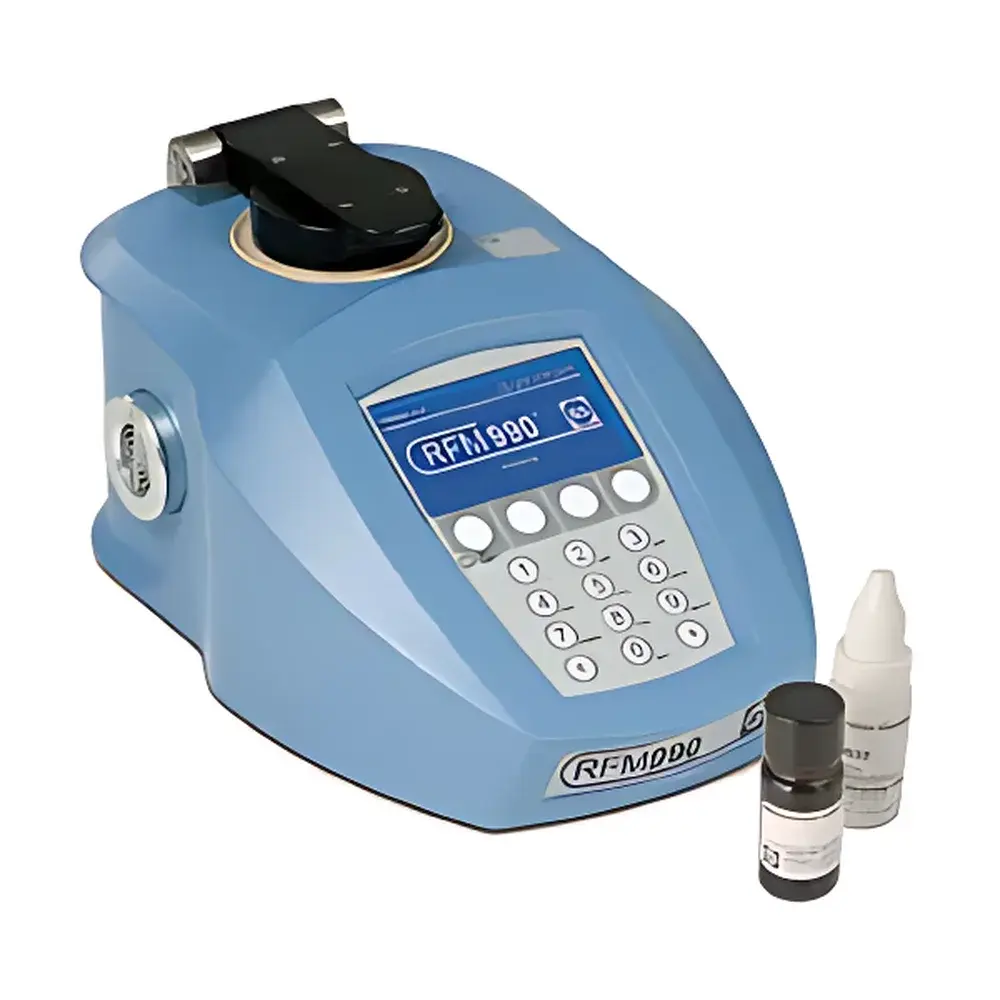
Bellingham + Stanley RFM990-AUS32 Automated Urea Refractometer
| Brand | Bellingham + Stanley |
|---|---|
| Origin | Germany |
| Model | RFM990-AUS32 |
| Refractive Index Range | 1.33–1.70 |
| Urea Concentration Range | 0–40% w/w |
| RI Resolution | 0.00001 |
| Urea Resolution | 0.01% |
| RI Accuracy | ±0.00002 |
| Urea Accuracy | ±0.02% |
| Temperature Control | Peltier (±0.1 °C) |
| Light Source | LED @ 589.3 nm (Lifespan >100,000 hr) |
| Temperature Compensation Modes | Urea-specific, ICUMSA sugar, AG, user-defined, none |
| Data Storage | 700 measurements with GLP-compliant audit trail |
| Interfaces | RS-232, parallel port |
| Sample Handling | Continuous flow compatible with multiple flow cell options |
| Compliance | ISO 22241-2, BS EN ISO 9001:2000, UKAS, CE |
Overview
The Bellingham + Stanley RFM990-AUS32 is a high-precision, fully automated refractometer engineered exclusively for the quantitative analysis of aqueous urea solutions used in Selective Catalytic Reduction (SCR) systems—commonly known as AUS32 (Aqueous Urea Solution 32%) or AdBlue®. It operates on the principle of critical-angle refractometry: a collimated LED beam (589.3 nm) is directed at the prism–sample interface; the resulting angle of total internal reflection is measured with sub-microradian resolution and converted into refractive index (RI), which is then translated into urea mass concentration using a thermodynamically validated, matrix-specific calibration algorithm. Unlike general-purpose refractometers, the RFM990-AUS32 implements a proprietary urea density–RI–temperature model compliant with ISO 22241-2, ensuring traceable, metrologically sound results across the full 0–40% w/w range under variable ambient conditions.
Key Features
- ISO 22241-2–compliant measurement engine optimized for AUS32 quality control and batch release testing
- Peltier-controlled sample stage with ±0.1 °C thermal stability and SMART temperature stabilization logic—measurements only initiate once thermal equilibrium is confirmed (ΔT < 0.02 °C over 5 s)
- Dedicated urea scale with built-in temperature compensation derived from empirical urea–water phase data, eliminating reliance on generic Brix-to-urea conversion tables
- High-stability 589.3 nm LED light source (rated >100,000 hr), eliminating lamp drift and warm-up delays associated with sodium vapor sources
- RFID-based user authentication and PIN-protected access control, supporting multi-user environments with role-based permissions
- Onboard storage for 700 measurement records, each timestamped and annotated with operator ID, temperature, RI, % urea, and instrument status—fully aligned with GLP data integrity requirements
- Modular flow cell support (including 1/4″, 3/8″, and sanitary tri-clamp configurations) enabling integration into QC lab workflows or inline process monitoring loops
Sample Compatibility & Compliance
The RFM990-AUS32 accepts clear, low-turbidity aqueous urea solutions meeting ISO 22241-1 specifications (e.g., particle count 2 µm, conductivity < 50 µS/cm). It is not intended for viscous, suspended, or highly colored samples. All hardware and firmware comply with BS EN ISO 9001:2000 for quality management systems and carry CE marking per EU Directive 2014/30/EU (EMC) and 2014/35/EU (LVD). The instrument’s measurement uncertainty budget has been validated against NIST-traceable urea reference standards and satisfies the repeatability (≤ ±0.01% urea) and reproducibility (≤ ±0.03% urea) criteria defined in ISO 22241-2 Annex C. UKAS-accredited calibration services are available for laboratories requiring ISO/IEC 17025–compliant verification.
Software & Data Management
Data export is supported via RS-232 serial interface (ASCII protocol) and parallel port, enabling direct integration with LIMS, SAP QM, or custom SCADA systems. Optional PC software provides real-time graphing, statistical process control (SPC) charting (X̄–R, Cpk), and automated report generation in PDF or CSV format. Audit trail functionality logs all user actions—including method changes, calibration events, and data deletions—with immutable timestamps and operator identifiers, satisfying FDA 21 CFR Part 11 electronic record requirements when deployed with appropriate system validation documentation.
Applications
- Final product release testing of AUS32 batches in chemical manufacturing facilities
- In-process verification during urea solution blending and dilution operations
- Incoming raw material inspection of technical-grade urea and deionized water
- Periodic verification of dispenser nozzle output concentration at fueling stations
- Research into urea hydrolysis kinetics and thermal decomposition behavior under controlled temperature ramping
- Supporting ISO 22241-3 conformance testing for packaging and storage stability studies
FAQ
Does the RFM990-AUS32 require daily calibration with certified standards?
No—factory calibration is stable for ≥12 months under normal use. However, daily verification using a single-point AUS32 reference standard (e.g., 32.5% w/w) is recommended per ISO 22241-2 Clause 7.2.
Can the instrument measure other solutions besides AUS32?
Yes—it supports user-defined scales (e.g., Brix, NaCl, ethanol), but accuracy for non-urea matrices requires independent validation and is not covered by ISO 22241-2 compliance.
Is temperature-controlled flow cell operation possible?
Yes—the Peltier stage maintains prism temperature independently of sample inflow; optional thermostatted flow cells enable precise control of sample temperature prior to measurement.
How is data integrity ensured during power interruption?
All measurements are written to non-volatile memory before display; unsaved data buffers are retained across cold restarts, and the audit trail remains intact.
What maintenance is required beyond routine prism cleaning?
Annual performance verification by an authorized B+S service center is recommended; no optical alignment or lamp replacement is required within the first 10 years of operation.




