
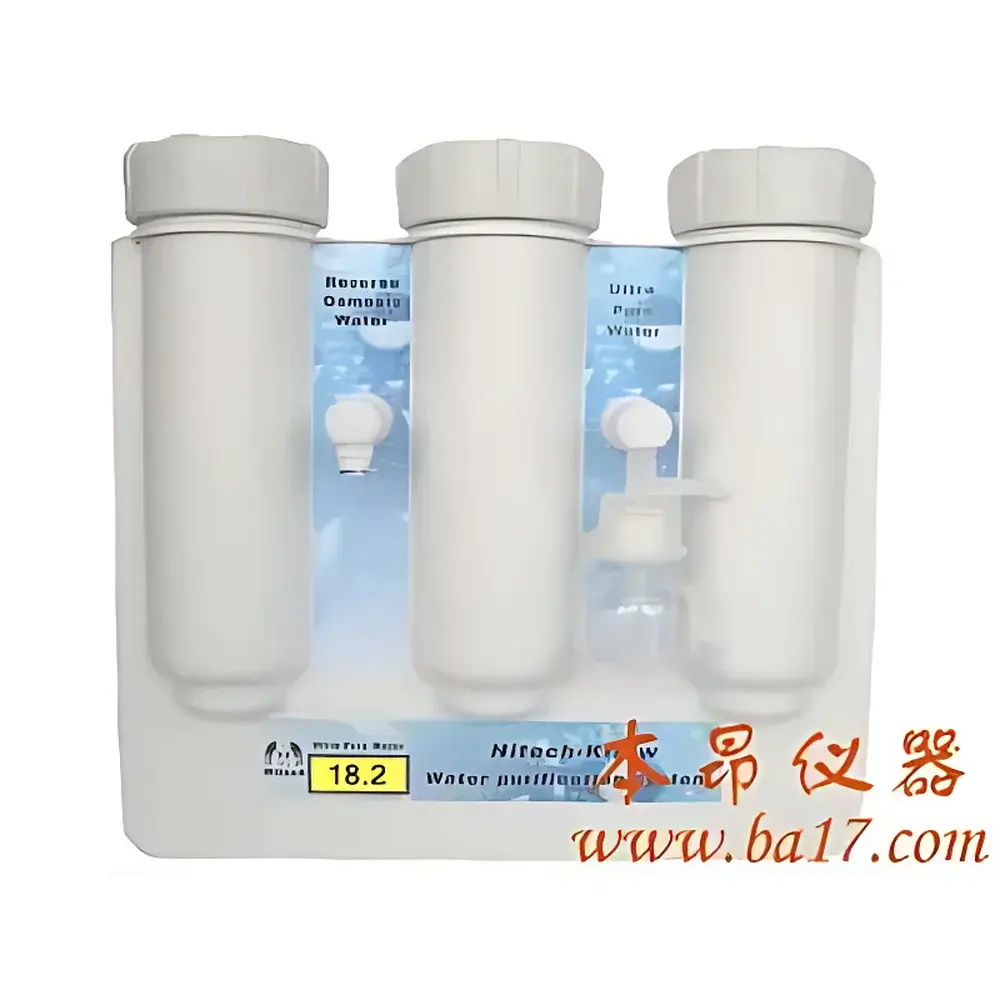
BenAng UP-15UV Low-TOC Ultra-Pure Water System
| Brand | BenAng |
|---|---|
| Origin | Shanghai, China |
| Manufacturer Type | Authorized Distributor |
| Country of Origin | China |
| Model | UP-15UV |
| Price | USD 2,680 (FOB Shanghai) |
| Output Flow Rate | 15 L/h |
| Resistivity | 18.2 MΩ·cm @ 25 °C |
| Total Organic Carbon (TOC) | <5 ppb |
| Microbial Count | <1 CFU/mL |
| Particles (>0.22 µm) | <1/mL |
| RO Outlet | 1 × |
| UPW Outlet | 1 × |
| Feed Water | Municipal tap water (TDS <200 ppm, 5–40 °C, pressure 1.0–3.5 kg/cm²) |
| Purification Stages | PF + AC + RO + UV (254/185 nm) + DI + UF + DMF + 0.22 µm final filter |
| Compliance | ASTM D1193-20 Type I, NCCLS CLSI EP21-A, GB/T 6682–2008 Grade I, GB/T 11446.1–2013 Grade I (Electronic Grade) |
Overview
The BenAng UP-15UV Low-TOC Ultra-Pure Water System is an integrated, fully automated laboratory water purification platform engineered for applications demanding ultralow organic contamination and consistent Type I ultrapure water (UPW) quality. It employs a multi-stage purification architecture grounded in validated physical and electrochemical separation principles: pretreatment (polypropylene sediment + dual activated carbon), high-rejection reverse osmosis (RO) using NASA-derived thin-film composite membranes, dual-wavelength ultraviolet photooxidation (254 nm germicidal + 185 nm TOC-destructive irradiation), ultrafiltration (MWCO 5,000 Da), mixed-bed deionization with nuclear-grade ion exchange resins, and terminal sterilizing filtration (0.22 µm PES membrane, Sartorius-certified). The system continuously monitors resistivity in real time via a backlit LCD conductivity/resistivity meter calibrated to NIST-traceable standards, delivering stable 18.2 MΩ·cm output at 25 °C — meeting or exceeding the most stringent specifications for analytical chemistry, life science research, and semiconductor process support.
Key Features
- Fully automated operation with intelligent pressure-sensing control: automatic RO membrane anti-scaling flush, dry-run protection, reservoir auto-fill, overflow shutdown, and unattended 24-hour cycling.
- Dual-wavelength UV chamber (254 nm + 185 nm) integrated pre- and post-RO to ensure continuous microbial inactivation and photochemical oxidation of trace organics, achieving TOC <5 ppb.
- High-efficiency ultrafiltration module (Pall, MWCO 5,000 Da) removes endotoxins, nucleases, and submicron colloids—critical for cell culture, protein purification, and molecular diagnostics.
- Four-column nuclear-grade mixed-bed polishing assembly (Rohm & Haas / Dow) ensures extended service life and stable resistivity performance; internal recirculation loop maintains equilibrium conductivity between cycles.
- Final 0.22 µm sterilizing filter (Sartorius, PES membrane) certified for bioburden reduction to <1 CFU/mL; includes pre-filter layer to extend service interval and reduce clogging risk.
- Long-life pretreatment: proprietary dual-carbon + PP depth filter cartridge rated for up to 24 months under typical municipal feed conditions, reducing consumable frequency and total cost of ownership.
Sample Compatibility & Compliance
The UP-15UV is validated for use with municipal tap water sources meeting ISO 14644-1 Class 8 ambient air compatibility and requiring no external softening or iron removal when feed TDS remains below 200 ppm. Its output complies with international standards governing critical laboratory water quality: ASTM D1193-20 Type I, CLSI EP21-A (formerly NCCLS), GB/T 6682–2008 Grade I (Chinese National Standard for Analytical Laboratory Water), and GB/T 11446.1–2013 Grade I (Electronic Grade Ultrapure Water). All wetted components are constructed from USP Class VI-certified polymers (e.g., PVDF, PTFE, and medical-grade polycarbonate), and the system architecture supports GLP/GMP documentation workflows including audit trails, user access logs, and event timestamping—facilitating FDA 21 CFR Part 11 readiness when integrated with compliant LIMS or ELN platforms.
Software & Data Management
While the UP-15UV operates via embedded microcontroller logic without cloud connectivity, its front-panel interface provides full operational transparency: real-time resistivity readout (with temperature compensation), system status icons (RO pressure, UV lamp life, filter saturation indicators), and historical fault logging (e.g., low inlet pressure, UV lamp timeout, reservoir full signal). All parameter thresholds and alarm conditions are field-configurable via password-protected menu navigation. For integration into regulated environments, optional RS-232 or analog 4–20 mA output modules enable connection to building management systems (BMS) or centralized lab monitoring dashboards. Raw data export is supported via USB serial dump for QC record retention per ISO/IEC 17025 clause 7.7.
Applications
This system serves as a primary UPW source for instrumentation and protocols where organic interference compromises detection sensitivity or biological integrity. Key use cases include: HPLC and UHPLC mobile phase preparation; ICP-MS and GF-AAS trace metal analysis; LC-MS/MS solvent blanks and calibration standards; PCR master mix formulation and CRISPR reagent dilution; mammalian and stem cell culture media preparation; monoclonal antibody purification buffers (e.g., Protein A elution); and photolithography rinse steps in cleanroom wafer fabrication. Its low-TOC profile and endotoxin-free output make it suitable for ELISA substrate preparation, electrophysiology saline solutions, and nanoparticle synthesis where carbon residue catalyzes unwanted side reactions.
FAQ
What feed water quality is required for optimal UP-15UV performance?
Municipal tap water with TDS ≤200 ppm, temperature between 5–40 °C, and inlet pressure of 1.0–3.5 kg/cm² (14–50 psi) is recommended. Iron, chlorine, and particulate levels must fall within ANSI/AWWA C651 limits; optional external sediment/activated carbon prefiltration is advised if feed exceeds 0.1 ppm Fe or 0.5 ppm free chlorine.
How often must consumables be replaced?
Under standard usage (15 L/day), the dual-carbon/PP prefilter lasts ~24 months; the RO membrane requires replacement every 2–3 years depending on feed TDS; the UV lamps are rated for 9,000 hours (~1 year continuous operation); the four-column DI pack typically lasts 6–12 months; and the Sartorius 0.22 µm terminal filter is replaced per batch or quarterly, whichever occurs first.
Does the UP-15UV support regulatory compliance for pharmaceutical QA/QC labs?
Yes—the system’s design, material certifications (USP Class VI, FDA-compliant wetted surfaces), and documented performance against ASTM D1193 and GB/T 6682–2008 align with ICH Q5C and USP requirements for purified water used in non-sterile pharmaceutical manufacturing. Full validation packages (DQ/IQ/OQ/PQ templates) and calibration certificates for the resistivity sensor are available upon request.
Can the RO and UPW outlets be used simultaneously without cross-contamination?
Yes—dual independent flow paths with physically isolated valving and dedicated pump control prevent backmixing. The RO stream bypasses UV, DI, and UF stages and is intended for glassware rinsing or buffer dilution; the UPW path undergoes full polishing and is reserved for critical applications.
Is remote monitoring or Ethernet connectivity available?
Standard configuration includes only local LCD display and relay outputs. Optional RS-232 or 4–20 mA analog modules support integration with SCADA or BMS; however, native Wi-Fi, Ethernet, or cloud-based telemetry are not supported due to cybersecurity constraints common in regulated lab infrastructure.



