
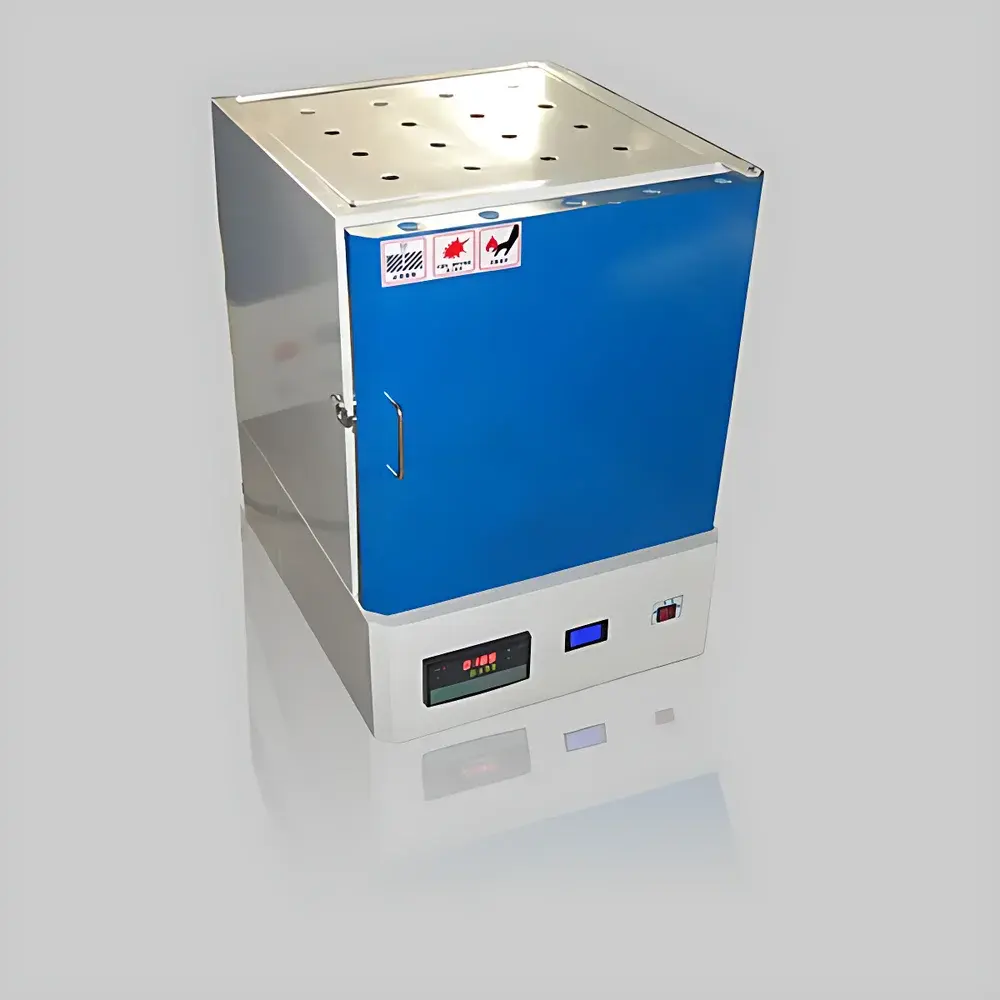
BenAng BA-3-10B Ceramic Fiber Muffle Furnace
| Brand | BenAng |
|---|---|
| Origin | Shanghai, China |
| Model | BA-3-10B |
| Type | Box-type Muffle Furnace |
| Max Temperature | 1000 °C |
| Temperature Control Accuracy | ±1 °C |
| Rated Power | 3 kW |
| Heating Time to 1000 °C | ≤60 min |
| Heating Element | Kanthal® A1 Alloy Resistance Wire |
| Internal Chamber Dimensions | 300 × 200 × 150 mm |
| Insulation Material | High-Purity Alumina-Silica Ceramic Fiber (50 mm thickness) |
| Temperature Sensor | K-Type Thermocouple (NiCr–NiSi) |
| Control System | PID Digital Controller with Ramp/Soak Programming |
| Safety Features | Door-Interlocked Power Cut-off, Over-Temperature Protection, Auto-Recovery Prevention After Power Interruption |
| Compliance | Designed per IEC 61000-6-3 (EMC), IEC 61000-6-2 (Immunity), and GLP-aligned operational safeguards |
Overview
The BenAng BA-3-10B Ceramic Fiber Muffle Furnace is a precision-engineered box-type laboratory furnace designed for rapid, uniform, and repeatable high-temperature thermal processing up to 1000 °C. It employs a robust thermal architecture centered on high-purity alumina-silica ceramic fiber insulation (50 mm total thickness) and Kanthal® A1 alloy resistance heating elements—industrial-grade components known for exceptional oxidation resistance, dimensional stability, and long-term resistivity consistency. Unlike traditional brick-lined muffle furnaces, the BA-3-10B eliminates thermal mass lag through low-density, low-conductivity insulation, enabling faster ramp rates and reduced energy consumption—typically ~40% lower than conventional refractory-lined units operating under identical duty cycles. Its sealed muffle chamber isolates samples from combustion by-products and heating element emissions, ensuring contamination-free ashing, calcination, annealing, and heat-treatment protocols required in analytical chemistry, materials science, and pharmaceutical quality control.
Key Features
- High-efficiency thermal design: 50 mm thick, low-density ceramic fiber insulation minimizes heat loss and enables rapid ambient-to-1000 °C ramping (≤60 minutes) with excellent temperature homogeneity (±3 °C across working zone)
- Kanthal® A1 heating elements: Engineered for stable resistivity, minimal sag or embrittlement at elevated temperatures, and extended service life—reducing maintenance frequency and calibration drift
- PID digital temperature controller with programmable ramp/soak profiles: Supports multi-step thermal protocols; includes real-time setpoint tracking, auto-tuning, and deviation alarm outputs
- Integrated safety architecture: Door-mounted microswitch cuts power immediately upon opening; independent over-temperature cut-off (OTC) circuit triggers at 1050 °C; anti-restart logic prevents unintended operation after grid interruption
- Robust mechanical construction: Cold-rolled steel outer casing with high-temp paint finish; reinforced ceramic fiber module mounting; front-loading configuration with counterbalanced door and high-temp silicone gasket
- GLP-compatible operational logging: Controller supports optional RS485 Modbus RTU interface for integration with LIMS or centralized lab data systems (firmware version 2.1+)
Sample Compatibility & Compliance
The BA-3-10B accommodates crucibles, boats, and sample pans up to 300 × 200 × 150 mm internal volume—suitable for ASTM E1727 (ash content determination), ISO 1171 (determination of ash in coal and coke), USP & EP general chapter <281> (residue on ignition), and EPA Method 3010A (total recoverable metals digestion support). Its inert, non-shedding ceramic fiber lining ensures zero particulate contamination—critical for trace elemental analysis (e.g., ICP-MS sample preparation) and pharmaceutical residual solvent studies. The unit complies with IEC 61010-1:2010 (Safety Requirements for Electrical Equipment for Measurement, Control, and Laboratory Use) and meets electromagnetic compatibility standards per IEC 61000-6-2/6-3. While not certified for Class I Div 1 hazardous locations, it is rated for continuous operation in standard ISO 14644-1 Class 8 cleanroom-adjacent laboratories.
Software & Data Management
The embedded PID controller provides local parameter configuration via a 4-digit LED display and membrane keypad. Optional firmware upgrade (v2.1+) enables ASCII protocol communication over RS485, supporting bidirectional data exchange—including real-time temperature reading, setpoint modification, profile upload/download, and event-triggered logging (e.g., door open/close, OTC activation, power failure). When interfaced with validated third-party software (e.g., LabVIEW™ 2022 SP1 or Python-based PyModbus v3.6.1), the system supports 21 CFR Part 11-compliant audit trails when deployed with appropriate user access controls and electronic signature modules. No proprietary cloud platform is required; all data remains on-premise unless explicitly routed via secure enterprise IT infrastructure.
Applications
- Coal and biomass analysis: Moisture, volatile matter, fixed carbon, and ash content per ASTM D3172/D3173/D3174/D3175
- Environmental testing: Total suspended solids (TSS) residue ignition, TCLP leachate residue conditioning, and sediment ash correction
- Pharmaceutical QC: Residue on ignition (USP <281>), loss on drying (LOD), and excipient thermal stability screening
- Materials R&D: Pre-sintering of ceramic green bodies, catalyst support calcination, and metal oxide precursor decomposition
- Academic research: Solid-state reaction kinetics, thermogravimetric method validation, and inter-laboratory round-robin ash reference material preparation
FAQ
What is the maximum recommended continuous operating temperature?
The BA-3-10B is rated for continuous operation at 1000 °C. Sustained use above this limit will accelerate insulation degradation and compromise thermocouple accuracy.
Can the furnace be used for sulfuric acid ashing procedures?
Yes—provided quartz or high-purity alumina crucibles are used and fume extraction is maintained per OSHA 1910.1200. The muffle design prevents direct contact between acidic vapors and heating elements.
Is the temperature uniformity validated across the entire chamber?
Per factory calibration report (included), radial and axial uniformity is ±3 °C at 1000 °C, measured at nine points using NIST-traceable K-type probes.
Does the unit support remote monitoring via Ethernet or Wi-Fi?
No native Ethernet/Wi-Fi interface is provided. Remote capability requires external RS485-to-Ethernet gateway hardware and custom middleware integration.
What maintenance intervals are recommended for the heating elements and insulation?
Under normal usage (≤5 cycles/week), Kanthal® elements require no scheduled replacement for ≥5 years; ceramic fiber modules should be inspected annually for compression or cracking—replacement advised if density falls below 120 kg/m³.



