
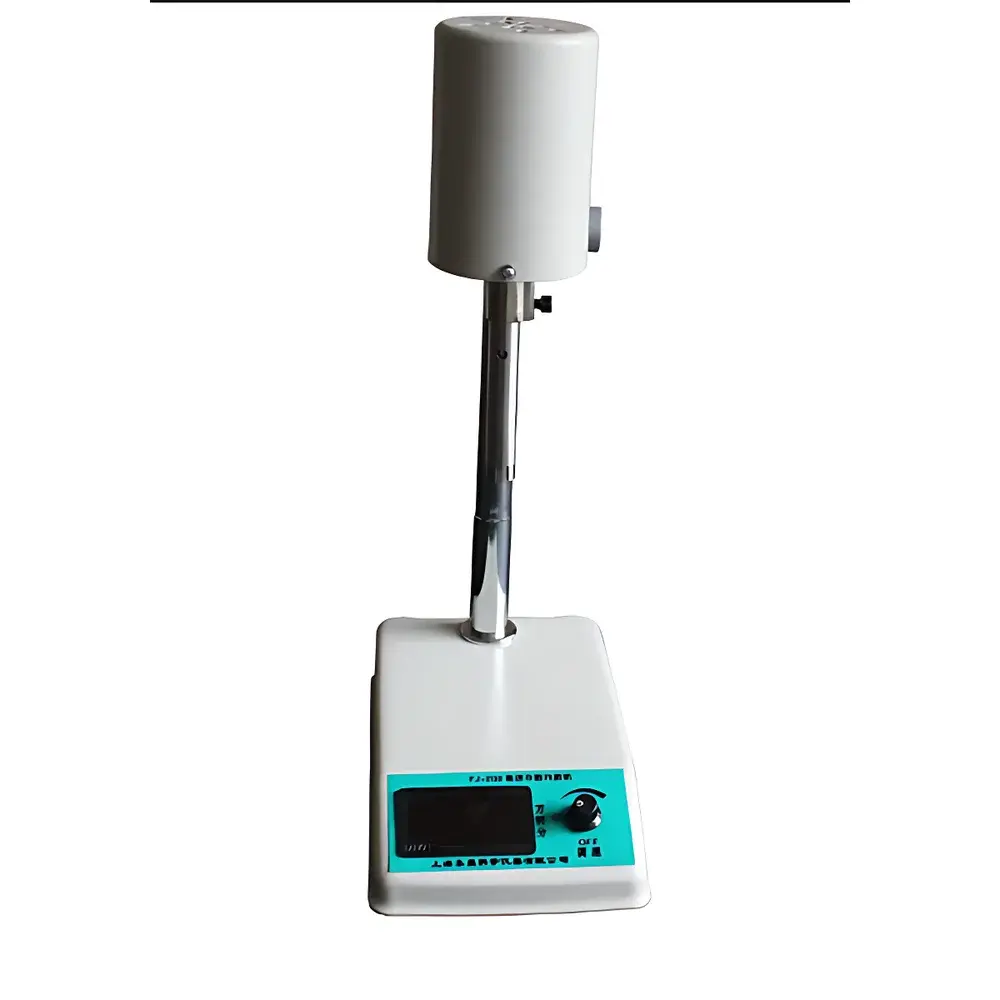
BenAng FJ-200 High-Speed Probe Homogenizer
| Brand | BenAng |
|---|---|
| Origin | Shanghai, China |
| Manufacturer Type | Authorized Distributor |
| Country of Origin | China |
| Model | FJ-200 |
| Instrument Type | Rotating Probe Homogenizer |
| Dimensions (W×D×H) | 230 × 300 × 530 mm |
| Processing Volume Range | 0.2–5000 mL |
| Speed Range | 300–23,000 rpm |
| Input Power | 280 W |
| Output Power | 200 W |
| Chuck Compatibility | Φ12 mm & Φ18 mm |
| Minimum Vessel Diameter | Φ15 mm standard test tube |
| Blade Materials | Premium-grade stainless steel (corrosion- and heat-resistant) |
| Compliance | Designed for GLP-compliant lab environments |
Overview
The BenAng FJ-200 High-Speed Probe Homogenizer is a precision-engineered laboratory instrument designed for rapid mechanical homogenization, dispersion, emulsification, and cell disruption through high-shear rotor-stator interaction. Operating on the principle of controlled hydrodynamic cavitation and intense localized shear stress generation, the FJ-200 delivers reproducible particle size reduction and phase stabilization across diverse sample matrices. Its probe-based architecture enables direct immersion into liquid-phase samples—eliminating cross-contamination risks associated with batch processing—and ensures efficient energy transfer without requiring vacuum or pressurized systems. The unit is optimized for small-to-medium volume applications (0.2–5000 mL), making it especially suitable for R&D-scale preparation of biological lysates, pharmaceutical suspensions, food emulsions, and nanomaterial dispersions. Unlike ultrasonic or bead-beating systems, the FJ-200 achieves consistent results without introducing thermal degradation or metal leaching, provided operational guidelines—including mandatory submersion and adherence to maximum run time limits—are strictly observed.
Key Features
- Variable-speed digital control (300–23,000 rpm) with precise speed regulation and real-time feedback for method reproducibility
- Dual interchangeable stainless-steel probes (Φ10 mm and Φ18 mm) engineered for optimal shear gradient distribution across vessel diameters from Φ15 mm up to 100 mm
- Robust brush-type motor with 200 W effective output power and thermally stable winding design, rated for continuous duty cycles under load
- Ergonomic vertical stand with adjustable height and secure clamping mechanism accommodating conical tubes, beakers, and Erlenmeyer flasks
- Low-noise operation (<65 dB(A) at 1 m distance) achieved via balanced rotor assembly and vibration-dampening base housing
- IP20-rated enclosure compliant with IEC 61000-6-3 for electromagnetic compatibility in shared laboratory infrastructure
Sample Compatibility & Compliance
The FJ-200 supports aqueous, organic, and mixed-phase systems including tissue homogenates, polymer solutions, pigment dispersions, and oil-in-water emulsions. It is not intended for dry grinding or solid-phase comminution. All wetted components—including probe shafts and stator sleeves—are fabricated from AISI 316 stainless steel, ensuring resistance to common solvents (e.g., ethanol, acetone, chloroform) and compatibility with autoclaving (121°C, 20 min) and chemical sterilants (e.g., 0.5% sodium hypochlorite, 70% isopropanol). The device meets essential safety requirements per GB 4793.1–2007 (equivalent to IEC 61010-1:2010) and supports traceable operation within GLP and GMP frameworks when integrated with documented SOPs and maintenance logs. While not inherently 21 CFR Part 11 compliant, its analog control interface permits integration with validated third-party data acquisition systems for audit-ready recordkeeping.
Software & Data Management
The FJ-200 operates via a dedicated analog/digital hybrid controller with tactile rotary encoder and LED display—designed for reliability and minimal firmware dependency. No embedded software or network connectivity is present; all operational parameters are set manually and retained only during active use. For laboratories requiring electronic records, optional external timers and RPM loggers (e.g., LabChart-compatible tachometers) may be deployed in series with the motor supply line. Calibration verification follows ASTM D2196-18 (Standard Test Methods for Rheological Properties of Non-Newtonian Materials) using certified viscosity standards. Routine performance checks include speed accuracy verification (±2% tolerance at full scale), probe concentricity assessment (runout 2 MΩ at 500 V DC).
Applications
- Pre-analytical sample preparation: rapid lysis of animal tissues (e.g., liver, spleen), microbial pellets, and plant material for downstream DNA/RNA extraction or protein quantification
- Pharmaceutical development: formulation of oral suspensions, topical gels, and nanoemulsions meeting USP <1151> and Ph. Eur. 2.9.36 criteria
- Food science research: stabilization of dairy-based beverages, nutraceutical delivery systems, and allergen dispersion studies
- Materials science: exfoliation of graphene oxide dispersions, carbon nanotube suspension, and pigment milling in coating formulations
- Quality control labs: batch-to-batch consistency verification for heterogeneous products such as vaccines, injectables, and functional foods
FAQ
What is the minimum recommended sample volume for reliable homogenization?
For optimal shear transmission and vortex control, a minimum working volume of 0.2 mL in a Φ15 mm tube is specified. Volumes below this threshold risk inadequate probe submersion and inconsistent energy coupling.
Can the FJ-200 be used with corrosive or highly viscous media?
Yes—provided the medium is chemically compatible with AISI 316 stainless steel and does not exceed 5,000 cP at operating temperature. For aggressive acids or halogenated solvents, verify long-term exposure resistance per NACE MR0175/ISO 15156.
How often should carbon brushes be replaced?
Under normal usage (≤2 h/day), inspect brushes every 500 operating hours. Replace when remaining length is ≤6 mm to prevent arcing, torque loss, or commutator pitting.
Is validation support documentation available?
BenAng provides IQ/OQ templates aligned with ISO/IEC 17025 and EU Annex 15 guidelines. Installation qualification includes dimensional verification, electrical safety testing, and speed calibration against NIST-traceable tachometry.
Does the FJ-200 meet FDA requirements for regulated manufacturing?
As a Class I laboratory device, it falls outside FDA device classification but may be employed in FDA-regulated environments when operated per written procedures, maintained per manufacturer specifications, and included in equipment master files per 21 CFR 211.68.



