
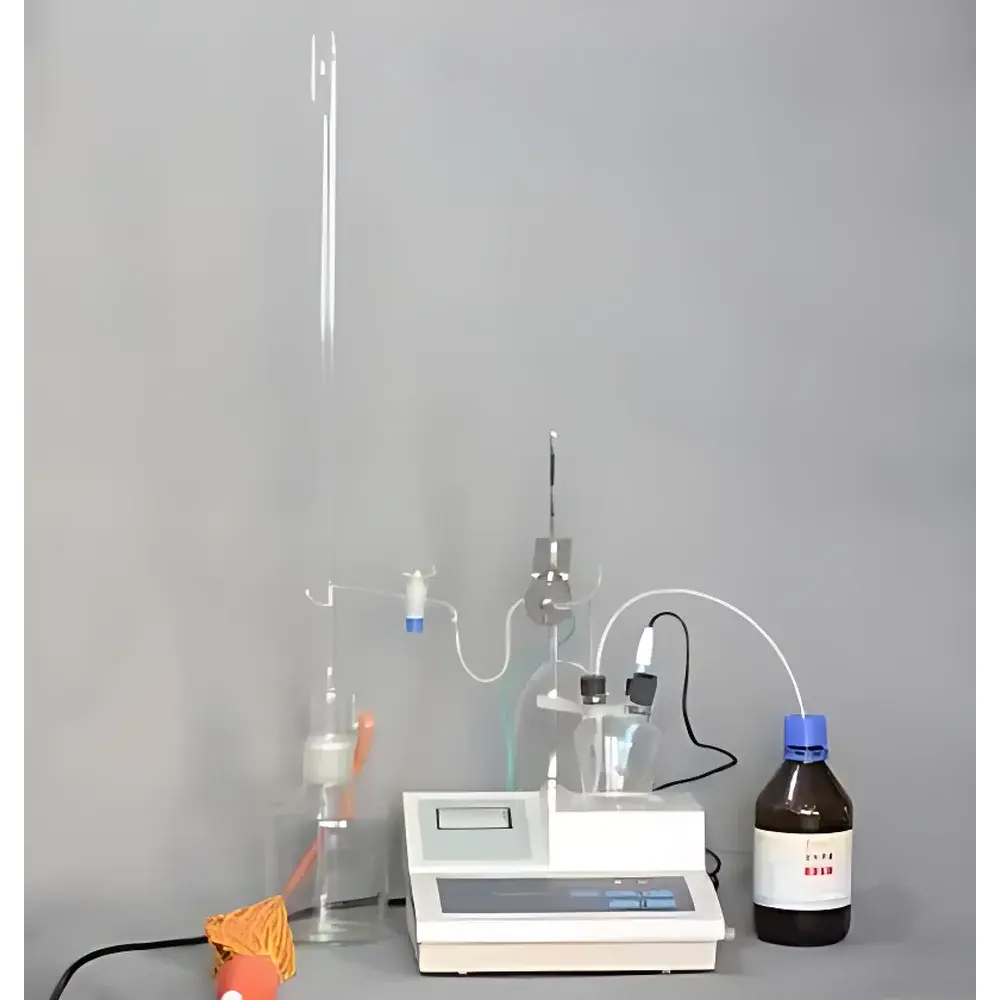
BenAng MA-1B Automatic Volumetric Karl Fischer Moisture Titrator
| Brand | BenAng |
|---|---|
| Origin | Shanghai, China |
| Manufacturer Type | Authorized Distributor |
| Instrument Type | Volumetric Karl Fischer Titrator |
| Moisture Range | 30 ppm to 100% (typical working range: 0.03–90%) |
| Measurement Accuracy | ±0.3% RSD |
| Minimum Dispensing Volume | 0.01 mL |
| Power Supply | AC 220 V ± 10%, 50/60 Hz |
| Compliance | Designed for GLP-compliant environments |
Overview
The BenAng MA-1B Automatic Volumetric Karl Fischer Moisture Titrator is a benchtop analytical instrument engineered for precise, reproducible quantification of water content in solid, liquid, and gaseous samples using the volumetric Karl Fischer (KF) titration principle. Based on the stoichiometric reaction between iodine, sulfur dioxide, methanol, and water—governed by the classic KF chemistry—the MA-1B delivers trace-level moisture determination via controlled reagent delivery and electrochemical endpoint detection. Unlike manual or semi-automated predecessors (e.g., KF-1/KF-1B), the MA-1B integrates real-time current monitoring, automatic titrant dosing, dynamic speed regulation, and endpoint lockout—eliminating operator-dependent variability while maintaining full adherence to internationally recognized wet chemical titration protocols.
Key Features
- Electrochemical Endpoint Detection: Dual-platinum indicator electrodes provide stable, corrosion-resistant sensing in aggressive KF reagents (e.g., pyridine-free or imidazole-based solutions), enabling accurate and repeatable endpoint identification without visual interpretation.
- Automated Titration Control: A high-integrity solenoid valve—constructed from chemically inert imported materials—regulates titrant flow with precision, preventing leakage and supporting both rapid initial titration and fine-dose addition near endpoint.
- Optical Process Monitoring: Borosilicate glass burette (manufactured to German optical-grade specifications) allows direct visual verification of titrant delivery and reaction progress within the sealed titration cell.
- Integrated Safety & Workflow Automation: Built-in waste evacuation system automatically discharges spent reagent and reaction byproducts post-analysis, minimizing user exposure to corrosive or toxic residues and eliminating manual handling risks.
- Intuitive Operation Interface: Analog ammeter provides continuous real-time current signal tracking during titration; simplified front-panel controls enable immediate operation without software training or configuration overhead.
- Endpoint Confirmation Logic: Red LED indicator and audible alert activate simultaneously upon endpoint detection; titration halts automatically with mechanical lockout to prevent over-titration and ensure measurement integrity.
Sample Compatibility & Compliance
The MA-1B accommodates a broad spectrum of sample matrices—including pharmaceutical actives and excipients, organic and inorganic chemicals, petrochemical fractions, agrochemical formulations, food ingredients, cosmetics, and surfactants—provided they are soluble in KF-compatible solvents (e.g., methanol, chloroform, or proprietary anhydrous media). The system operates under ambient conditions and does not require inert gas purging for routine applications. It is designed to support compliance with ASTM E203 (Standard Test Method for Water Using Volumetric Karl Fischer Titration), ISO 8533 (Determination of Water Content—Volumetric Karl Fischer Titration Method), and pharmacopeial guidelines including USP and EP 2.5.2. While the instrument itself does not embed electronic audit trails or user authentication, its operational repeatability and endpoint consistency align with foundational GLP documentation requirements for moisture testing in regulated QC laboratories.
Software & Data Management
The MA-1B operates as a standalone hardware platform without embedded digital data logging or PC connectivity. All measurements are recorded manually or transcribed into laboratory notebooks or LIMS systems via operator input. This architecture prioritizes mechanical reliability and regulatory transparency—avoiding software validation burdens associated with 21 CFR Part 11 compliance—making it suitable for labs where procedural simplicity, low total cost of ownership, and minimal IT infrastructure dependency are primary operational criteria. Calibration verification is performed using certified water standards (e.g., sodium tartrate dihydrate or pure water standards traceable to NIST), and results are reported as mass percent (w/w%), ppm, or absolute µg H₂O per sample—consistent with standard reporting conventions across chemical QA/QC workflows.
Applications
The MA-1B serves as a core moisture verification tool in quality control laboratories across multiple industrial sectors. In pharmaceutical manufacturing, it validates residual moisture in lyophilized products, active pharmaceutical ingredients (APIs), and tablet granulations prior to packaging. In petrochemical and polymer production, it monitors water contamination in solvents, monomers, and catalyst systems—critical for preventing hydrolysis or premature polymerization. In food and beverage R&D, it verifies moisture levels in powdered dairy, spices, and dehydrated fruits to ensure microbial stability and shelf-life compliance. Its robustness and tolerance to moderately complex matrices also make it appropriate for raw material release testing in agrochemical and specialty chemical supply chains.
FAQ
What titration method does the MA-1B employ?
It uses volumetric Karl Fischer titration, relying on standardized iodine-containing reagents and dual-platinum electrode-based endpoint detection.
Is the MA-1B compatible with non-aqueous or viscous samples?
Yes—when dissolved or suspended in appropriate KF-compatible solvents (e.g., methanol, formamide, or specialized anhydrous media); homogenization or heating may be required for viscous or poorly soluble samples.
Does the instrument meet FDA or ISO calibration traceability requirements?
The MA-1B itself is not a calibrated device but a platform requiring periodic verification using NIST-traceable water standards; users must establish and document their own calibration procedures per internal SOPs.
Can the MA-1B be integrated into a networked LIMS environment?
No—it lacks digital output interfaces (RS-232, USB, or Ethernet); data entry is manual or via external transcription.
What maintenance is required for long-term accuracy?
Routine cleaning of the titration vessel and electrodes, periodic replacement of the solenoid valve seal, and verification with certified water standards every 10–20 analyses or per shift, whichever occurs first.





