
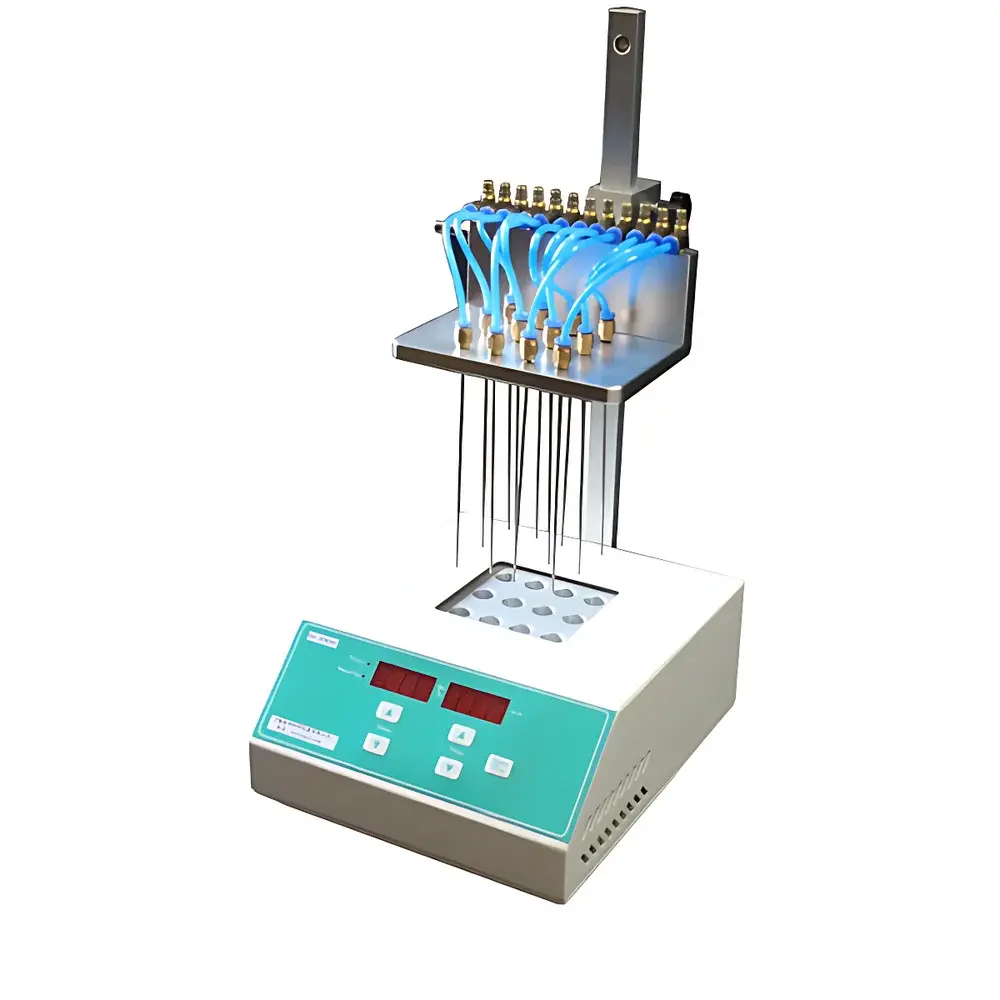
BenAng NBI-12D Dry-Block Nitrogen Evaporator
| Brand | BenAng |
|---|---|
| Origin | Shanghai, China |
| Model | NBI-12D |
| Heating Method | Dry-block heating |
| Temperature Range | Ambient +5°C to 150°C |
| Temperature Stability | ±0.1°C |
| Sample Capacity | 12 positions |
| Tube Diameter Compatibility | 10–29 mm |
| Gas Flow Rate | 0–5 L/min (max 15 L/min at ≤16 needles) |
| Max Gas Pressure | 0.02 MPa |
| Heating Power | 350 W |
| Timer Range | 0–99 h 59 min |
| Temperature Uniformity | ≤±0.5°C at 100°C |
| Ramp Time (40–150°C) | ≤30 min |
| Vertical Travel | 200 mm |
| Display | Dual digital LED (setpoint & actual temperature, four-digit resolution) |
| Dimensions (W×D×H) | 280 × 240 × 500 mm |
| Weight | 7 kg |
Overview
The BenAng NBI-12D Dry-Block Nitrogen Evaporator is an engineered solution for controlled, inert-gas-assisted solvent removal in analytical sample preparation workflows. It operates on the principle of gentle nitrogen gas stream impingement onto the surface of heated liquid samples—accelerating solvent evaporation while minimizing thermal degradation, oxidation, or analyte loss. Designed for compatibility with HPLC, GC, GC-MS, LC-MS, and immunoassay sample cleanup protocols, the NBI-12D employs a precision-machined aluminum dry-block heating module that ensures rapid thermal response and spatial uniformity across all 12 sample positions. Unlike water bath evaporators, its dry-block architecture eliminates contamination risk from bath fluid, supports operation above 100°C without boiling constraints, and enables stable setpoint control within ±0.1°C under steady-state conditions—critical for thermally labile compounds such as steroids, pesticides, pharmaceutical metabolites, and environmental contaminants.
Key Features
- Dry-block heating system with high-thermal-conductivity aluminum alloy block, delivering fast ramp-up (<30 min from 40°C to 150°C) and exceptional temperature repeatability (≤±0.5°C uniformity at 100°C).
- Independent, height-adjustable nitrogen delivery needles (200 mm vertical travel) with individual gas flow control per position—preventing cross-contamination and enabling heterogeneous sample sets.
- Dual four-digit LED display showing both user-defined setpoint and real-time measured temperature simultaneously—enhancing operator verification and GLP-compliant documentation.
- Integrated spill containment tray beneath the heating block captures accidental liquid overflow, protecting internal electronics and ensuring operational continuity during extended unattended runs.
- Programmable digital timer (0–99 h 59 min) with auto-shutdown function, supporting overnight or multi-shift evaporation protocols without manual intervention.
- Robust mechanical design rated for continuous operation at elevated temperatures (up to 150°C), validated for >10,000 hours of service life under routine laboratory use.
Sample Compatibility & Compliance
The NBI-12D accommodates standard borosilicate glass test tubes, culture tubes, and conical-bottom vials with outer diameters ranging from 10 mm to 29 mm—covering common formats used in EPA Method 525.3 (drinking water), ASTM D7066 (petroleum hydrocarbons), and USP residual solvents testing. Its inert nitrogen environment complies with ISO/IEC 17025 requirements for contamination-controlled sample handling. While not certified to IEC 61010-1 as a standalone safety-certified instrument, the unit incorporates a 250 V / 3 A fuse (Φ5×20 mm) and conforms to Class I electrical safety principles. For regulated environments, users may integrate the device into validated workflows under FDA 21 CFR Part 11-compliant LIMS or ELN systems via external logging of timer and temperature settings.
Software & Data Management
The NBI-12D operates as a stand-alone benchtop instrument with no embedded firmware or proprietary software interface. All parameter inputs—including temperature setpoint, timer duration, and gas flow adjustment—are performed manually via front-panel controls. This architecture eliminates cybersecurity vulnerabilities associated with networked instruments and simplifies IQ/OQ validation by reducing software dependencies. Temperature and time data are visually recorded via dual LED displays; for audit-trail compliance, laboratories typically pair the unit with calibrated external data loggers (e.g., Omega OM-DAQPRO-5300) or integrate it into electronic lab notebooks where operator entries document start/end times, batch IDs, and observed endpoint conditions.
Applications
- Routine concentration of extracts prior to GC-FID or GC-MS analysis in environmental monitoring (e.g., PAHs in soil leachates, organochlorine pesticides in wastewater).
- Preparative cleanup of biological matrices—including plasma, urine, and tissue homogenates—for clinical toxicology screening using LC-MS/MS.
- Removal of volatile organic solvents (e.g., hexane, dichloromethane, ethyl acetate) after solid-phase extraction (SPE) or QuEChERS sample preparation.
- Controlled drying of standards and reference materials during calibration curve preparation under inert atmosphere.
- Parallel evaporation of up to 12 samples in method development studies requiring consistent thermal history and minimal inter-sample variance.
FAQ
Is the NBI-12D compatible with corrosive solvents such as concentrated HCl or TFA?
No. The aluminum heating block and stainless-steel gas manifolds are not resistant to strong acids or halogenated solvents at elevated temperatures. Use only with compatible solvents per manufacturer’s chemical resistance guidelines.
Can the unit be operated inside a fume hood?
Yes—its compact footprint (280 × 240 × 500 mm) and low power draw (350 W) make it suitable for fume hood installation. Ensure adequate clearance around ventilation slots and confirm hood face velocity remains ≥0.5 m/s during operation.
Does the NBI-12D support external temperature probe input for independent verification?
No. It relies solely on integrated PT100-class sensors embedded in the block. For metrological traceability, users should perform periodic calibration using NIST-traceable handheld probes inserted into designated calibration wells.
What maintenance is required to sustain long-term accuracy?
Annual cleaning of gas pathways with compressed air and visual inspection of needle tips for clogging or deformation. Replace O-rings every 2 years if used continuously at >120°C.
Is the device suitable for GMP-regulated QC laboratories?
Yes—as a Class II ancillary equipment item, provided it is included in the laboratory’s equipment qualification protocol (IQ/OQ/PQ), maintained per SOPs, and operated within documented environmental and procedural controls.



