
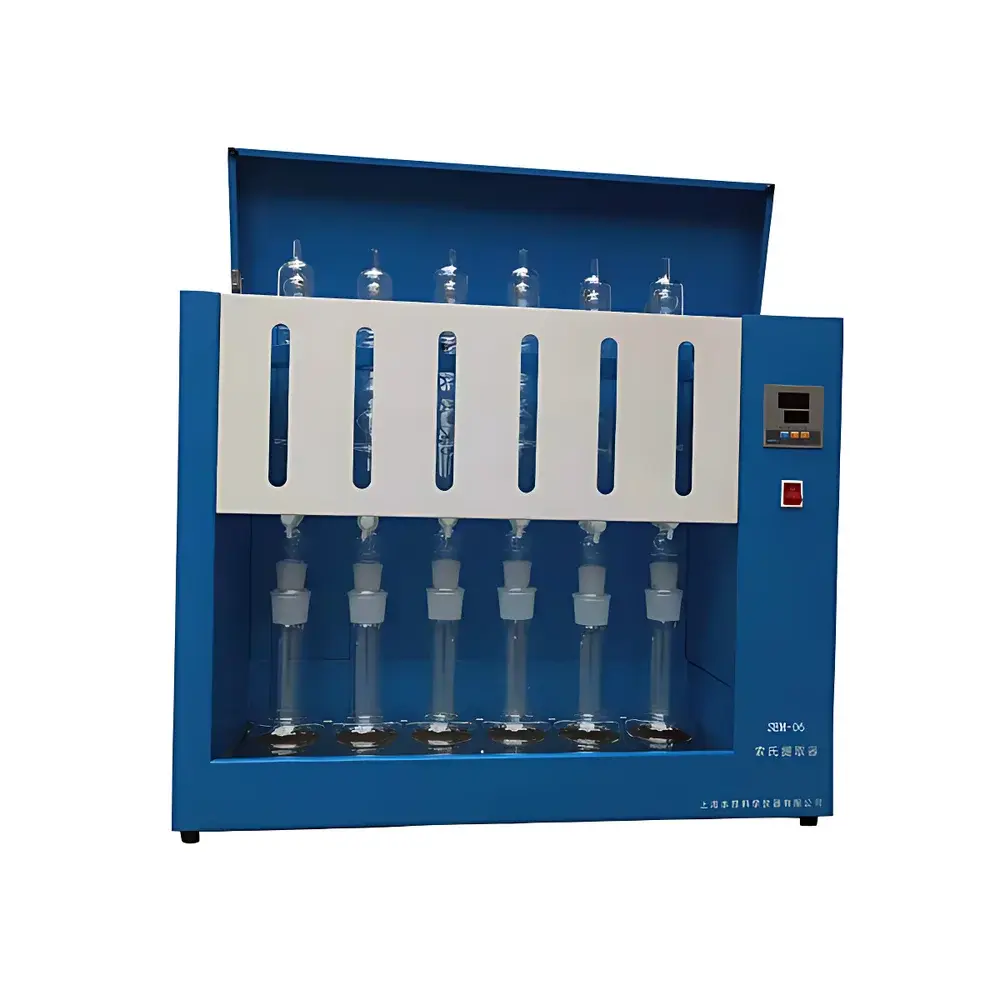
BenAng SEM-06 Six-Channel Soxhlet Extractor
| Brand | BenAng |
|---|---|
| Origin | Shanghai, China |
| Model | SEM-06 |
| Extraction Chamber Volume | 30 mL |
| Receiving Flask Volume | 100 mL |
| Temperature Range | Ambient +5°C to 100°C |
| Temperature Control Accuracy | ±1°C |
| Number of Channels | 6 |
| Power Supply | 220 V ±10 V, 50 Hz |
| Heating Power | 800 W |
| Dimensions (W×D×H) | 740 × 230 × 650 mm |
| Net Weight | 23 kg |
Overview
The BenAng SEM-06 Six-Channel Soxhlet Extractor is a benchtop laboratory instrument engineered for automated, parallel solvent extraction based on the classical Soxhlet principle. It operates via continuous cyclic percolation of refluxing solvent through solid samples contained in thimbles, enabling exhaustive lipid or semi-volatile organic compound (SVOC) recovery with high reproducibility. Designed for compliance with standardized gravimetric and chromatographic workflows, the SEM-06 supports method-defined protocols including GB 5512–1985 (Crude Fat Determination in Cereals and Oilseeds) and HJ 834–2017 (Determination of Semi-Volatile Organic Compounds in Soil and Sediment by GC-MS), where controlled solvent reflux, precise temperature regulation, and consistent extraction kinetics are critical. Its modular architecture integrates heating, condensation, and solvent recovery into a single compact unit—eliminating manual solvent handling while maintaining full traceability of extraction conditions.
Key Features
- Six independent extraction channels with synchronized yet individually controllable heating zones, enabling parallel processing of up to six samples without cross-contamination.
- Precision thermostatic control (±1°C) across a wide operating range (ambient +5°C to 100°C), optimized for common solvents including petroleum ether (bp ≈ 40–60°C), diethyl ether (bp ≈ 35°C), and chloroform (bp ≈ 61°C).
- Integrated solvent recovery system with air-cooled condenser and drip-return design, minimizing solvent loss and reducing exposure risk during extended extractions.
- Dedicated extraction thimbles with 30 mL chamber volume and compatible receiving flasks (100 mL standard; optional 120/150/450 mL configurations available), supporting sample masses from 0.5 g to 30 g—including ≥10 g wool specimens per channel per GB/T 10685–2007 requirements.
- Programmable extraction timer with audible end-of-cycle alarm, facilitating unattended operation while ensuring adherence to method-specified durations.
- Robust stainless-steel and borosilicate glass construction, compliant with GLP laboratory infrastructure standards and suitable for installation in fume hoods or dedicated extraction suites.
Sample Compatibility & Compliance
The SEM-06 accommodates heterogeneous solid matrices requiring fat or SVOC quantification, including cereals, oilseeds, animal feed, soil, sediment, and natural fibers such as wool. Its validated performance meets the physical and operational criteria outlined in national and environmental standards: GB 5512–1985 (crude fat), HJ 834–2017 (soil SVOC pre-concentration), and GB/T 10685–2007 (wool grease content). While not inherently 21 CFR Part 11-compliant (as it lacks electronic audit trail functionality), its mechanical repeatability and documented calibration procedures support integration into GMP/GLP environments when paired with paper-based SOPs and manual logbooks. All glass components conform to ISO 3585 specifications for laboratory-grade borosilicate glass.
Software & Data Management
The SEM-06 is a hardware-only platform with no embedded microprocessor or digital interface. Temperature setpoints and extraction duration are configured manually via analog dials and mechanical timers. As such, it does not generate electronic records, nor does it require software installation or firmware updates. This design prioritizes operational simplicity, long-term reliability, and compatibility with regulated environments where deterministic, non-programmable instrumentation is preferred for critical extraction steps. Users maintain full procedural control through standardized lab notebooks, handwritten calibration logs, and periodic verification against NIST-traceable thermometers.
Applications
- Quantitative determination of crude fat in agricultural commodities per AOAC Official Method 920.39 and ISO 659:2020.
- Preparative isolation of lipids from wool scours for subsequent gas chromatographic analysis of lanolin composition.
- Extraction of polycyclic aromatic hydrocarbons (PAHs), organochlorine pesticides, and phthalate esters from environmental soil and sediment samples prior to GC-MS analysis per EPA Method 3541 and HJ 834–2017.
- Routine quality control testing in feed mills and edible oil refineries, where batch-to-batch consistency of fat content directly impacts nutritional labeling and process yield.
- Method development and validation studies requiring orthogonal confirmation of automated extraction systems (e.g., ASE or ultrasonic-assisted extraction) using classical Soxhlet as a reference technique.
FAQ
Is the SEM-06 compatible with halogenated solvents such as chloroform or dichloromethane?
Yes—the condenser and flask assembly are constructed from borosilicate glass and PTFE-sealed joints, making them chemically resistant to most common organic solvents, including chlorinated compounds. Always verify solvent compatibility with local safety protocols before use.
Can I use different flask sizes simultaneously across the six channels?
No—while optional flask volumes (120 mL, 150 mL, 450 mL) are available, all six channels must use identical receiving flask geometry to ensure uniform condensate return dynamics and avoid channel imbalance.
Does the instrument include temperature calibration documentation?
Each unit ships with a factory calibration certificate referencing ambient temperature and mid-range setpoint verification (e.g., 60°C), performed using a NIST-traceable digital thermometer. Users are advised to conduct periodic in-house verification per internal QA procedures.
What maintenance is required to sustain optimal performance?
Routine cleaning of glassware after each use, inspection of condenser tubing for mineral deposits, and annual verification of heater element resistance and thermostat response time are recommended. No consumable parts require scheduled replacement under normal operating conditions.



