
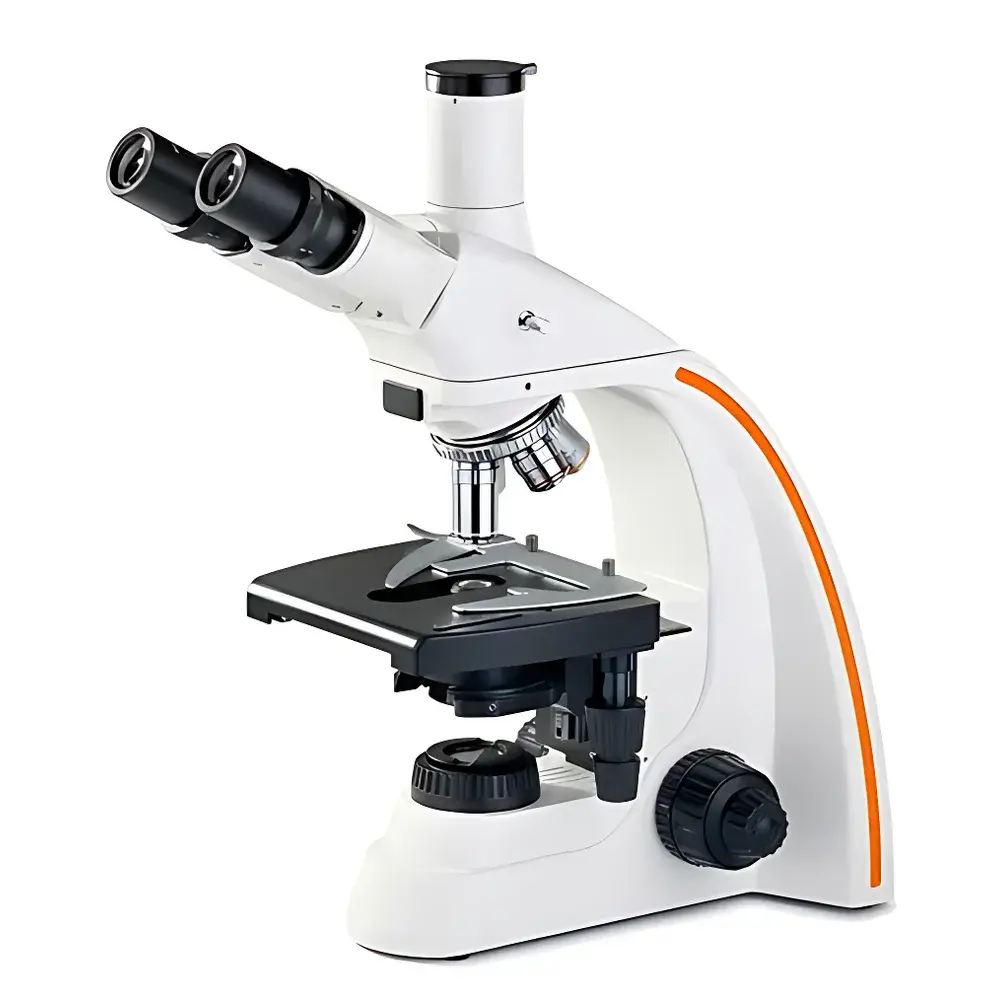
Betop Scientific L2800 Biological Upright Microscope
| Brand | Betop Scientific |
|---|---|
| Origin | Guangdong, China |
| Manufacturer Type | Direct Manufacturer |
| Country of Origin | China |
| Model | L2800 |
| Price Range | USD 700 – 1,400 (FOB) |
| Instrument Type | Upright Microscope |
| Eyepiece Configuration | Trinocular |
| Optical Design | Infinity-Corrected Plan Achromatic Objective System |
| Standard Illumination | 6V 20W Halogen |
| Optional Illumination | High-Power Adjustable White LED |
| Stage Type | Dual-Layer Mechanical Stage |
| Condenser | Abbe Condenser NA 1.25 with Vertical Adjustment |
| Eyepiece Inclination | 30° |
| Interpupillary Distance Adjustment | Yes |
| Focusing Mechanism | Coaxial Coarse/Fine Focus with 2 µm Fine Focus Graduation |
| Objective Turret | Internal-Style 4-Position Ball-Bearing Nosepiece |
| Maximum Magnification (Standard) | 1000× (with 100× oil immersion objective) |
| Compliance | Designed to meet ISO 8579-1:2020 (Microscopy — Nomenclature and Performance Requirements for Light Microscopes), GLP-ready configuration support |
Overview
The Betop Scientific L2800 is an upright biological microscope engineered for precision routine observation and educational research in life science laboratories. Built on an infinity-corrected optical architecture, it integrates plan achromatic objectives and wide-field eyepieces to deliver high-fidelity, low-distortion monochrome imaging across the visible spectrum (400–700 nm). Its optical path supports both direct visual inspection and simultaneous digital acquisition via trinocular port—enabling seamless integration into teaching labs, clinical histology workflows, and basic cell biology studies. The system adheres to fundamental design principles outlined in ISO 8579-1:2020 for light microscopy performance validation, including resolution verification, field flatness assessment, and chromatic aberration control. With a mechanical stage offering 75 mm × 50 mm travel range and sub-micron repeatability in fine focusing (2 µm graduation), the L2800 provides stable, reproducible positioning essential for serial section analysis and time-lapse documentation.
Key Features
- Infinity-corrected plan achromatic objective set (4×/0.10, 10×/0.25, 40×/0.65 spring-loaded, 100×/1.25 oil immersion) optimized for consistent flat-field illumination and minimal spherical aberration.
- Trinocular observation tube with 30° inclination, adjustable interpupillary distance (55–75 mm), and dual-path beam splitter enabling 100% light transmission to camera during photomicrography.
- Dual-layer mechanical stage with coaxial gear-and-steel-cable drive mechanism—ensuring smooth, backlash-free XY translation while fully enclosing transmission components for operator safety and dust resistance.
- Abbe condenser (NA 1.25) with vertical height adjustment and integrated blue filter + ground glass diffuser for Köhler illumination setup; compatible with optional phase contrast and polarizing accessories.
- Ergonomic low-position coaxial focus controls with tension adjustment, coarse/fine focus lock, and upper/lower limit stops to prevent objective collision and ensure repeatable Z-axis positioning.
- Integrated rear-handling grip and internalized nosepiece design reduce mechanical stress during relocation and improve long-term alignment stability.
Sample Compatibility & Compliance
The L2800 accommodates standard 1″ × 3″ (25 × 75 mm) glass slides and circular cover slips (18–22 mm diameter), supporting both fixed and live specimens—including stained tissue sections, unstained bacterial smears, suspended algal cultures, and explanted organotypic slices. Its halogen or optional high-CRI white LED illumination ensures uniform brightness across magnifications without spectral shift. For regulated environments, the instrument’s mechanical consistency and calibration traceability support GLP-compliant documentation protocols. While not certified under FDA 21 CFR Part 11, its modular architecture allows integration with third-party audit-trail-capable imaging software (e.g., NIS-Elements, CellSens) meeting ISO/IEC 17025 and GMP Annex 11 requirements when deployed in QC/QA settings.
Software & Data Management
The L2800 interfaces natively with USB 2.0/3.0 digital cameras (1.3 MP to 9 MP resolution) and analog CCTV systems (380–520 TV lines) via standardized C-mount or proprietary 0.4×/0.5×/1.0× reduction adapters. Optional Canon EF and Nikon F-mount adapters enable DSLR coupling for publication-grade macrophotography. Image capture, annotation, measurement (length, area, angle), and multi-focus stacking are supported through vendor-neutral SDKs compatible with Windows-based acquisition platforms. Metadata embedding (objective ID, magnification, exposure time, date/time stamp) follows EXIF 2.3 standards, facilitating DICOM-SR and LabArchives-compatible export workflows.
Applications
- Teaching laboratories: Routine examination of plant anatomy, animal histology slides, and microbiological preparations in undergraduate biology curricula.
- Clinical diagnostics support: Morphological assessment of peripheral blood smears, urine sediments, and Gram-stained isolates in resource-constrained settings.
- Cell culture monitoring: Observation of adherent monolayers, spheroid formation, and transfection efficiency without requiring inverted configuration.
- Agricultural pathology: Identification of fungal hyphae, nematode morphology, and seed viability assays using transmitted brightfield and optional phase contrast.
- Industrial QA: Inspection of biofilm formation on medical device surfaces and particulate contamination in sterile packaging environments.
FAQ
Is the L2800 suitable for oil immersion work?
Yes—the 100×/1.25 NA objective is spring-loaded and designed for use with Type A immersion oil (nD = 1.515), achieving theoretical resolution down to ~0.35 µm at 550 nm wavelength.
Can I upgrade to phase contrast without replacing the base unit?
Yes—optional phase contrast kits include centering telescopes, phase annuli for the condenser, and matched phase objectives (10×, 20×, 40×, 100×), all mechanically compatible with the existing nosepiece and condenser turret.
What power supply options are available for international deployment?
The standard 6V/20W halogen lamp operates via external 100–240 VAC auto-ranging power adapter (IEC 60320 C7); LED illumination modules support universal input and include PWM dimming circuitry compliant with IEC 61000-3-2 Class C harmonic limits.
Does the microscope meet CE or UKCA marking requirements?
As supplied, the L2800 complies with EN 61000-6-3 (EMC emission) and EN 61000-6-2 (immunity) for laboratory equipment; CE marking requires end-user responsibility for full conformity assessment under Directive 2014/30/EU and 2014/35/EU.
How is maintenance and calibration performed?
Routine maintenance includes dust removal from optical surfaces using lens-grade air blower and solvent-free microfiber cloths; annual verification of stage linearity, focus scale accuracy, and condenser centering is recommended per ISO 8579-2:2020 guidelines.
Related Products




