
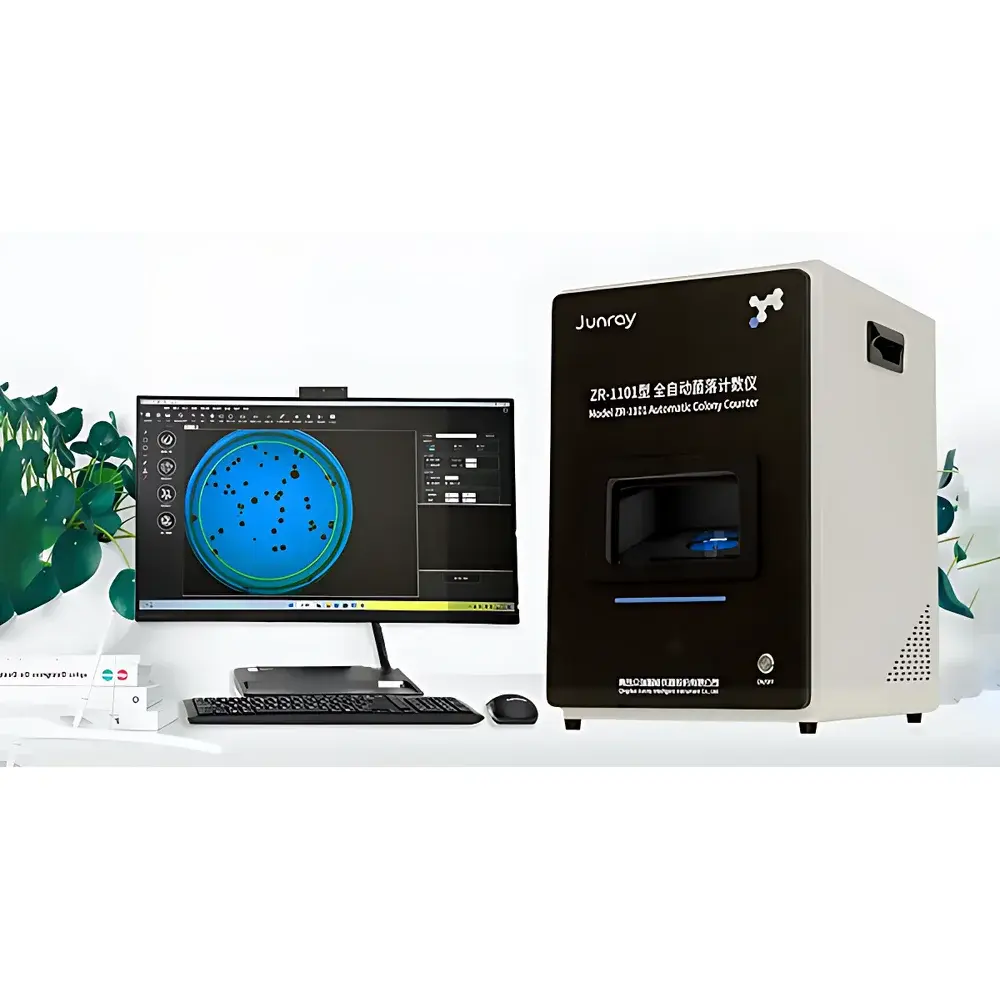
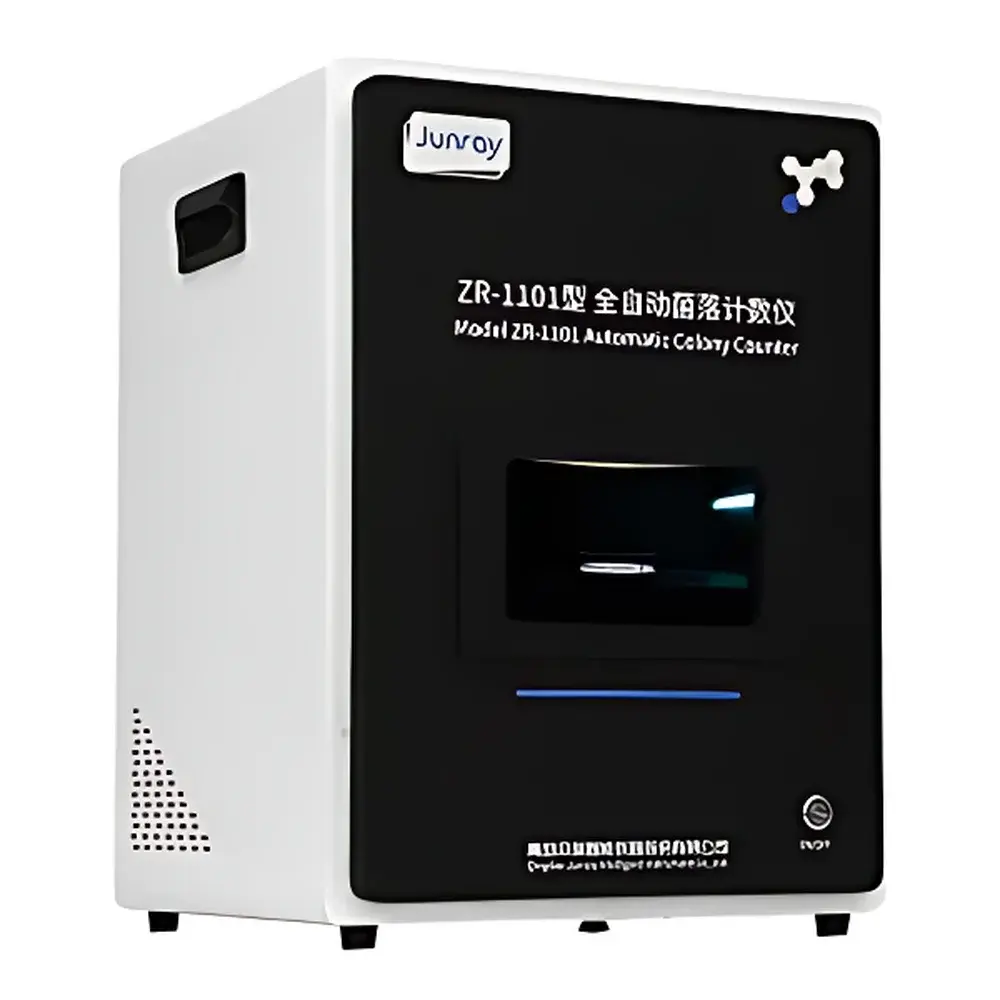
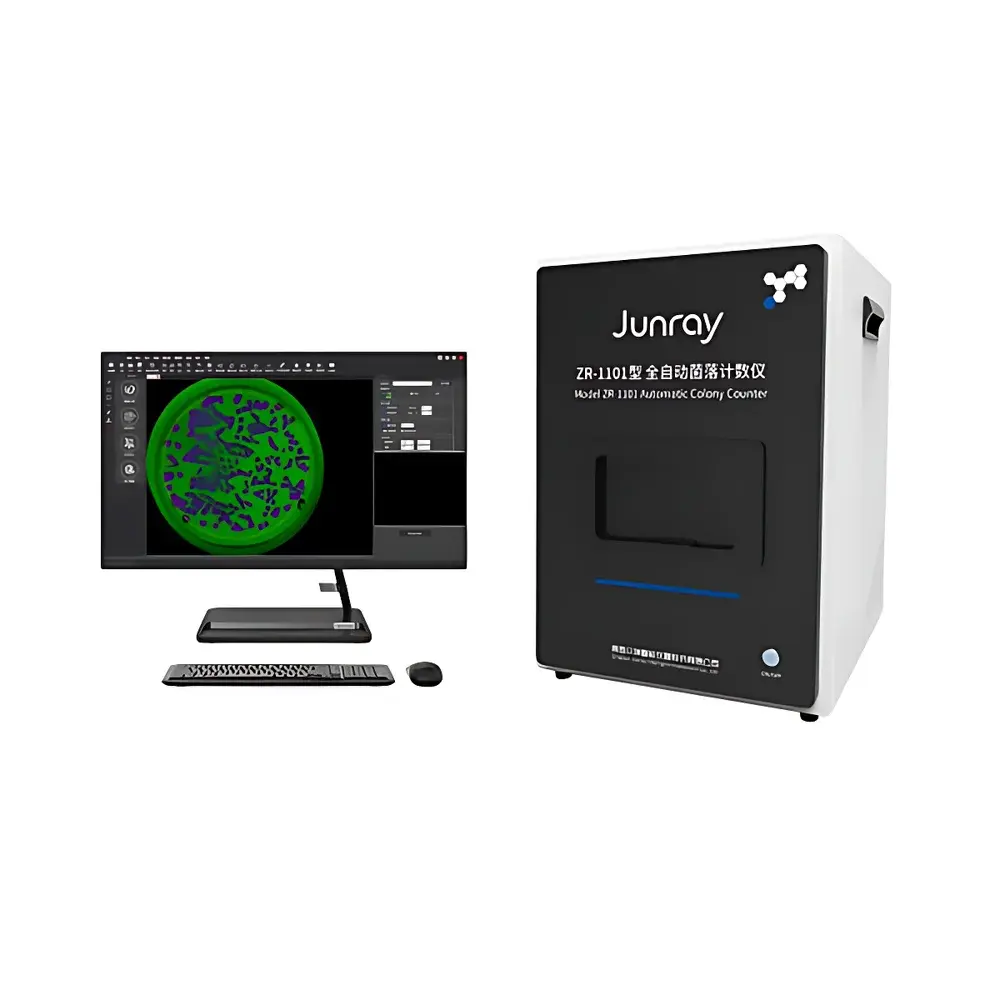
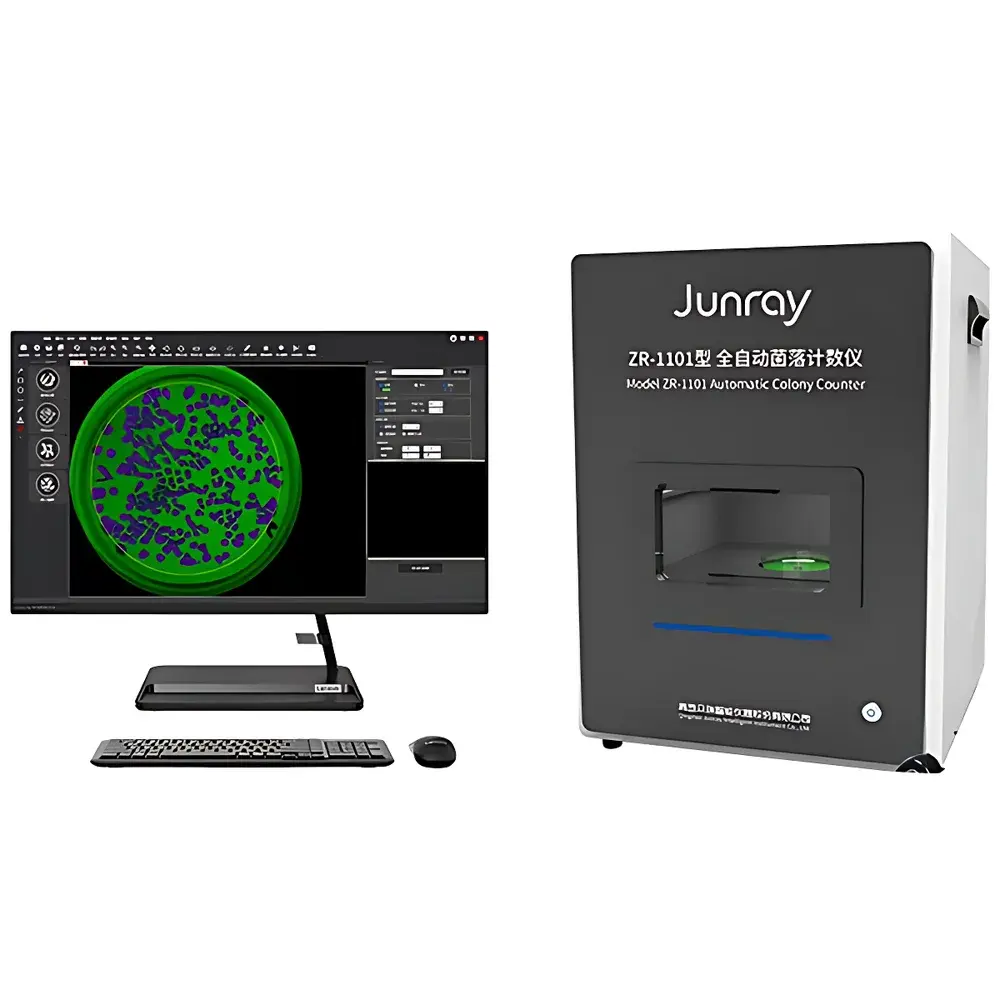
Junray ZR-1101 Fully Automated Colony Counter
| Brand | Junray |
|---|---|
| Origin | Shandong, China |
| Manufacturer Type | Direct Manufacturer |
| Instrument Type | Fully Automated Colony Counter |
| Sample Type | Solid Culture Media |
| Sample Capacity | 1 Petri Dish per Imaging Cycle |
| Counting Speed | 1,000 Colonies per Second |
| Counting Accuracy | ≥98% |
| Imaging Sensor | 12-Megapixel CMOS |
| Core Functions | Colony Counting, Inhibition Zone Measurement, Antibiotic Potency Analysis, Spiral Plate Counting |
| UV Light Sources | 254 nm (sterilization) and 365 nm (fluorescence excitation) |
| Compliance | FDA 21 CFR Part 11 Audit Trail, GLP/GMP Data Integrity Support |
| Included | Dedicated Image Processing Workstation |
Overview
The Junray ZR-1101 Fully Automated Colony Counter is a dedicated digital imaging system engineered for high-throughput, objective, and reproducible microbial colony enumeration on solid agar media. It operates on the principle of high-resolution digital image acquisition followed by algorithm-driven morphological segmentation and classification—leveraging advanced computer vision techniques rooted in grayscale thresholding, edge detection, watershed segmentation, and machine learning–enhanced pattern recognition. Unlike manual or semi-automated counters, the ZR-1101 eliminates inter-operator variability and subjective interpretation by standardizing detection criteria across all colony types—including irregular, confluent, faint, or pigmented colonies—and supports regulatory-compliant documentation workflows required in pharmaceutical QC, clinical microbiology, and food safety laboratories.
Key Features
- High-fidelity imaging architecture: Integrated 12-megapixel industrial-grade CMOS sensor with auto-calibration capability ensures pixel-to-millimeter mapping accuracy; real-time optical calibration compensates for lens distortion and working distance variation.
- Tri-modal illumination system: Top-mounted 360° ring LED provides shadow-free reflected-light imaging; bottom-transmitted dark-field illumination enhances contrast for translucent or low-pigment colonies; side-mounted matrix LEDs enable optical staining via controlled angular illumination—improving differentiation between colonies and agar background.
- Intelligent segmentation engine: Combines adaptive thresholding, multi-scale blob analysis, and iterative watershed splitting to resolve clustered, overlapping, or filamentous colonies; includes manual correction tools with region-of-interest (ROI) masking and undo/redo functionality for traceable editing.
- Dual-wavelength UV module: Built-in 254 nm germicidal lamp sterilizes internal chamber surfaces between runs; 365 nm UV source enables fluorescence-based colony detection—compatible with GFP-expressing strains, coliform-selective media (e.g., Chromocult®), and antibiotic resistance screening assays.
- FDA 21 CFR Part 11–compliant software: Enforces user authentication, electronic signatures, immutable audit trails, and automatic timestamped logging of all actions—including image acquisition, parameter changes, manual edits, and report generation.
Sample Compatibility & Compliance
The ZR-1101 accepts standard 90 mm and 100 mm Petri dishes (including vented, gridded, and spiral-plated variants) and accommodates both conventional and chromogenic agars (e.g., TSA, PCA, VRBA, MAC, CHROMagar™). It complies with ISO 4833-1:2013 (microbiology of food and animal feeding stuffs—horizontal method for enumeration of microorganisms), ASTM E2925-22 (standard practice for digital imaging of microbial colonies), and USP / microbiological examination requirements. All data handling adheres to ALCOA+ principles (Attributable, Legible, Contemporaneous, Original, Accurate, Complete, Consistent, Enduring, Available), supporting GLP and GMP validation protocols.
Software & Data Management
The proprietary ZR-Count™ software provides an intuitive Windows-based interface with multilingual support (English, Spanish, French, Chinese). It enables batch processing of up to 99 plates per session, customizable counting templates (e.g., aerobic vs. anaerobic, selective vs. non-selective media), and configurable pass/fail thresholds based on regulatory limits. Quantitative outputs include colony count, diameter distribution (µm), circularity index, perimeter (mm), area (mm²), and inhibition zone diameter (mm) with confidence intervals. Export formats include CSV, Excel (.xlsx), PDF reports with embedded images and metadata, and direct LIMS integration via HL7 or ASTM E1384-compliant interfaces.
Applications
- Pharmaceutical microbiology: Sterility testing, environmental monitoring (ISO 14644-1 Grade A–D), media fill simulations, and bioburden assessment per ICH Q5C and EU Annex 1.
- Clinical diagnostics: Rapid quantification of urinary tract pathogens, wound swab isolates, and blood culture subcultures—supporting CLSI M07 and M45 standards.
- Food & beverage safety: Total viable count (TVC), Enterobacteriaceae, coliforms, yeasts/molds per ISO 21528-2, ISO 6887, and FDA BAM Chapter 3.
- Academic research: High-content screening of mutagenesis libraries, CRISPR-Cas9 clone validation, and antibiotic synergy studies using double-disk diffusion or E-test methods.
FAQ
Does the ZR-1101 support spiral plate counting according to ISO 7218 and FDA BAM guidelines?
Yes—the instrument includes a dedicated spiral counting module calibrated for common spiral platers (e.g., WASP, Spiral Biotech) and automatically applies dilution factor correction based on user-defined plating parameters.
Can the system validate colony morphology classification (e.g., distinguishing Staphylococcus aureus from coagulase-negative staphylococci)?
While the ZR-1101 does not perform species-level identification, it supports morphotype tagging and statistical clustering of size, shape, and color features—enabling correlation with downstream MALDI-TOF or PCR results.
Is remote access or network deployment supported?
The workstation supports domain authentication and can be deployed in client-server mode for centralized database management; remote desktop access is permitted under IT-administered security policies.
What maintenance is required for long-term optical performance?
Annual recalibration of the imaging subsystem and UV intensity verification are recommended; the CMOS sensor and LED arrays are rated for >50,000 operating hours with no consumables required.
How is data integrity ensured during power failure or software crash?
All operations are transaction-logged in real time; unsaved image buffers are retained in RAM-backed cache, and interrupted sessions resume from last stable checkpoint upon restart.
Related Products




