
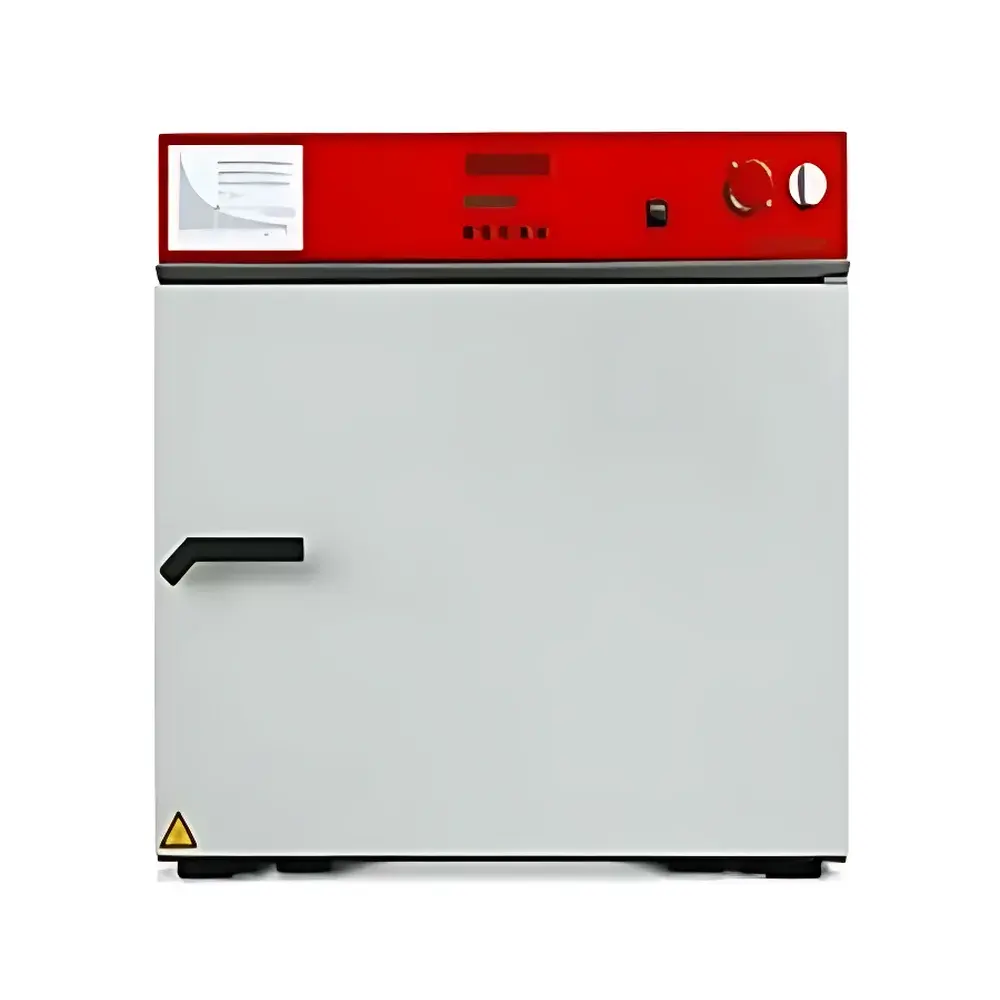
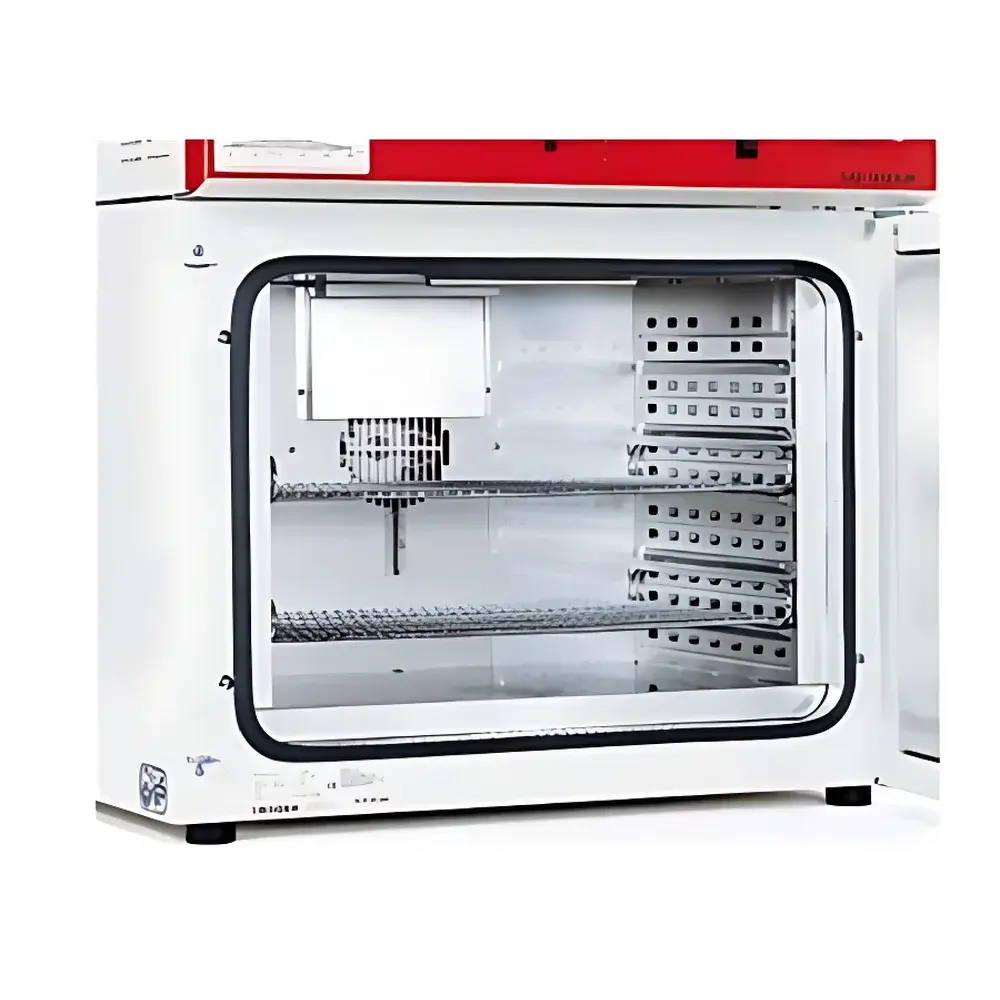
BINDER FDL Series Safety Drying Oven
| Brand | BINDER |
|---|---|
| Origin | Germany |
| Model | FDL |
| Instrument Type | High-Temperature Safety Drying Oven |
| Temperature Range | 10 °C above ambient to 300 °C |
| Temperature Uniformity (at 150 °C) | ±2.5 K |
| Temperature Fluctuation | ±0.8 K |
| External Dimensions | 830 mm × 805 mm × 685 mm |
| Internal Volume | 115 L |
| Internal Chamber Material | Stainless Steel (Si-free, dust-free) |
| Fresh Air Filtration | Replaceable M6-class filter |
| Door Seal | FKM (standard, ≤200 °C) or Silicone (optional, ≤300 °C) |
| Safety Compliance | DIN EN 1539:2010-08, DIN 12880 Class 2 |
| Controller | Programmable with interval & real-time scheduling |
| Interface | RS422 |
| Alarm System | Acoustic & optical fresh-air monitoring + automatic heating cutoff |
| Insulation Thickness | 60 mm |
| Shelf Capacity | 2 standard chrome-plated shelves (max. 30 kg each), up to 5 optional |
| Recovery Time (150 °C, 30 s door open) | 12 min |
| Heating Time to 150 °C | 20 min |
| Rated Power (230 V) | 2.9 kW |
| Net Weight (empty) | 90 kg |
| Max. Load Capacity | 60 kg |
Overview
The BINDER FDL Series Safety Drying Oven is an engineered solution for thermally stable, solvent-compatible drying and conditioning of samples in regulated laboratory and industrial quality control environments. Designed in accordance with DIN EN 1539:2010-08 — the European standard governing safety requirements for ovens used with flammable substances — the FDL series integrates controlled ventilation, explosion-safe airflow architecture, and certified thermal management to mitigate risks associated with volatile organic solvents. Its core operating principle relies on a symmetric, high-flow air circulation system paired with an M6-class replaceable fresh-air filter and electronic fresh-air monitoring. This ensures continuous dilution of solvent vapors while maintaining precise temperature homogeneity across the entire working chamber. The patented APT.line® preheating chamber technology eliminates thermal gradients by pre-conditioning incoming air before it enters the main chamber, delivering uniform temperature distribution (±2.5 K at 150 °C) independent of sample load, position, or geometry. With a temperature range from 10 °C above ambient to 300 °C and a documented fluctuation of only ±0.8 K, the FDL oven supports applications demanding both safety integrity and metrological rigor.
Key Features
- Compliance with DIN EN 1539:2010-08 for safe operation with flammable solvents
- APT.line® preheating chamber technology ensuring uniform temperature distribution throughout the 115 L stainless-steel interior
- Integrated M6-class fresh-air filtration system with visual and acoustic alarm for filter saturation and low airflow
- Dual-stage independent temperature safety device (DIN 12880 Class 2) with optical warning and automatic heater shutdown
- FKM door seal standard (rated ≤200 °C); optional silicone seal available for extended high-temperature use (≤300 °C)
- 60 mm thick insulation layer minimizing thermal loss and improving energy efficiency
- Chrome-plated, tool-free sliding shelves (2 standard, up to 5 optional) enabling rapid cleaning and full accessibility
- RS422 interface for external data logging and integration into centralized lab management systems
- Programmable controller supporting interval-based and real-time scheduling for unattended multi-step drying protocols
Sample Compatibility & Compliance
The FDL series is explicitly validated for drying samples containing moderate concentrations of organic solvents — including acetone, ethanol, isopropanol, ethyl acetate, and toluene — under controlled ventilation conditions. Its certified airflow rate, combined with real-time fresh-air monitoring, ensures vapor concentration remains below lower explosive limit (LEL) thresholds at all operational temperatures. All internal surfaces are constructed from Si-free, electropolished stainless steel, eliminating particle shedding and enabling ISO 14644-compliant cleanroom-adjacent use. The oven meets GLP-relevant design criteria: audit-trail-capable controllers (when integrated with compliant software), calibrated temperature sensors traceable to national standards, and mechanical safety interlocks preventing operation with the door unlatched. It is routinely deployed in pharmaceutical stability testing (ICH Q1), coating curing per ASTM D2197, and residual solvent analysis sample preparation per USP .
Software & Data Management
While the FDL series features a built-in microprocessor controller with local display and keypad operation, its RS422 interface enables seamless connection to BINDER’s optional CDS (Control & Documentation System) software or third-party LIMS/SCADA platforms. When configured with compliant documentation software, the system supports 21 CFR Part 11–aligned electronic records — including user authentication, change tracking, and immutable event logs for temperature setpoints, alarm triggers, and door-open events. All temperature data can be exported in CSV or XML format for trend analysis, deviation investigation, and regulatory submission. Calibration certificates for integrated Pt100 sensors are provided with NIST-traceable documentation upon request.
Applications
- Residual solvent removal from polymer films, adhesives, and printed electronics substrates
- Moisture and solvent evaporation in pharmaceutical active ingredient (API) processing
- Curing of solvent-borne paints, lacquers, and conformal coatings in R&D and QC labs
- Pre-drying of moisture-sensitive catalysts and battery electrode materials
- Thermal conditioning of calibration standards prior to gravimetric or spectroscopic analysis
- Accelerated aging studies requiring controlled solvent retention profiles
FAQ
What safety standards does the FDL series comply with?
It conforms to DIN EN 1539:2010-08 (safety requirements for ovens handling flammable substances) and DIN 12880 Class 2 (independent secondary temperature protection).
Can the FDL oven be used for inert-atmosphere drying?
No — the FDL is designed for forced-air ventilation with ambient air exchange; for inert gas applications, consider BINDER’s VD or VO series vacuum or nitrogen-purged ovens.
Is the M6 filter certified for specific solvent types?
The M6-class particulate filter retains aerosols and dust but does not chemically adsorb vapors; solvent capture relies on dilution via controlled airflow — always verify compatibility with your specific solvent mixture using BINDER’s application engineering support.
How often must the fresh-air filter be replaced?
Replacement frequency depends on ambient air quality and usage intensity; BINDER recommends inspection every 200 operating hours and replacement every 500 hours or when the acoustic/optical alarm activates.
Does the FDL series support validation documentation (IQ/OQ/PQ)?
Yes — BINDER provides factory-issued IQ/OQ templates, calibration reports, and traceable sensor certificates; PQ execution requires site-specific protocol development aligned with user-defined acceptance criteria.



