
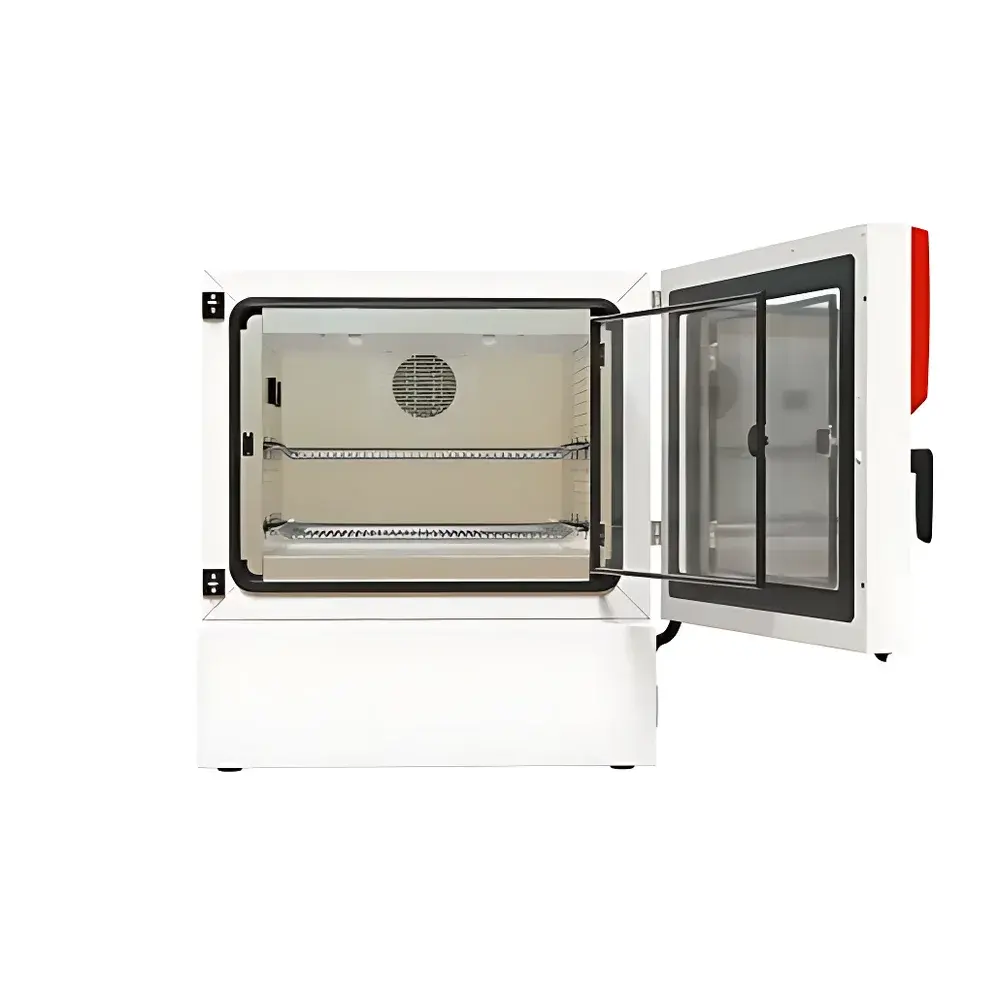
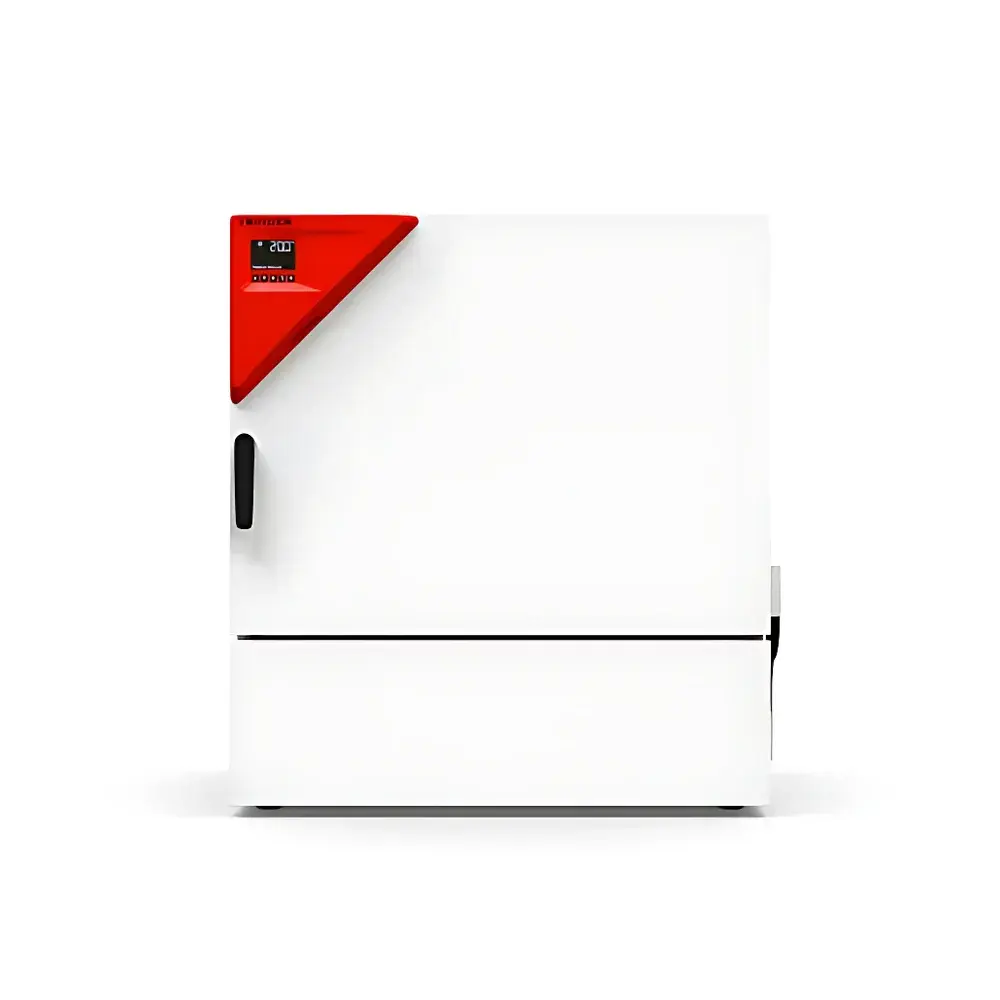
BINDER KB130 Low Temperature Incubator
| Brand | BINDER |
|---|---|
| Origin | Germany |
| Manufacturer | BINDER GmbH |
| Type | Imported |
| Model | KB 130 |
| Cooling Method | Compressor-based refrigeration |
| Heating Method | Water-jacketed heating |
| Temperature Range | 0 °C to +70 °C |
| Temperature Accuracy | ±0.2 K |
| Temperature Uniformity | ±0.2 K |
| Temperature Stability (Fluctuation) | ±0.1 K |
| Chamber Volume | 127 L |
| External Dimensions | 656 mm × 500 mm × 386 mm |
Overview
The BINDER KB130 Low Temperature Incubator is a precision-engineered, water-jacketed incubation system designed for demanding microbiological, cell culture, and environmental stability applications requiring stable sub-ambient to moderate elevated temperatures. Unlike forced-air incubators, the KB130 employs a dual-mode thermal management architecture: compressor-based refrigeration for precise sub-zero and low-temperature control (down to 0 °C), and a fully integrated water jacket for uniform, vibration-free, and drift-resistant heating up to +70 °C. This hybrid design eliminates thermal gradients common in air-circulated systems and ensures exceptional temperature homogeneity across the entire 127 L chamber volume—critical for sensitive assays, long-term storage of thermolabile strains, or ISO/IEC 17025-compliant stability testing protocols. The stainless steel interior chamber (AISI 304) provides corrosion resistance, ease of decontamination, and structural integrity over extended operational lifetimes.
Key Features
- Water-jacketed heating with compressor-assisted cooling: Enables seamless transition between refrigeration and heating modes while maintaining ±0.1 K short-term stability and ±0.2 K spatial uniformity—even at full load and across the full 0–70 °C range.
- Energy-optimized thermal architecture: Incorporates variable-speed compressor technology and insulated water jacket design, reducing power consumption by up to 40% compared to previous-generation BINDER low-temperature incubators (per internal BINDER lifecycle assessment, 2022).
- Dry-heat sterilization cycle: Integrated programmable dry-heat decontamination routine (up to +180 °C, configurable duration) supports GLP/GMP-aligned lab hygiene practices without external autoclave dependency.
- Intuitive microprocessor controller: Features real-time temperature logging, multi-step program scheduling (including weekend/holiday hold functions), and password-protected parameter access—fully compliant with FDA 21 CFR Part 11 requirements when paired with BINDER’s optional data acquisition software.
- Robust mechanical construction: All-welded stainless steel inner chamber, double-glazed observation window with anti-fog coating, and reinforced door seal ensure long-term reliability and minimal maintenance under continuous operation.
Sample Compatibility & Compliance
The KB130 accommodates standard microbiological and cell culture vessels—including Petri dishes, flasks, multiwell plates, and cryovial racks—within its 127 L working volume. Its absence of internal fans eliminates airflow-induced desiccation and mechanical stress on delicate cultures. The unit conforms to IEC 61010-1 (Safety Requirements for Electrical Equipment for Measurement, Control, and Laboratory Use) and carries CE marking for the European Economic Area. Optional validation packages support IQ/OQ/PQ documentation per ASTM E2500 and EU Annex 15 guidelines. Temperature performance is traceable to national standards via factory calibration certificates (ISO/IEC 17025-accredited calibration available upon request).
Software & Data Management
BINDER’s optional ecoLINK software enables remote monitoring, alarm notification (email/SMS), and secure audit-trail generation—including user login history, parameter changes, and temperature deviation events. Data export complies with CSV and PDF formats suitable for regulatory submission. When configured with digital signature and electronic record modules, the system meets ALCOA+ principles (Attributable, Legible, Contemporaneous, Original, Accurate) and supports 21 CFR Part 11 compliance for electronic records and signatures in regulated environments.
Applications
- Low-temperature cultivation of psychrophilic and mesophilic microorganisms (e.g., Pseudomonas fluorescens, Bacillus cereus)
- Stability testing of biologics, vaccines, and diagnostic reagents per ICH Q5C and USP <1151>
- Controlled degradation studies under accelerated conditions (0–25 °C)
- Long-term storage of microbial reference strains and primary cell stocks
- Environmental simulation for material compatibility testing (e.g., polymer aging, adhesive performance)
- Compliance-driven incubation workflows in ISO 15189-accredited clinical laboratories
FAQ
Does the KB130 require external water supply or drainage?
No—the water jacket is a sealed, non-evaporative system filled during factory commissioning and requires no user refilling or draining.
Can the dry-heat sterilization cycle be validated for GMP use?
Yes—BINDER provides validation templates, thermocouple mapping procedures, and IQ/OQ documentation kits compatible with EU GMP Annex 15 and FDA guidance.
Is temperature uniformity verified at full load?
Yes—BINDER certifies uniformity performance (±0.2 K) under ISO 15189-recommended load conditions (90% chamber volume occupied with inert mass simulating typical labware).
What is the mean time between failures (MTBF) for the compressor system?
Based on field data from >10,000 installed units, the MTBF exceeds 25,000 operating hours under standard laboratory conditions (23 °C ambient, 50% RH).
Does the KB130 support integration into a central building management system (BMS)?
Yes—via optional Modbus TCP or BACnet/IP interface modules, enabling real-time status reporting and alarm forwarding to facility-wide monitoring platforms.




