
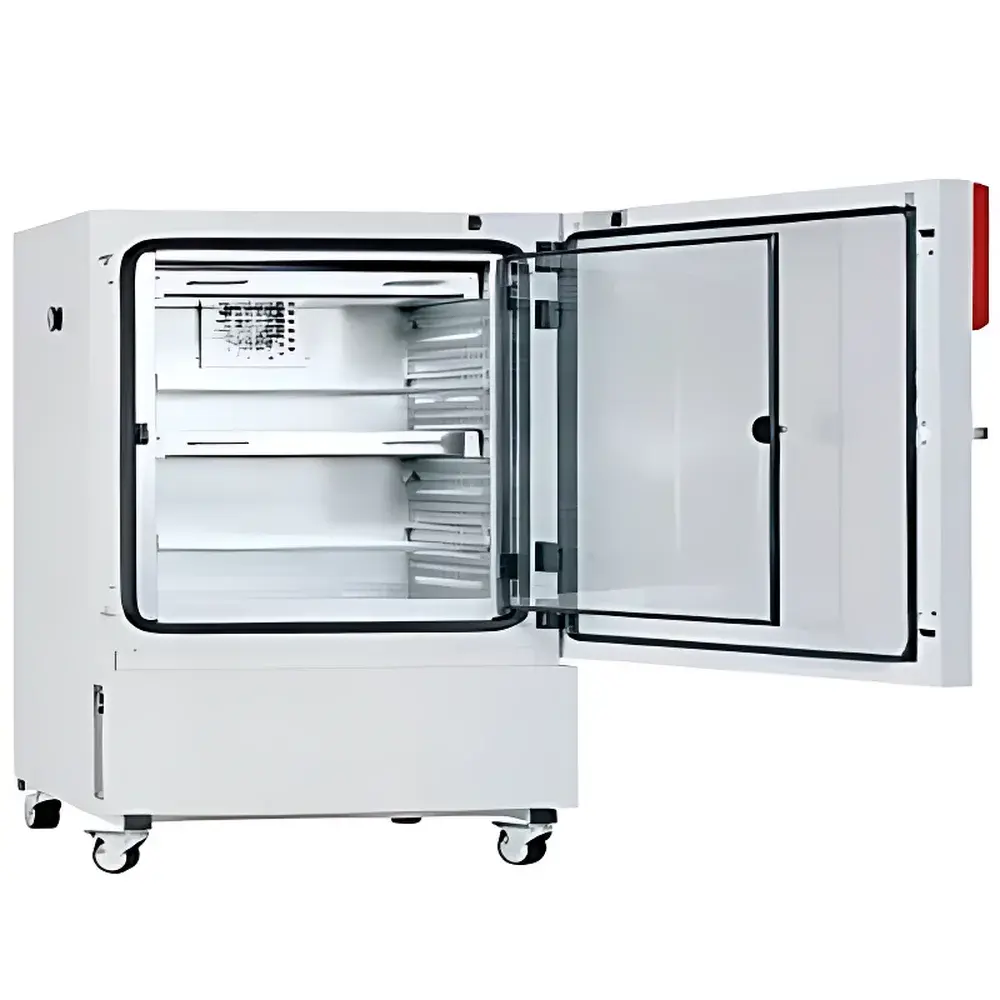
BINDER KBF, KBF P, KBF LQC & KMF Series Temperature and Humidity Controlled Chambers
| Brand | BINDER |
|---|---|
| Origin | Germany |
| Chamber Type | Upright |
| Model Families | KBF, KBF P, KBF LQC, KMF |
| Temperature Range (dry) | 0–70 °C |
| Temperature Range (humidified) | 10–70 °C |
| Humidity Range | 10–80 % RH |
Overview
The BINDER KBF, KBF P, KBF LQC, and KMF series temperature and humidity controlled chambers are precision-engineered environmental test systems designed for regulatory-compliant stability testing, photostability assessment, climate simulation, and long-term sample conditioning in pharmaceutical, biotechnology, food, cosmetic, and materials science laboratories. These upright chambers operate on the principle of forced-air convection with active humidity control, integrating BINDER’s proprietary APT.Line® preheating technology to eliminate vertical thermal gradients—ensuring uniform temperature distribution (< ±0.3 °C deviation across chamber volume) and high spatial reproducibility. Unlike conventional heating architectures, APT.Line® heats the entire inner chamber wall uniformly before air circulation begins, eliminating cold spots and minimizing overshoot during setpoint transitions. Combined with the DCT® (Direct Cooling Technology) system, this architecture delivers rapid thermal recovery after door openings and tight temperature stability (±0.1 °C at setpoint). Humidity control is achieved via a maintenance-free capacitive sensor and electronically regulated steam humidification/dehumidification, enabling precise, drift-free RH maintenance across the full 10–80 % RH range.
Key Features
- APT.Line® inner chamber preheating technology ensures homogeneous temperature distribution and eliminates vertical temperature stratification
- DCT® direct cooling system enables fast temperature recovery (< 15 min from +60 °C to +25 °C) and stable operation under dynamic load conditions
- MCS microprocessor controller with 25 programmable protocols (100 segments each), real-time clock, and integrated electronic chart recorder
- Capacitive humidity sensor with NIST-traceable calibration—no routine recalibration or maintenance required
- Class 3.1 independent temperature safety device (DIN 12880), featuring visual and audible alarm outputs
- Sealed double-glazed inner glass door with anti-fog coating for uninterrupted visual monitoring without compromising environmental integrity
- Integrated water supply safety kit (6 m total length, including inlet hose and drain line) with leak-detection interlock
- KBF P models equipped with ICH Q1B Option 2–compliant light source (cool-white fluorescent + UV-A/B), spectral output certified per ICH Q1B Annex 2
- KBF LQC models include a spherical irradiance sensor for simultaneous measurement of visible (320–800 nm) and UV (290–400 nm) irradiance; automated exposure time calculation and termination upon reaching user-defined cumulative dose (kJ/m²)
- KMF series extends operational range for climatic testing: extended low-temperature capability (–20 °C optional), wider humidity span, and enhanced airflow design for accelerated weathering simulation
Sample Compatibility & Compliance
These chambers support a broad spectrum of sample formats—including vials, trays, Petri dishes, blister packs, and packaged consumer goods—without requiring internal modifications. All models comply with international regulatory frameworks essential for GxP environments: ICH Q1A(R2) and Q1B (Option 2), EN 60068-2-1/2/14/30, ISO 16770, and ASTM E145. The MCS controller supports audit trail functionality, user access levels (admin/operator), and electronic signature readiness—fully compatible with FDA 21 CFR Part 11 requirements when deployed with validated IT infrastructure. Data integrity is reinforced through non-volatile memory storage, automatic timestamping of all parameter changes, and password-protected configuration locks. Optional IQ/OQ documentation packages and factory calibration certificates (traceable to DAkkS-accredited standards) are available to support qualification under GLP and GMP regimes.
Software & Data Management
BINDER’s optional ecoLINK software enables remote monitoring, real-time data visualization, and centralized fleet management across multiple chambers. It logs all process variables (temperature, RH, irradiance, alarm events, door openings) with configurable sampling intervals (1–60 s), stores data in CSV and PDF report formats, and supports automated email/SMS alerts for critical deviations. Raw data files are stored in encrypted, tamper-evident archives compliant with ALCOA+ principles (Attributable, Legible, Contemporaneous, Original, Accurate, Complete, Consistent, Enduring, Available). For integration into LIMS or MES platforms, the chamber provides Modbus TCP and Ethernet/IP communication protocols, along with OPC UA server support (optional license).
Applications
- ICH-guided drug substance and product stability studies (long-term, accelerated, intermediate conditions)
- Photostability testing per ICH Q1B Option 2 using calibrated UV/visible irradiance profiles
- Real-time and accelerated shelf-life determination for pharmaceuticals, nutraceuticals, and biologics
- Climate stress testing of packaging materials (e.g., moisture barrier performance, seal integrity)
- Microbial growth inhibition studies and controlled bacterial/fungal culture conditioning
- Material aging tests for polymers, adhesives, and composites under defined thermal-hygrometric cycles
- Food spoilage modeling and sensory stability evaluation under simulated storage conditions
- Reference standard storage under ICH-recommended conditions (e.g., 25 °C/60 % RH)
FAQ
What ICH guidelines do BINDER KBF series chambers support?
The KBF series complies with ICH Q1A(R2) for stability testing; KBF P meets ICH Q1B Option 2 for photostability; KBF LQC adds automated irradiance dosimetry per Q1B Annex 2.
Is the humidity sensor factory-calibrated and field-serviceable?
Yes—the capacitive humidity sensor is pre-calibrated at manufacture and requires no periodic recalibration or user maintenance throughout its service life.
Can the chamber be validated for GMP use?
Yes—BINDER provides IQ/OQ protocol templates, DAkkS-traceable calibration certificates, and 21 CFR Part 11–ready firmware options for full GMP validation support.
What is the maximum allowable door opening time without compromising test integrity?
Thermal recovery to ±0.3 °C of setpoint is guaranteed within 12 minutes after a 30-second door opening event at 40 °C/75 % RH, per DIN EN 60068-3-5 test methodology.
Does the MCS controller support multi-user access control?
Yes—three hierarchical user roles (Administrator, Supervisor, Operator) with configurable permissions for parameter editing, program execution, and data export functions.



