
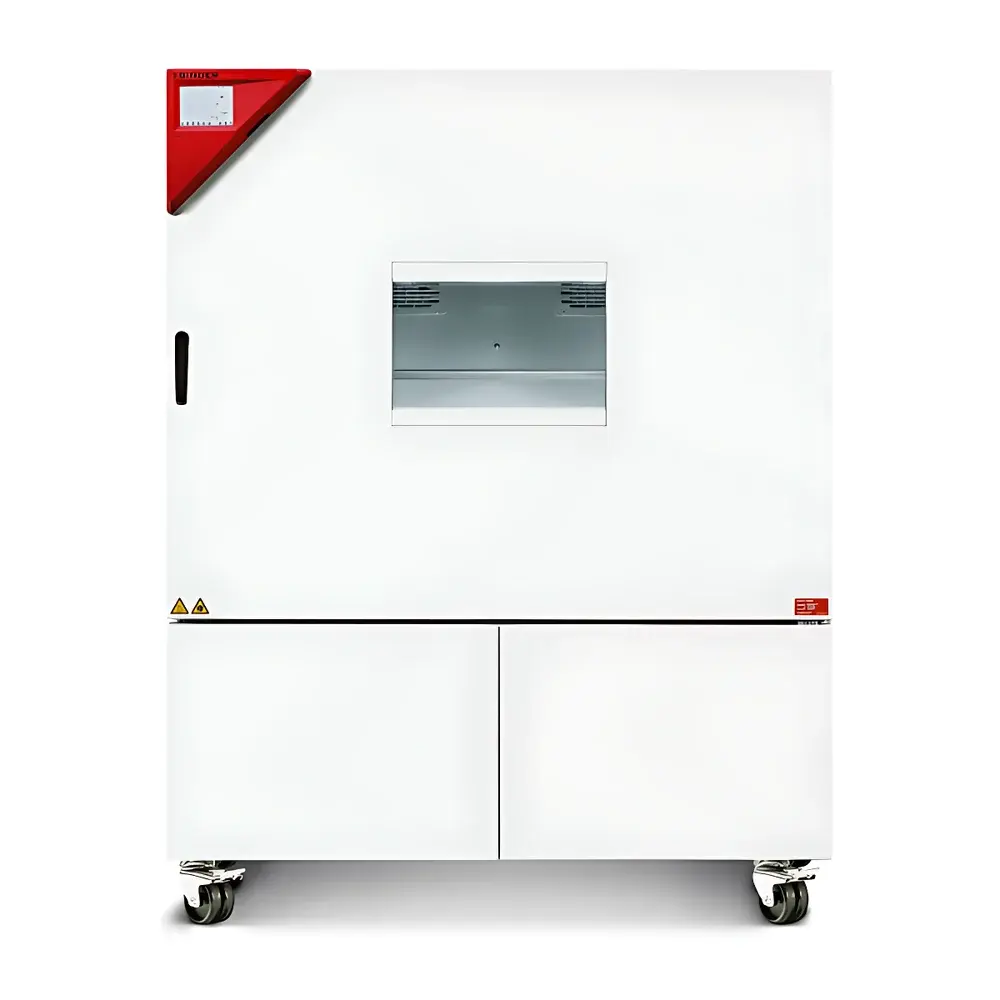
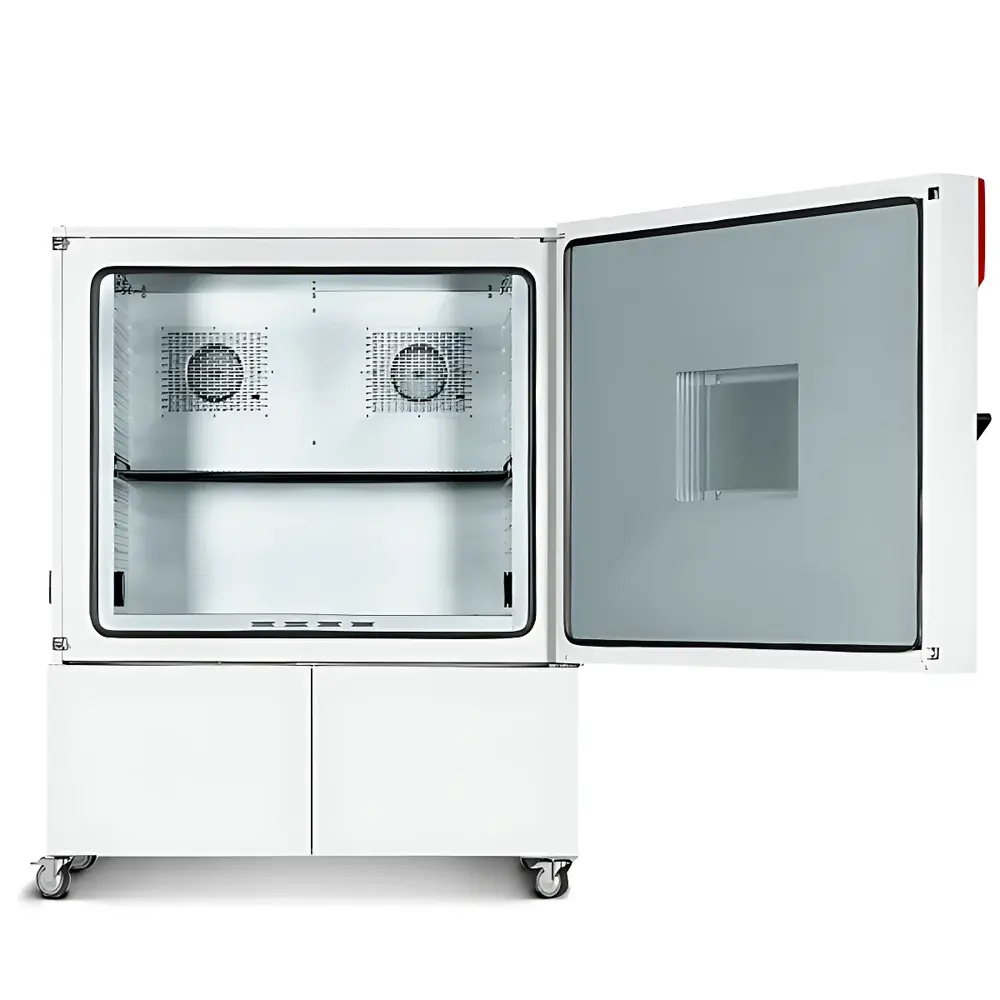
BINDER MKFT 720 Environmental Simulation Chamber
| Brand | BINDER |
|---|---|
| Origin | Germany |
| Manufacturer | BINDER GmbH |
| Model | MKFT 720 |
| Temperature Range | −70 to +180 °C |
| Humidity Range | 10–98 %RH |
| Refrigeration System | Dual-stage compression refrigeration |
| Temperature Uniformity | ±0.1 to ±0.5 °C (at setpoint, steady state) |
| Temperature Deviation | ±0.3 to ±2.0 °C (across working chamber) |
| Heating Rate | up to 4.8 °C/min (typical, empty chamber) |
| Cooling Rate | 180 → −70 °C in ≤120 min (empty chamber) |
| Integrated Water Reservoir | 20 L |
| Control Interface | APT Line™ touchscreen controller with interval & real-time programming |
| Data Logging | Internal recorder with USB export capability |
| Viewing Window | Heated, double-glazed, LED-illuminated |
| Preconditioning Technology | APT Line™ preheating chamber |
| Alarm System | Optical and acoustic fault diagnostics |
| Safety Certification | Complies with IEC 61010-1, EN 60529 (IPX1), CE-marked for EU use |
| Explosion Protection | Standard (non-explosion-proof) configuration |
Overview
The BINDER MKFT 720 Environmental Simulation Chamber is a high-precision, programmable climate test system engineered for rigorous dynamic environmental profiling across extreme thermal and hygrothermal conditions. Designed and manufactured in Tuttlingen, Germany, the MKFT 720 employs dual-stage compression refrigeration coupled with high-efficiency resistive heating and advanced humidity generation via steam injection—enabling stable, reproducible operation from −70 °C to +180 °C and 10–98 %RH. Its core architecture follows BINDER’s APT Line™ platform philosophy: integrating preconditioning cavities, thermally decoupled sensor placement, and active chamber wall temperature control to minimize thermal lag and improve spatial uniformity. This chamber is purpose-built for applications requiring compliance with international environmental stress screening standards—including IEC 60068-2, MIL-STD-810H, ASTM D4332, and ISO 16750-4—making it suitable for validation in automotive electronics, aerospace component qualification, pharmaceutical stability testing (ICH Q1A–Q1E), and reliability assessment of polymer-based materials.
Key Features
- Dual-stage refrigeration system with cascade compressor design ensures rapid cooling performance: 180 °C to −70 °C in ≤120 minutes under no-load conditions.
- APT Line™ preheating chamber technology actively stabilizes inlet air temperature prior to chamber entry, reducing thermal overshoot during ramp transitions and enhancing repeatability across thermal cycles.
- Integrated 20 L stainless-steel water reservoir with automatic level monitoring supports continuous humidity generation without external plumbing or manual refilling.
- Heated, double-glazed observation window with integrated LED lighting enables real-time visual inspection without compromising chamber integrity or introducing condensation artifacts.
- Touchscreen controller featuring intuitive interval programming (stepwise profiles) and real-time programming (continuous ramp/soak sequences), with password-protected user levels and configurable alarm thresholds.
- Comprehensive fault diagnostics with optical indicators and audible alerts for critical events including refrigerant pressure anomalies, door open detection, sensor failure, and humidity saturation limits.
Sample Compatibility & Compliance
The MKFT 720 accommodates standard ISO/IEC 17025-compliant test specimens up to 720 L internal volume (W × D × H: 900 × 700 × 1140 mm). Its interior is constructed from electropolished stainless steel (AISI 316L), ensuring corrosion resistance against aggressive humidity regimes and facilitating GLP/GMP-compliant cleaning protocols. The chamber meets essential safety requirements per IEC 61010-1 (electrical safety) and EN 60529 (IPX1 ingress protection). While configured as a standard non-explosion-proof unit, optional ATEX-certified variants are available upon request for hazardous area deployment. All firmware and controller logic adhere to traceability principles required for FDA 21 CFR Part 11 compliance when paired with validated software configurations.
Software & Data Management
Internal data logging captures temperature, relative humidity, and system status at user-defined intervals (1 s to 60 min resolution), storing up to 30 days of continuous measurement history. Export occurs via USB 2.0 interface in CSV format, compatible with common statistical analysis platforms (e.g., JMP, Minitab, Python pandas). Optional BINDER CLOUD connectivity enables remote monitoring, alarm forwarding via email/SMS, and centralized fleet management for multi-chamber laboratories. Audit trails—including operator ID, parameter changes, start/stop timestamps, and calibration event logs—are retained locally and exportable for regulatory review.
Applications
- Accelerated aging and shelf-life prediction of pharmaceutical dosage forms under ICH Q1 guidelines.
- Thermal cycling validation of printed circuit boards (PCBs) and embedded sensors per JEDEC JESD22-A104.
- Material property evaluation of elastomers, composites, and adhesives under combined thermal-hygric stress.
- Environmental stress screening (ESS) of avionics modules to MIL-STD-810H Method 502.7 (low temperature) and Method 501.7 (high temperature).
- Calibration reference chamber for secondary humidity and temperature sensors in metrology labs.
FAQ
What is the typical temperature recovery time after door opening?
Typical recovery to ±0.5 °C of setpoint following a 30-second door opening at 25 °C/50 %RH is ≤5 minutes.
Can the MKFT 720 operate continuously at −70 °C?
Yes—the dual-stage refrigeration system supports uninterrupted operation at −70 °C for extended durations, subject to ambient room conditions ≤25 °C and adequate ventilation.
Is humidity control available independently of temperature control?
Yes—humidity setpoints can be maintained across the full temperature operating range, with dew point control enabled down to −40 °C.
Does the chamber support automated calibration verification?
It supports external probe integration for periodic verification; full automated calibration requires optional BINDER CALIBRATION KIT and certified reference sensors.
What maintenance intervals are recommended for optimal performance?
Compressor oil and refrigerant checks every 24 months; humidity generator descaling every 6 months (frequency dependent on water quality); annual validation of temperature/humidity uniformity per ISO 17025 Annex C.
Related Products



