
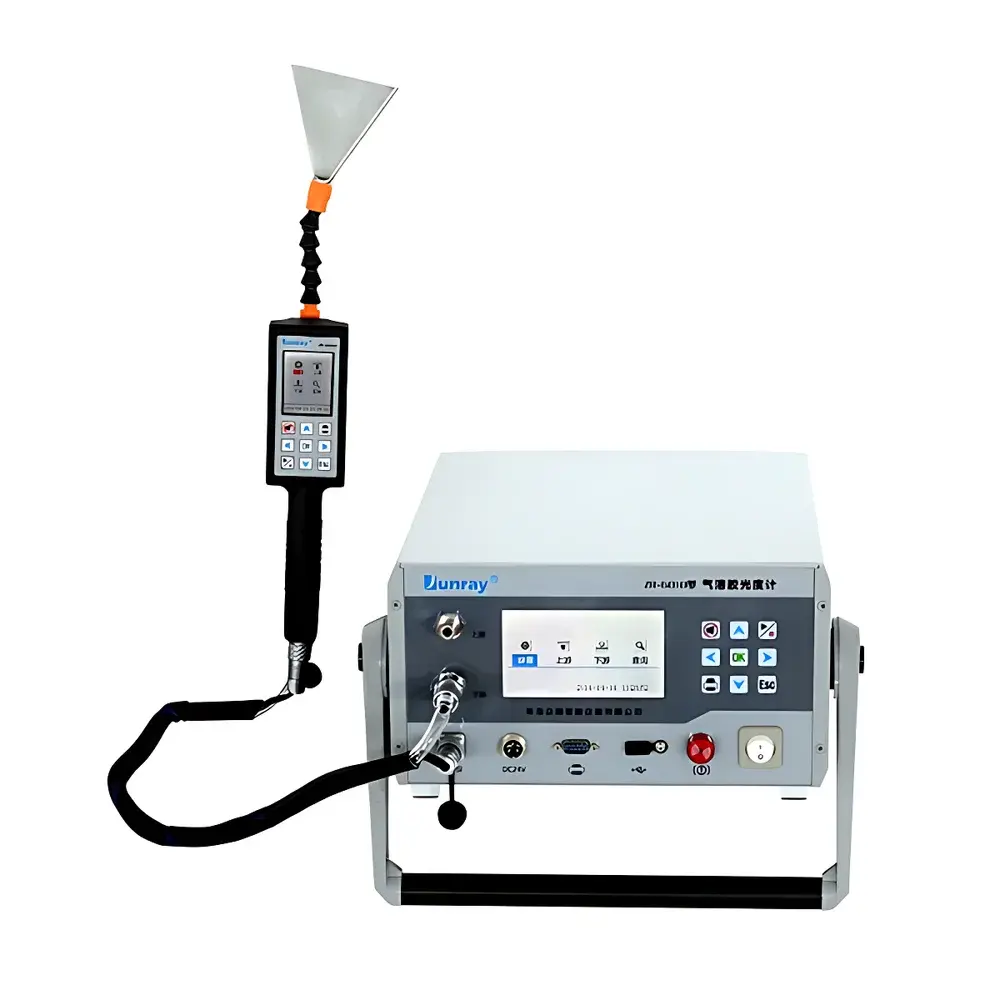
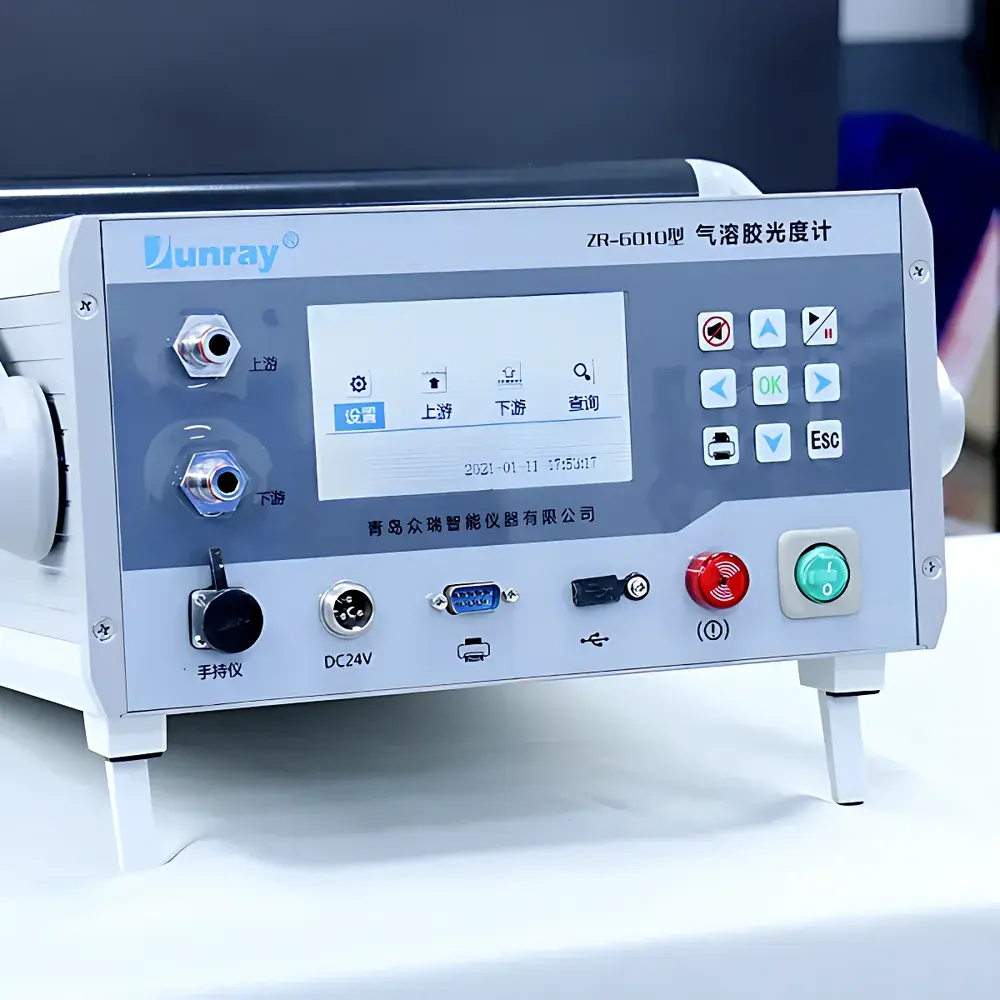
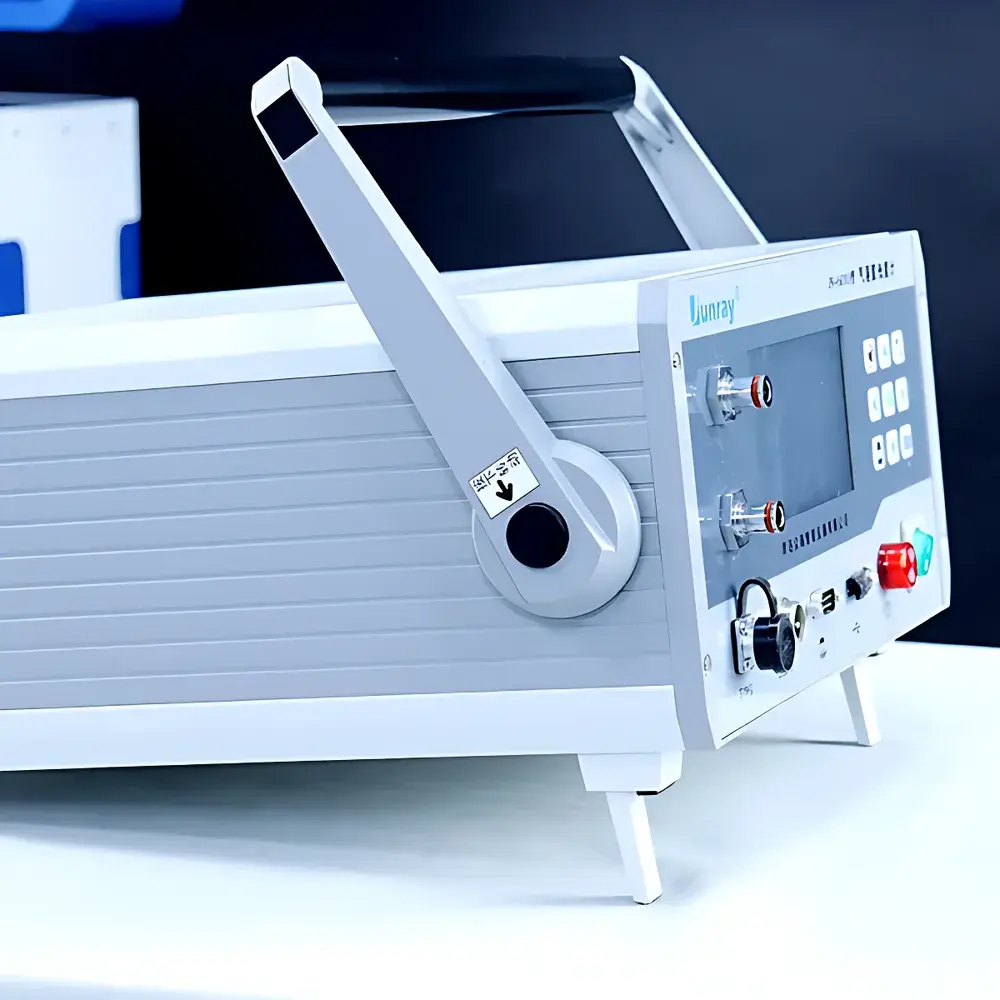
Junray ZR-6010 Aerosol Photometer (External Thermal Printer Model)
| Brand | Junray |
|---|---|
| Origin | Shandong, China |
| Manufacturer Type | Direct Manufacturer |
| Instrument Type | Aerosol Photometer |
| Model | ZR-6010 (with External Thermal Printer) |
| Sampling Flow Rate | 28.3 L/min |
| Max. Permissible Error | ±5% |
| Concentration Range | 0.0001–125 µg/L |
| Leak Detection Range | 0.0001%–100% |
| Accuracy | ±1% of reading (0.01%–100%) |
| Repeatability | ±0.5% of reading (0.01%–100%) |
| Data Storage Capacity | 1,000 test records |
| Dimensions (L×W×H) | 380 × 400 × 170 mm |
| Net Weight | 8 kg |
| Gross Weight (incl. packaging & accessories) | 15 kg |
| Power Supply | AC 220 V ±10%, 50 Hz ±2% |
| Power Consumption | <100 W |
Overview
The Junray ZR-6010 Aerosol Photometer is a precision-engineered instrument designed specifically for quantitative leak testing of high-efficiency particulate air (HEPA) and ultra-low penetration air (ULPA) filters in controlled environments. Based on Mie scattering theory, the device measures light intensity scattered by aerosol particles—typically polyalphaolefin (PAO), di-octyl phthalate (DOP), or other standardized challenge agents—at a fixed wavelength (typically 635–650 nm laser source). It delivers real-time, ratio-based leakage quantification by comparing upstream challenge concentration to downstream penetration, enabling compliance verification per ISO 14644-3:2019, NSF/ANSI 49-2020, GB 50591-2010, and JJF 1800-2020. Its fixed 28.3 L/min sampling flow ensures compatibility with standard probe-based scanning protocols used in cleanroom certification, biosafety cabinet validation, and HVAC commissioning.
Key Features
- High-sensitivity photomultiplier tube (PMT) detector optimized for low-concentration aerosol detection (down to 0.0001 µg/L), delivering stable signal-to-noise performance across the full dynamic range.
- Integrated 635 nm long-life laser diode light source with thermal stabilization, minimizing drift during extended field operation.
- Backlit high-resolution LCD display supporting simultaneous visualization of upstream concentration, downstream concentration, calculated leak percentage, and real-time trend curves.
- Dual data output: direct thermal printing via external printer (included) and USB flash drive export for CSV-formatted raw datasets—including timestamp, location tag, operator ID, and calibration metadata.
- Configurable aerosol type selection (DOP, PAO, OPA, DOS) with preloaded refractive index compensation algorithms to maintain measurement fidelity across different challenge agents.
- Automated alarm system with audible buzzer and visual LED indicators triggered when user-defined leak thresholds (e.g., >0.01% for HEPA, >0.005% for ULPA) are exceeded.
- Onboard fault diagnostics including flow sensor validation, PMT gain monitoring, and laser power self-check, ensuring measurement integrity prior to and during each test cycle.
Sample Compatibility & Compliance
The ZR-6010 is validated for use with industry-standard aerosol challenge agents compliant with ISO 14644-3, NSF/ANSI 49, and GB 50073-2013. It supports both pressurized and non-pressurized scanning modes for HEPA filter integrity testing in laminar flow hoods, Class II biosafety cabinets (per YY 0569-2011 and JJF 1815-2020), pharmaceutical cleanrooms (aligned with EU GMP Annex 1 and 2010 Chinese GMP Guide), nuclear containment ventilation systems, and negative-pressure isolation enclosures. All firmware and calibration routines adhere to metrological traceability requirements outlined in JJF 1800-2020, with optional NIST-traceable calibration certificate available upon request. The instrument architecture supports audit-ready operation under GLP and GMP environments, including password-protected parameter configuration and immutable event logging.
Software & Data Management
Data acquisition and reporting are managed through embedded firmware—not PC-dependent software—ensuring robustness in field deployments. Each stored record includes date/time stamp, operator ID (manually entered), test location identifier, aerosol type, upstream concentration (µg/L), downstream concentration (µg/L), calculated leak rate (%), pass/fail status, and calibration validity flag. Exported CSV files are structured for direct import into LIMS platforms or Excel-based QA review workflows. No proprietary drivers or cloud dependencies are required; USB mass storage mode enables drag-and-drop file retrieval. Firmware updates are performed via FAT32-formatted USB stick, with version rollback capability and SHA-256 checksum verification.
Applications
- Leak testing of HEPA/ULPA filters in ISO Class 3–8 cleanrooms per ISO 14644-3:2019 Section 8.3.
- Annual certification and routine surveillance of Class II A2 and B2 biosafety cabinets per NSF/ANSI 49-2020 and YY 0569-2011.
- Pre-commissioning validation of HVAC terminal filters in pharmaceutical manufacturing suites (EU GMP Annex 1, FDA Guidance for Industry).
- Integrity verification of glovebox inlet/outlet filters and negative-pressure exhaust scrubbers in radiological or biocontainment labs.
- Field verification of surgical suite air filtration systems per GB 50333-2013 and local hospital accreditation standards.
- Performance assessment of portable HEPA vacuum systems and mobile clean-air workstations.
FAQ
What aerosol agents are supported for challenge testing?
The ZR-6010 supports DOP, PAO, OPA, and DOS aerosols. Refractive index correction factors are pre-programmed for each agent to ensure accurate scattering cross-section compensation.
Is the instrument suitable for ULPA filter testing?
Yes—its 0.0001% minimum detectable leak rate and ±0.5% repeatability meet the sensitivity requirements for ULPA filter qualification per ISO 14644-3:2019 Annex B.
Does it comply with FDA 21 CFR Part 11 requirements?
While the device itself does not include electronic signature functionality, its immutable audit trail (timestamped, operator-tagged, calibration-validated records) and exportable CSV logs support Part 11 compliance when integrated into a validated laboratory information management system (LIMS).
Can the thermal printer be replaced with a network-enabled printer?
No—the external thermal printer is a dedicated RS-232 interface peripheral calibrated for synchronized print timing and unit-specific formatting; third-party printers are not supported.
What maintenance intervals are recommended?
Annual PM is advised: optical path cleaning, flow sensor verification against a primary rotameter, PMT dark-current check, and laser output power validation using a NIST-traceable photodiode meter.
Related Products







