
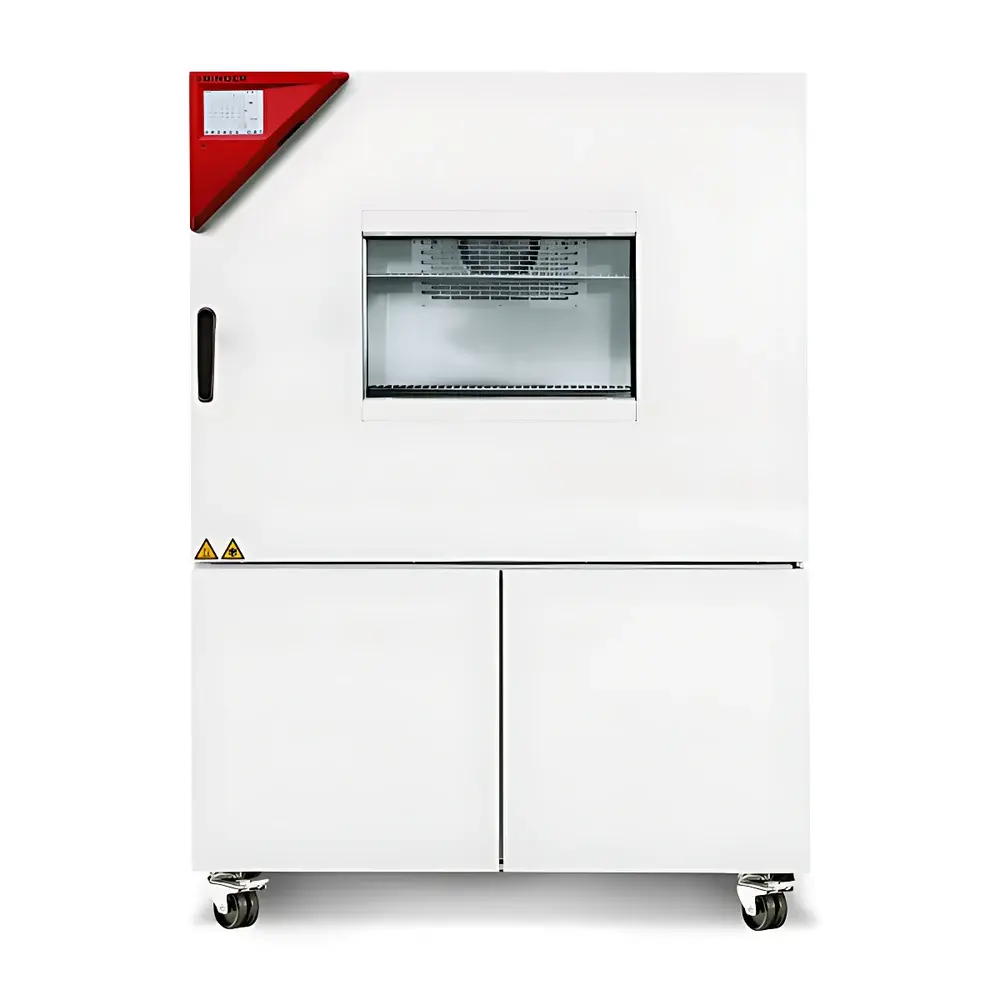
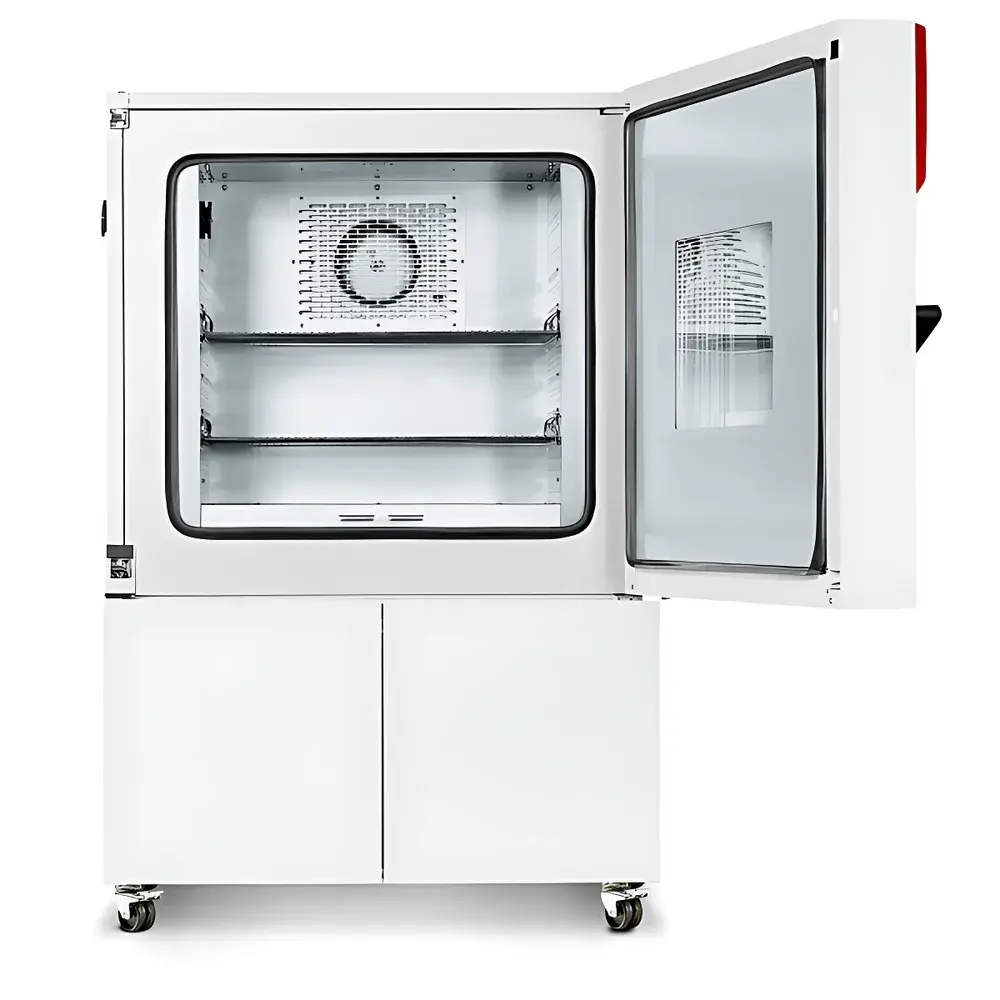
BINDER MKT240 High-Low Temperature Cycling Climate Chamber
| Brand | BINDER |
|---|---|
| Origin | Germany |
| Manufacturer | BINDER GmbH |
| Product Type | Imported Environmental Test Chamber |
| Model | MKT 240 |
| Temperature Range | −70 °C to +180 °C |
| Refrigeration Method | Dual-stage compression refrigeration |
| Explosion-Proof Design | Standard (non-explosion-proof) |
| Temperature Stability | ±0.1–0.4 °C (dependent on setpoint) |
| Temperature Uniformity | ±0.1–1.0 °C (dependent on setpoint) |
| Heating Rate (IEC 60068-3-5) | 5.0 °C/min (average) |
| Cooling Rate (IEC 60068-3-5) | 4.2 °C/min (average) |
| Internal Chamber Dimensions | 1115 mm × 925 mm × 1935 mm (W × D × H) |
Overview
The BINDER MKT240 High-Low Temperature Cycling Climate Chamber is an engineered environmental simulation system designed for precise, repeatable, and rapid thermal cycling across an exceptionally wide temperature range—from −70 °C to +180 °C. Based on the fundamental principles of forced-air convection with optimized airflow distribution and dual-stage compression refrigeration, the MKT240 delivers high-fidelity thermal profiles required for reliability validation, accelerated aging, qualification testing, and material stability assessment in R&D and quality assurance laboratories. Its architecture complies with IEC 60068-3-5 for standardized heating and cooling rate verification, enabling traceable, reproducible test conditions aligned with international environmental stress screening protocols. The chamber integrates APT Line™ preheating cavity technology to eliminate condensation during low-temperature ramp-down phases—critical for moisture-sensitive samples and electronic assemblies undergoing thermal shock or cyclic humidity-free thermal stress.
Key Features
- Wide operational temperature range: −70 °C to +180 °C, enabled by a high-efficiency dual-stage compressor system with environmentally compliant refrigerant (R290/R170 blend)
- High dynamic performance: average heating rate of 5.0 °C/min and cooling rate of 4.2 °C/min (per IEC 60068-3-5), supporting stringent thermal cycling requirements
- Precision climate control via intuitive 7-inch capacitive touchscreen controller with real-time programming, interval-based scheduling, and multi-segment ramp/soak profiles
- APT Line™ preheating cavity: actively maintains internal surface temperatures above dew point during transitions, preventing condensation formation on samples and chamber walls
- Heated, double-glazed observation window with integrated LED lighting ensures clear visual monitoring without thermal distortion or frosting
- Robust stainless-steel interior (AISI 304), reinforced insulated chamber walls (≥120 mm polyurethane foam), and corrosion-resistant exterior housing for long-term stability and cleanroom compatibility
- Integrated diagnostics with optical and acoustic alarms for overtemperature, sensor failure, door open, refrigeration fault, and power interruption events
Sample Compatibility & Compliance
The MKT240 accommodates diverse sample configurations—including large electronic enclosures, automotive components, aerospace subassemblies, pharmaceutical packaging, and polymer specimens—within its spacious internal volume (≈2.0 m³). Chamber geometry supports uniform airflow distribution validated per DIN EN 60068-3-5, ensuring temperature uniformity within ±0.1–1.0 °C across the working zone. The system meets essential compliance benchmarks including IEC 60068-2-1 (cold), IEC 60068-2-2 (dry heat), IEC 60068-2-14 (change of temperature), and supports GLP/GMP-aligned validation documentation packages. While not intrinsically explosion-proof, it may be deployed in non-hazardous areas per IEC 60079-0; optional inert gas purging (N₂) is available for oxygen-sensitive applications.
Software & Data Management
Data acquisition and logging are managed through the built-in internal data recorder, storing time-stamped temperature readings at user-defined intervals (1 s to 60 min resolution). Measurement values—including chamber air temperature, sensor status, and alarm logs—are exportable via USB interface in CSV format for post-test analysis. The controller firmware supports audit trail functionality with timestamped operator actions and parameter changes—facilitating 21 CFR Part 11 readiness when paired with external validation software and access-controlled user accounts. Optional BINDER CDS (Climate Data System) software enables remote monitoring, automated report generation, and integration into enterprise LIMS or MES platforms.
Applications
- Thermal cycling qualification of printed circuit boards (PCBs), sensors, and embedded systems per IPC-9701 and JEDEC JESD22-A104
- Stability testing of active pharmaceutical ingredients (APIs) and drug products under ICH Q1A(R3) long-term and accelerated storage conditions
- Material behavior analysis of composites, elastomers, and adhesives across extreme thermal gradients
- Environmental stress screening (ESS) of avionics modules and defense electronics per MIL-STD-810H Method 503.6
- Calibration reference chamber support for secondary temperature standard verification
- Preconditioning of batteries and energy storage systems prior to electrochemical characterization
FAQ
What is the minimum achievable temperature and how is it maintained?
The MKT240 achieves and holds −70 °C using a cascade refrigeration system with independent high- and low-stage compressors, validated per IEC 60068-2-1.
Can the chamber be validated for GxP environments?
Yes—its controller supports user-level permissions, electronic signatures, and change history logging; IQ/OQ/PQ protocols are available upon request.
Is humidity control available on this model?
No—the MKT240 is a dry-thermal cycling chamber; for combined temperature/humidity testing, consider the BINDER MKF or MKFT series.
What safety certifications does the unit carry?
It bears CE marking, complies with EU Machinery Directive 2006/42/EC and Low Voltage Directive 2014/35/EU, and conforms to EN 61000-6-2/6-4 for EMC.
How is temperature uniformity verified across the workspace?
Uniformity is determined using nine calibrated PT100 sensors positioned per DIN EN 60068-3-5 Annex B, with results documented in factory acceptance test reports.



