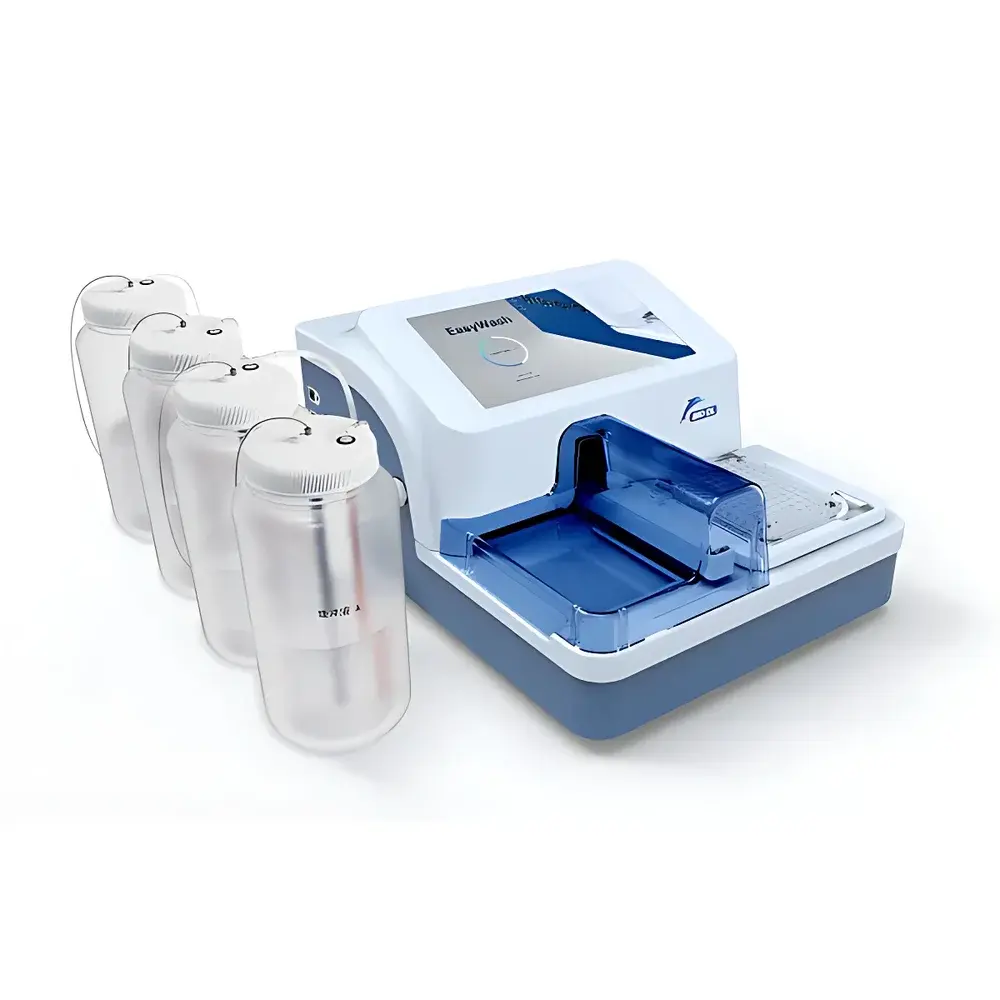
BIO-DL Easywash Microplate Washer
| Brand | BIO-DL |
|---|---|
| Origin | Shanghai, China |
| Model | Easywash |
| Display | 10-inch capacitive touchscreen (1280 × 800) |
| Wash Head Options | Interchangeable 8-channel or 12-channel single/dual-row heads |
| Aspiration/Dispense Speed | 9 adjustable levels |
| Data Storage | Internal 4 GB flash memory (≥20,000 protocol & run records) |
| Automation Interface | RS-232, USB Device/Host, optional Ethernet |
| Compliance Features | Liquid-level sensing, plate-position detection, leak detection, dual independent peristaltic pumps with pressure monitoring |
| Software | Embedded GUI with bilingual (English/Chinese) support, folder-based protocol organization, USB firmware update & data export capability |
| Residual Volume | ≤2 µL/well (96-well plate, standard wash cycle) |
| Compatibility | ANSI/SLAS-format microplates (96-, 384-well), PCR plates, deep-well plates |
Overview
The BIO-DL Easywash Microplate Washer is an engineered solution for high-fidelity, reproducible plate washing in ELISA, cell-based assays, immunoassays, and molecular biology workflows. Utilizing a dual-peristaltic pump architecture with independent aspiration and dispense control, the system delivers precise fluid handling across standardized microplate formats. Its core design adheres to fundamental principles of volumetric displacement and gravitational drainage optimization—ensuring consistent wash efficiency while minimizing carryover and residual volume. The instrument is intended for use in regulated environments where traceability, repeatability, and operational transparency are essential, including QC labs supporting ISO 13485, CLIA, and GLP-compliant processes.
Key Features
- Dual independent peristaltic pumps with real-time pressure feedback and automatic calibration—enabling simultaneous, synchronized control of aspiration and dispense cycles.
- 9-step programmable aspiration and dispense speed adjustment, allowing fine-tuned optimization for viscous samples, low-volume wells (e.g., 384-well), or sensitive cell monolayers.
- 10-inch high-resolution capacitive touchscreen interface (1280 × 800) with anti-glare coating and glove-compatible responsiveness—supporting intuitive navigation and rapid parameter entry.
- Modular wash head system: quick-release mechanism enables tool-free swapping between 8-channel (single-row) and 12-channel (dual-row) configurations, compatible with ANSI/SLAS-standard 96-, 384-, and deep-well plates.
- Color-coded fluid path connectors (blue for wash buffer, red for waste, yellow for soak solution) reduce misconnection risk during maintenance or reconfiguration.
- Integrated liquid-level sensing and plate-position detection—prevents dry aspiration, misaligned plate loading, and overflow events through hardware-level interlocks.
Sample Compatibility & Compliance
The Easywash supports all common microplate formats conforming to ANSI/SLAS standards, including flat-bottom, U-bottom, V-bottom, and PCR plates. It accommodates both aqueous and mild detergent-based wash buffers (e.g., PBS-Tween, Tris-buffered saline). Built-in leak detection and pressure threshold monitoring comply with IEC 61010-1 safety requirements for laboratory equipment. The system logs all critical operational events—including plate recognition status, pump actuation count, and error codes—with timestamped records stored in non-volatile memory. Audit trail functionality meets foundational expectations for FDA 21 CFR Part 11–aligned environments when paired with validated networked data management practices.
Software & Data Management
The embedded operating system features a folder-based protocol library structure, enabling hierarchical organization of assay-specific wash routines (e.g., “ELISA_Standard,” “Cell_Staining_Wash”). Protocols include configurable parameters: pre-wet volume, soak time, number of cycles, final aspiration dwell time, and edge-well exclusion logic. All run data—including start/stop timestamps, selected protocol ID, actual volumes dispensed/aspirated (derived from pump rotation counts), and anomaly flags—are saved automatically. USB Host port supports direct export of CSV-formatted run logs and protocol backups; USB Device mode allows firmware updates and remote configuration import. Internal 4 GB flash memory retains ≥20,000 complete run records without external dependency.
Applications
- High-throughput ELISA processing in clinical diagnostics and biopharmaceutical development labs.
- Cell-based assay preparation requiring gentle yet thorough removal of unbound antibodies or media components.
- Pre- and post-incubation washing steps in multiplex immunoassays and lateral flow strip validation workflows.
- Integration into automated microplate handling lines—via RS-232 or Ethernet—coordinating with plate stackers, readers (e.g., SpectraMax, EnSpire), and liquid handlers using ASTM SLA command sets.
- Research settings demanding method flexibility: customizable soak intervals, variable cycle counts, and selective well washing via mask-based pattern definition.
FAQ
Does the Easywash support 384-well plates?
Yes—it accepts ANSI/SLAS-standard 384-well plates using the optional 12-channel dual-row wash head. Wash uniformity is maintained via calibrated channel alignment and adaptive dispensing timing.
Can protocols be transferred between instruments?
Yes—protocols and run logs are stored in portable XML/CSV format and can be copied via USB drive for cross-instrument deployment or archival backup.
Is remote monitoring or control possible?
The system supports serial command-line interface (CLI) over RS-232 and TCP/IP socket communication on Ethernet-equipped units, enabling integration with LIMS or custom lab automation software.
What maintenance is required for long-term reliability?
Daily wipe-down of the deck and wash head; monthly inspection of tubing elasticity and pump roller wear; annual calibration verification using gravimetric volume checks per manufacturer’s SOP.
How does the system ensure low residual volume?
Through synchronized dual-pump aspiration with optimized dwell time, vacuum-assisted final draw, and precision-engineered nozzle geometry—validated to ≤2 µL residual per well in 96-well plates under standard conditions.