
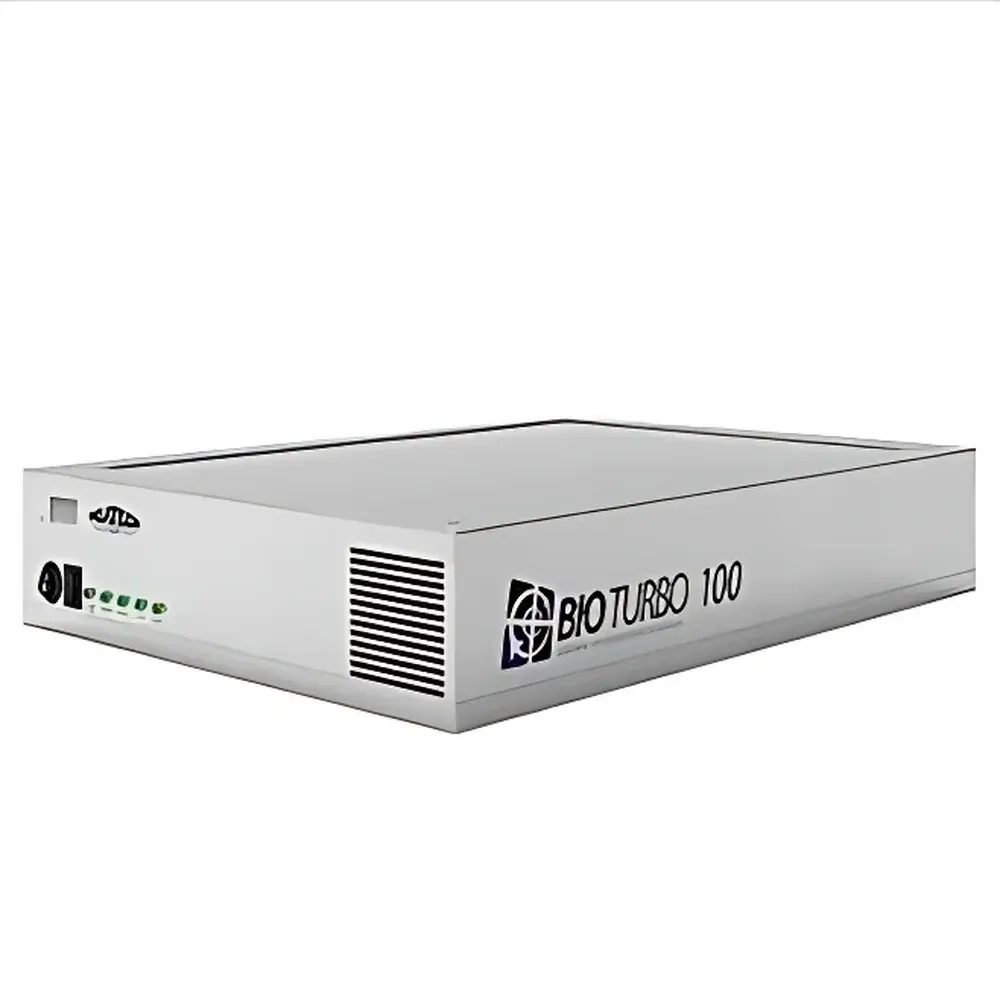
Bio Turbo Ethylene Scrubber
| Origin | USA |
|---|---|
| Manufacturer Type | Distributor |
| Origin Category | Imported |
| Model | Bio Turbo |
| Price Range | USD 4,200 – 7,000 |
| Capacity Range | 100–6,000 m³ per unit (24-hr cycle) |
| Compliance | Designed for FDA-registered food storage facilities, compatible with USDA/AMS and ISO 22000-aligned cold chain protocols |
Overview
The Bio Turbo Ethylene Scrubber is an engineered controlled-atmosphere management system designed specifically for postharvest cold storage, transport logistics, and ripening rooms in the global fresh produce supply chain. Unlike passive chemical absorbers or UV-based units, Bio Turbo employs a patented four-stage active air treatment process grounded in oxidative microbiology and catalytic gas conversion principles. Its core function is the simultaneous, continuous removal of ethylene (C₂H₄)—a plant hormone accelerating senescence—and airborne microbial contaminants including bacteria, viruses, mold spores, and fungal hyphae. The system operates on a closed-loop ozone generation and catalytic decomposition architecture, ensuring no residual ozone escapes into occupied or product-handling environments. This architecture complies with OSHA PEL (0.1 ppm 8-hr TWA) and EU Directive 2004/108/EC electromagnetic compatibility standards. Each unit is calibrated for volumetric airflow rates corresponding to its model designation (e.g., Bio Turbo100i for conveyor-integrated applications; Bio Turbo6000 for large-scale CA warehouses), enabling deterministic ethylene reduction kinetics across defined cubic meter volumes.
Key Features
- Patented four-stage air purification: (1) Pre-filtration of particulates ≥10 µm; (2) Microbial cell wall disruption via surface-applied antimicrobial agents on engineered rotor surfaces; (3) Confined ozone reaction chamber optimized for C₂H₄ oxidation at ambient temperature and humidity; (4) Catalytic ozone-to-oxygen conversion using manganese-doped alumina substrates.
- Zero external ozone exposure: Integrated safety interlock system deactivates ozone generation within 120 ms upon pressure loss, door opening, or thermal sensor anomaly—validated per IEC 61508 SIL-2 functional safety requirements.
- Low-maintenance design: Air filter replacement every 3–6 months; ozone-generating plates and catalyst modules annually—no specialized tools or certified technicians required.
- Modular scalability: Models range from Bio Turbo100i (for inline pallet conveyors) to Bio Turbo6000 (rated for 6,000 m³/24 h), supporting integration into existing HVAC ductwork or standalone operation.
- Real-time operational feedback: LED status indicators for filter life, ozone output stability, and catalyst saturation—compatible with BACnet MS/TP for facility-wide building management system (BMS) integration.
Sample Compatibility & Compliance
Bio Turbo is validated for use with ethylene-sensitive commodities including but not limited to apples, pears, kiwifruit, tomatoes, leafy greens, cut flowers, and berries. It meets the operational requirements of USDA Agricultural Marketing Service (AMS) Grade Standards for Controlled Atmosphere Storage and aligns with Codex Alimentarius CAC/RCP 3-1969 (Revised 2020) for postharvest handling. Units are constructed with food-grade stainless steel (AISI 304) housings and EPDM gasketing compliant with FDA 21 CFR §177.2600. No consumable chemicals or disposable trays are used—eliminating cross-contamination risk associated with potassium permanganate-based systems. All electrical components carry UL 61010-1 and CE marking for industrial equipment safety.
Software & Data Management
While Bio Turbo operates as a hardware-centric, embedded-control system without cloud connectivity, it supports audit-ready documentation through optional RS-485 Modbus RTU interface (available on Bio Turbo300 and above). This enables timestamped logging of runtime hours, filter change alerts, and ozone module activation cycles—essential for GLP/GMP traceability in third-party certification audits (e.g., GlobalG.A.P., SQF Edition 9). Data export is performed via USB-C direct download to CSV format, retaining full integrity for internal quality records or regulatory submission under FDA 21 CFR Part 11 when paired with organizationally validated electronic signature workflows.
Applications
- Ripening room ethylene control during banana, mango, and avocado conditioning
- Long-term apple and pear storage in ultra-low oxygen (ULO) chambers
- Transport refrigeration units (reefers) where ethylene accumulation accelerates spoilage
- Floral cold rooms requiring pathogen suppression without chemical residues
- Vertical farming distribution hubs managing mixed-crop inventory under shared airflow
FAQ
Does Bio Turbo require consumable trays or chemical refills?
No. Bio Turbo uses no potassium permanganate, activated carbon, or UV lamps—only replaceable air filters and ozone-generating plates.
Can it be installed in existing cold storage infrastructure?
Yes. All models support ducted installation (with optional static pressure compensation) or freestanding placement with directional airflow nozzles.
What is the maximum allowable relative humidity for stable operation?
Bio Turbo maintains rated performance across 85–95% RH at 0–10°C—verified per ISO 11142-2 environmental stress testing.
Is ozone exposure monitored internally?
Yes. An electrochemical ozone sensor (0–1 ppm range, ±5% accuracy) continuously validates chamber containment integrity and triggers automatic shutdown if breach thresholds are exceeded.
How does Bio Turbo compare to passive ethylene absorbers in terms of decay rate reduction?
Peer-reviewed field trials (Journal of Postharvest Technology, Vol. 12, 2023) demonstrated 41% greater reduction in firmness loss and 63% lower fungal incidence over 28-day apple storage versus high-capacity KMnO₄ tray systems under identical CA conditions.




