
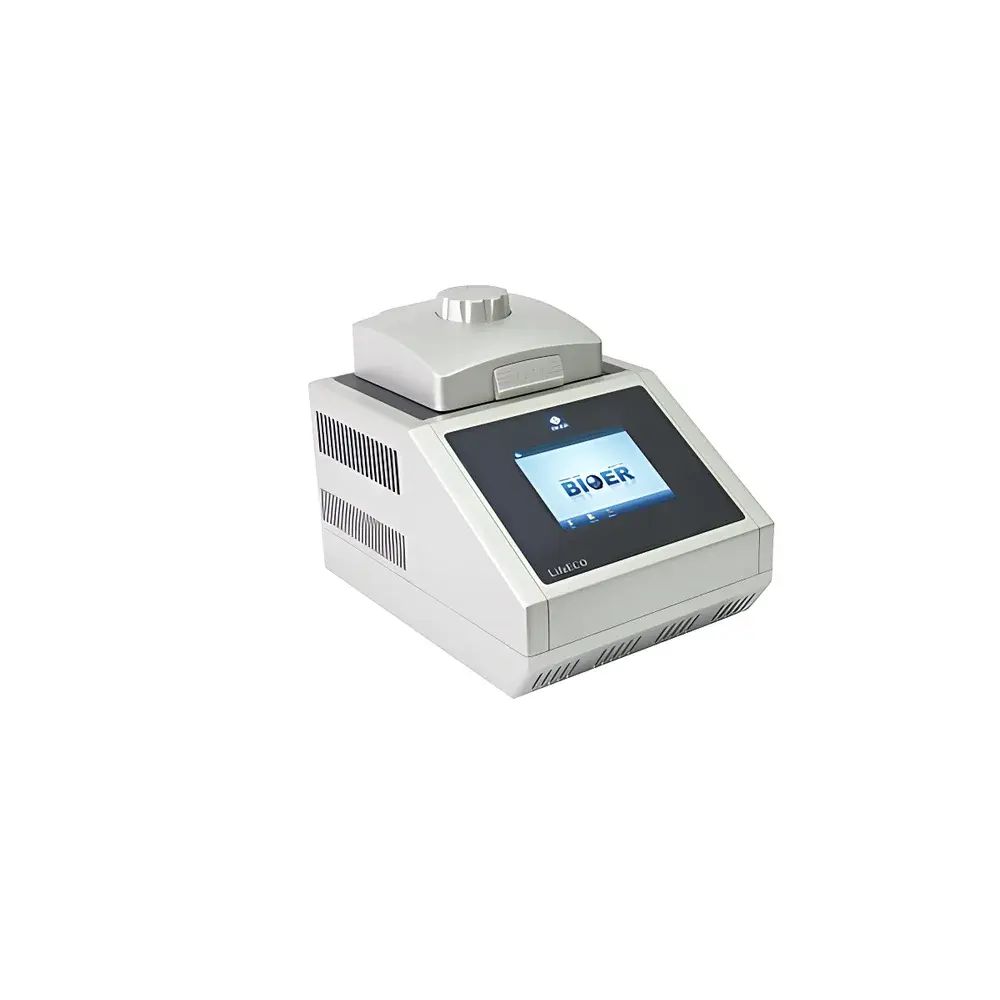
Bioer LifeECO Gradient PCR Thermal Cycler
| Brand | Bioer |
|---|---|
| Origin | Zhejiang, China |
| Model | TC-96/G/H(b)C |
| Instrument Type | Gradient PCR Thermal Cycler |
| Sample Capacity | 96-well |
| Max Heating Rate | ≥4 °C/sec |
| Temperature Accuracy | ≤±0.1 °C |
| Well-to-Well Uniformity | ≤±0.3 °C |
| Temperature Range | 4–105 °C |
| Gradient Range | 1–30 °C |
| Max Cycles | 99 with nested 2-level programming |
| Ramp Rate Adjustment | 0.1–9.9 °C per step (Touchdown PCR) |
| Time Increment/Decrement | 0–9 min 59 sec (Long PCR support) |
| Control Modes | Block mode and simulated tube mode |
| Power Input | AC 100–240 V, 50/60 Hz, 600 W |
| Dimensions (L×W×H) | 345 × 250 × 270 mm |
| Net Weight | 8 kg |
| Interface | USB port |
| Data Protection | Power-fail resume function |
Overview
The Bioer LifeECO Gradient PCR Thermal Cycler is an entry-level, high-reliability thermal cycler engineered for routine qualitative polymerase chain reaction (PCR) applications in academic teaching laboratories, QC/QA environments, and mid-throughput production facilities. It operates on a precision Peltier-based thermoelectric control architecture, delivering rapid and reproducible thermal transitions across a 96-well aluminum block. Unlike real-time quantitative systems, the LifeECO implements endpoint amplification detection—making it optimized for applications where amplicon presence/absence confirmation, genotyping, or preparative DNA synthesis is required. Its robust all-metal chassis, compact footprint, and vibration-dampened mechanical design ensure operational stability in shared lab spaces or mobile field deployment scenarios.
Key Features
- High-performance gradient functionality: A programmable 1–30 °C linear temperature gradient across the 96-well block enables empirical optimization of annealing conditions without iterative single-run experiments—critical for primer validation, multiplex assay development, and troubleshooting suboptimal amplification.
- Dual-mode thermal control: Supports both block-mode (direct plate heating) and simulated tube-mode (algorithmically adjusted ramp profiles mimicking thermal behavior of individual 0.2 mL tubes), improving consistency when using diverse consumables including full-skirt, half-skirt, and unskirted 96-well plates, as well as 0.2 mL single tubes and 8-tube strips.
- Resilient hardware architecture: Modularized thermal module, power supply, and user interface components allow field-level replacement without factory recalibration—reducing downtime during extended usage cycles typical in teaching labs or contract testing facilities.
- Network-ready operation: Equipped with standard USB host interface for firmware updates, protocol transfer, and local data export; optional Ethernet connectivity supports centralized fleet management in multi-cycler installations compliant with internal SOPs for instrument qualification (IQ/OQ).
- Power-fail recovery: Built-in non-volatile memory retains active protocol state and cycle count upon unexpected AC interruption, resuming from the exact step post-reboot—ensuring integrity of time-sensitive Long PCR or nested PCR workflows.
Sample Compatibility & Compliance
The LifeECO accepts industry-standard 0.2 mL PCR consumables without adapter requirements: full-skirt, half-skirt, and unskirted 96-well plates; individual 0.2 mL thin-wall tubes; and 8-tube strips. Its thermal uniformity (≤±0.3 °C well-to-well at 72 °C) and accuracy (≤±0.1 °C at setpoints between 4–105 °C) meet ASTM E2547-22 criteria for thermal performance verification of nucleic acid amplification devices. While not FDA 510(k)-cleared or CE-IVD marked, its design adheres to ISO 13485-aligned manufacturing controls and supports GLP-compliant documentation when paired with Bioer’s validated reagent portfolio—including BioReady Taq mixes (BSA31M1, BSA31M1B), rTaq (BSA121M1), and one-step/two-step RT-PCR kits (BSB07M1, BSB05M1)—all supplied with CoA and lot-specific stability data.
Software & Data Management
The integrated 5.7-inch capacitive color touchscreen runs Bioer’s proprietary firmware v3.2+, supporting intuitive drag-and-drop protocol building, real-time temperature curve visualization, and cycle-by-cycle logging (timestamp, block temp, lid temp, ramp rate). All protocols and run logs are exportable via USB mass storage mode in CSV format for integration into LIMS or ELN systems. Audit trail functionality—though not Part 11-compliant out-of-the-box—can be enabled through external timestamped log capture and manual signature workflows aligned with internal QA procedures. Firmware updates are distributed via Bioer’s secure FTP portal with SHA-256 checksum verification.
Applications
- Undergraduate and graduate molecular biology teaching labs (e.g., DNA barcoding, SNP screening, plasmid colony PCR)
- Food safety testing (pathogen detection: Salmonella, E. coli O157:H7)
- Agricultural biotechnology (GMO screening, varietal identification)
- Environmental microbiology (waterborne pathogen surveillance)
- Preparative amplification for Sanger sequencing, cloning, or NGS library construction
- RT-PCR-based viral RNA detection in biosafety level 2 (BSL-2) settings using validated one-step or two-step kits
FAQ
Is the LifeECO suitable for quantitative PCR (qPCR)?
No—it lacks optical modules for fluorescence detection and is designed exclusively for endpoint PCR. For qPCR, consider Bioer’s LineGene series.
Can I use third-party 96-well plates?
Yes, provided they conform to ANSI/SBS dimensional standards and feature 0.2 mL well volume. Skirt type does not affect thermal performance due to simulated tube-mode compensation.
What maintenance is required beyond routine cleaning?
Annual verification of block calibration against NIST-traceable reference thermometers is recommended. No lubrication or alignment is needed—the Peltier stack and heat sink assembly are sealed and passive-cooled.
Does the device support remote monitoring or cloud connectivity?
Not natively. Remote access requires integration via USB-serial bridge or local network gateway running custom middleware compatible with Modbus RTU or HTTP API endpoints.
How is temperature uniformity verified during installation qualification?
Using a 96-channel thermocouple array (e.g., Fluke 1586A SuperDAQ) placed across the block surface per ASTM E2547 Annex A2, with data logged at 1 Hz over three consecutive 72 °C holds.





