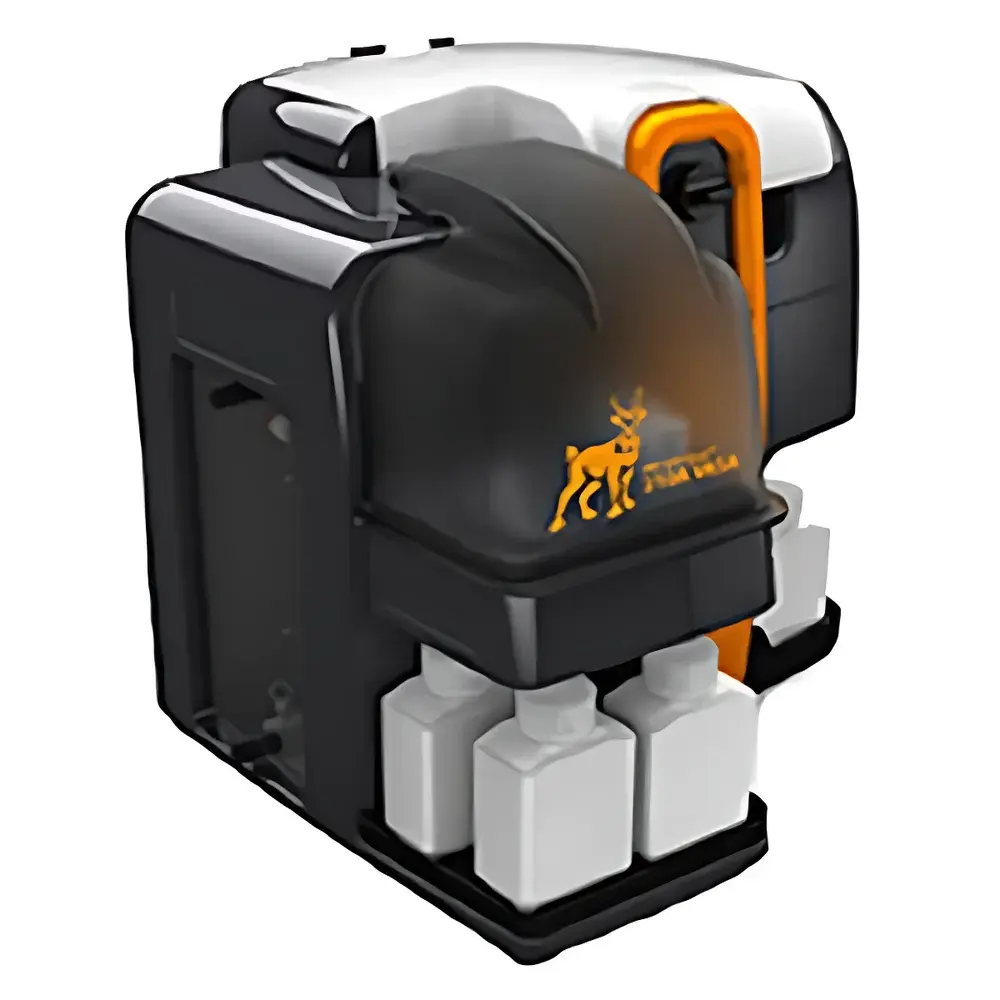
Bionavis MP-SPR Navi 210A VASA Multi-Parameter Surface Plasmon Resonance Analyzer
| Brand | Bionavis |
|---|---|
| Origin | Finland |
| Model | MP-SPR Navi 210A VASA |
| Sample Volume | 250 µL |
| Injection Volume | 50 µL |
| Analysis Time | 5–10 min |
| Temperature Control Range | 15–45 °C (ambient ±7 °C / +20 °C) |
Overview
The Bionavis MP-SPR Navi 210A VASA is a high-precision, label-free multi-parameter surface plasmon resonance (MP-SPR) analyzer engineered for quantitative real-time characterization of molecular interactions, thin-film optical properties, and interfacial phenomena across solid, liquid, and gaseous phases. Unlike conventional angular-interrogation SPR systems limited to single-wavelength, single-angle detection, the MP-SPR 210A implements true angular scanning (40°–78°) with <0.001° angular resolution using a rotating laser and synchronized detector array. This enables full SPR curve acquisition—yielding simultaneous extraction of resonance angle, full-width-at-half-maximum (FWHM), intensity, and phase-derived parameters—thereby supporting independent determination of layer thickness, complex refractive index (n + ik), and binding kinetics without prior assumptions about optical model or homogeneity. The instrument operates on the Kretschmann configuration but eliminates the need for index-matching oil via proprietary prism coupling with integrated optical gel, ensuring rapid sensor exchange, contamination-free sample handling, and compatibility with post-measurement ex situ analysis (e.g., XPS, SEM, AFM).
Key Features
- True angular scanning mode (40°–78°) with 0.001° resolution and sub-2-second full-curve acquisition; supports both MP-SPR mode (full curve) and fixed-angle kinetic mode (1 ms sampling rate)
- Dual independent flow channels with programmable serial/parallel injection; flow rate range: 1–1000 µL/min, integrated degassing unit, and precision syringe pumps
- Standard 670 nm laser per channel; optional L-configuration adds 785 nm for simultaneous dual-wavelength measurement—enabling unambiguous separation of thickness and refractive index in high-RI layers (up to n = 2.7, e.g., diamond-like carbon, crystalline oxides)
- Chemically resistant PEEK flow cell with enlarged internal diameter (optimized for nanoparticle suspensions and viscous polymers); quick-release mechanism enables tool-free replacement in <30 seconds
- Expandable flow cell portfolio: SPR321-EC (electrochemical), SPR310-GS (gas-phase), SPR302-LS (low-dead-volume for fast kinetics), SPR301 (PDMS-based microfluidic), and custom configurations
- Universal sensor compatibility: Au, Ag, Cu, Pt, SiO₂, Al₂O₃, TiO₂, CMD, Ni²⁺-NTA, and other functionalized surfaces; chip holder supports off-line deposition (e.g., dip-coating, spin-coating, ALD)
- PureKinetics™ algorithm corrects for bulk RI shifts arising from buffer composition differences—including up to 5% DMSO—ensuring robust kinetic fitting under physiologically relevant conditions
Sample Compatibility & Compliance
The MP-SPR 210A VASA accommodates diverse sample classes: aqueous and organic solvents (ethanol, acetonitrile), gases (H₂, CO₂, NH₃), colloidal nanoparticles (metallic, polymeric, silica), hydrogels, lipid bilayers, and ultrathin functional coatings (1 Å–10 µm). It meets requirements for GLP-compliant environments through audit-trail-enabled software (MP-SPR Navi™), electronic signature support, and 21 CFR Part 11–ready configuration (optional). All hardware components—including HPLC-grade fluidic lines, PEEK manifolds, and stainless-steel fittings—comply with ISO 8573-1 (compressed air purity) and USP (plastic materials). Sensor surfaces are certified for ISO 10993-5 cytotoxicity testing when used with biocompatible coatings.
Software & Data Management
MP-SPR Navi™ Control and DataViewer software are provided at no additional license cost, supporting Windows 7/8.1/10 (4 GB RAM, 10 GB HDD, USB 2.0). Data export is native to CSV, Excel, and HDF5 formats. LayerSolver™ enables rigorous optical modeling of multilayer stacks using Levenberg–Marquardt fitting against full SPR curves—critical for characterizing graded interfaces, porous films, or anisotropic layers. TraceDrawer™ (optional add-on) delivers global fitting of association/dissociation phases across multiple concentrations, reporting ka (10³–10⁸ M⁻¹s⁻¹), kd (10⁻⁷–0.1 s⁻¹), and KD (10⁻¹²–10⁻³ M) with confidence intervals. All processing steps are scriptable via Python API for integration into automated QC pipelines.
Applications
- Functional Thin Films: Quantitative thickness and n/k mapping of anti-reflective, barrier, photocatalytic, and conductive coatings (e.g., ITO, MoS₂, perovskites) during deposition or environmental exposure
- Nanoparticle Interactions: Real-time monitoring of ligand exchange, protein corona formation, cellular uptake, and triggered release—correlatable with TEM/SEM pre-/post-characterization
- Biosensor Development: Optimization of recognition layer density and orientation; detection of small molecules (e.g., cocaine in saliva, H₂ on Pd) with sub-100 Da sensitivity in liquid phase
- Electrochemical-SPR Coupling: Synchronized potentiostatic control and optical readout for studying redox-driven swelling, ion insertion, or catalytic surface reactions
- Soft Matter & Biomaterials: Hydration-dependent swelling kinetics of hydrogels, polymer brush collapse, and antimicrobial peptide membrane disruption without labeling artifacts
FAQ
What is the minimum detectable molecular weight in liquid phase?
The system resolves analytes down to <100 Da in aqueous solution (e.g., glycine, acetate), validated via direct binding to immobilized receptors.
Can MP-SPR measure films thicker than 1 µm?
Yes—within physical limits of evanescent field penetration (~200–300 nm for visible light)—but thickness quantification relies on optical modeling; layers >500 nm require multi-wavelength or spectroscopic extension.
Is temperature control precise enough for thermodynamic binding studies?
The Peltier-based stage maintains ±0.1 °C stability over 24 h, enabling van’t Hoff analysis across the 15–45 °C operational range.
How does MP-SPR differ from Biacore-class instruments?
MP-SPR uses angular interrogation rather than wavelength scanning, avoids gold-coated chips and index-matching oil, supports higher RI substrates, and provides intrinsic thickness/refractive index decoupling—making it suitable for materials science beyond biomolecular interaction analysis.
Are service contracts mandatory?
No—hardware is designed for user-level maintenance; HPLC-compatible fluidics allow straightforward replacement of pumps, valves, and tubing without factory intervention.