
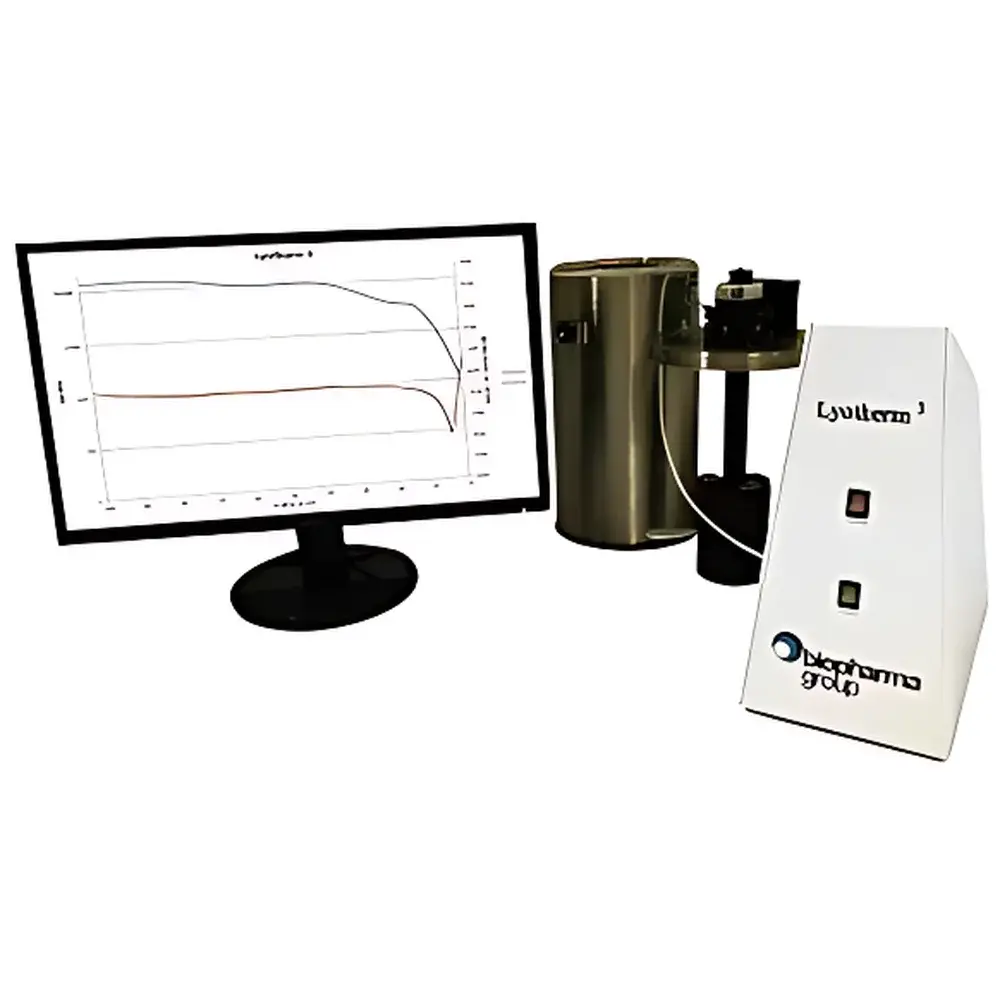
Biopharma Lyotherm3 Cryostate Analyzer
| Brand | Biopharma |
|---|---|
| Origin | United Kingdom |
| Manufacturer Type | Authorized Distributor |
| Import Status | Imported |
| Model | Lyotherm3 |
| Pricing | Available Upon Request |
Overview
The Biopharma Lyotherm3 Cryostate Analyzer is an advanced dual-mode analytical instrument engineered for real-time, in-situ characterization of materials undergoing cryogenic processing—particularly during freezing, annealing, and lyophilization (freeze-drying) cycles. Unlike conventional thermal analyzers, the Lyotherm3 integrates simultaneous Differential Thermal Analysis (DTA) and fixed-frequency impedance spectroscopy (Z·sinφ) within a single, thermally stabilized measurement chamber. This co-registered approach enables concurrent detection of both enthalpic transitions (e.g., glass transition temperature *Tg′*, eutectic melting, crystallization onset) and dielectric responses linked to molecular mobility in the frozen matrix. The instrument operates under controlled cooling/heating rates (±0.1–10 °C/min), with high-stability platinum resistance thermometry and calibrated reference compensation—ensuring traceable, reproducible data aligned with ICH Q5C and USP guidelines for lyophilized product development.
Key Features
- Dual-sensor architecture: Synchronized DTA and impedance acquisition at 1 kHz fixed frequency, eliminating temporal misalignment between thermal and dielectric events
- Cryostatic temperature range: –80 °C to +60 °C, with ±0.05 °C thermal stability over 30-minute dwell periods
- Impedance sensitivity: Detects sub-microsiemens conductivity shifts correlated with ice nucleation kinetics and amorphous phase rigidity
- Modular sample holder: Compatible with standard 10–20 µL volume vials (Type I borosilicate), enabling direct process-representative measurements without reconstitution
- Robust thermal shielding and electromagnetic isolation: Minimizes noise coupling during low-signal impedance acquisition in cryogenic environments
- FDA 21 CFR Part 11–compliant firmware: Audit trail logging, electronic signatures, and user-access-level controls preconfigured for GMP/GLP environments
Sample Compatibility & Compliance
The Lyotherm3 supports aqueous and non-aqueous formulations commonly encountered in biopharmaceutical development—including monoclonal antibodies, recombinant proteins, mRNA-LNPs, and small-molecule APIs in cryoprotectant matrices (e.g., sucrose, trehalose, mannitol). It accommodates both homogeneous solutions and heterogeneous suspensions, provided particulate size remains below 50 µm to ensure uniform field distribution during impedance measurement. All hardware and software modules comply with ISO/IEC 17025 calibration traceability requirements. Data output formats (CSV, XML) support integration into LIMS and electronic lab notebook (ELN) platforms. The system meets essential safety standards per IEC 61010-1 and electromagnetic compatibility (EMC) requirements under EN 61326-1.
Software & Data Management
Lyotherm Control Suite v4.2 provides synchronized visualization of DTA heat flow (µW/mg) and impedance-derived loss factor (Z·sinφ, dimensionless) on shared time–temperature axes. Peak deconvolution algorithms identify overlapping transitions (e.g., *Tg′* and devitrification) using derivative-based inflection detection. Raw data files include full metadata: operator ID, instrument serial number, calibration certificate expiry, ambient humidity/pressure logs, and thermal ramp history. Export options include ASTM E1356–compatible DTA reports and custom templates aligned with internal SOPs for freeze-drying cycle design (e.g., primary drying shelf temperature qualification). All software updates undergo version-controlled validation per Annex 11 principles.
Applications
- Optimization of freeze-drying cycle parameters by identifying critical temperatures (*Tg′*, collapse temperature *Tc*) and detecting latent crystallization during annealing
- Comparative assessment of formulation robustness across excipient blends, including detection of mannitol polymorphic conversion not resolvable by DSC alone
- Stability monitoring of cryopreserved cell therapies—tracking ice recrystallization and membrane integrity loss via impedance hysteresis
- Root-cause analysis of vial breakage or cake heterogeneity through correlation of mechanical stiffening (impedance rise) with exothermic events (DTA peaks)
- Supporting regulatory filings with orthogonal, process-relevant data meeting ICH Q5A(R2) and Q5C expectations for structural characterization of frozen intermediates
FAQ
How does Lyotherm3 differ from conventional DSC or DTA instruments?
It adds impedance-derived molecular mobility data—capturing dynamic changes in frozen-state rigidity that are thermally silent but mechanistically significant for product stability.
Can Lyotherm3 replace my existing DSC system?
No—it complements DSC by providing orthogonal information; DSC remains preferred for absolute enthalpy quantification, while Lyotherm3 excels in detecting subtle, non-enthalpic transitions during freezing.
Is calibration traceable to national standards?
Yes—temperature calibration uses NIST-traceable Pt100 sensors; impedance calibration employs certified precision resistors and capacitors per ISO/IEC 17025.
What sample preparation is required?
Minimal: Samples are loaded directly into standard lyophilization vials; no pelletizing, encapsulation, or electrode modification is needed.
Does the system support automated method sequencing?
Yes—up to 24 pre-programmed thermal–impedance protocols can be queued, with inter-run auto-zeroing and baseline correction enabled.





