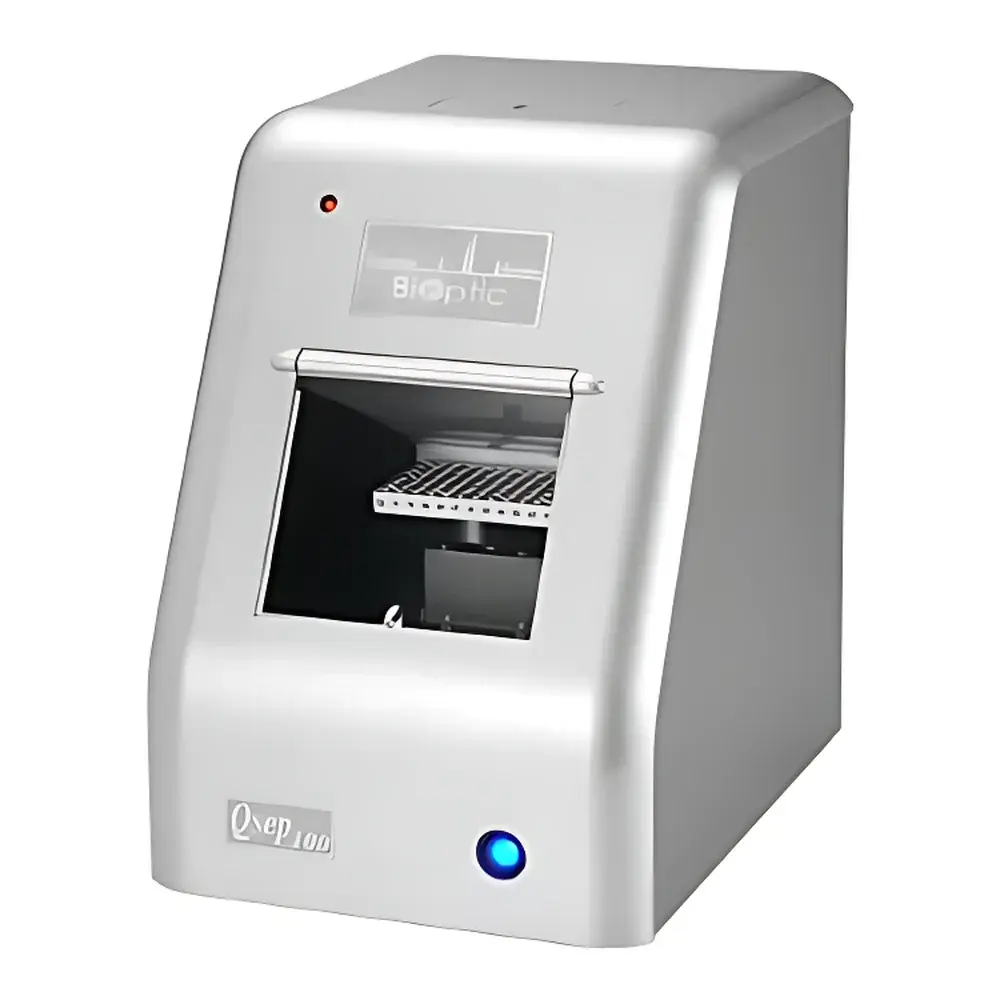
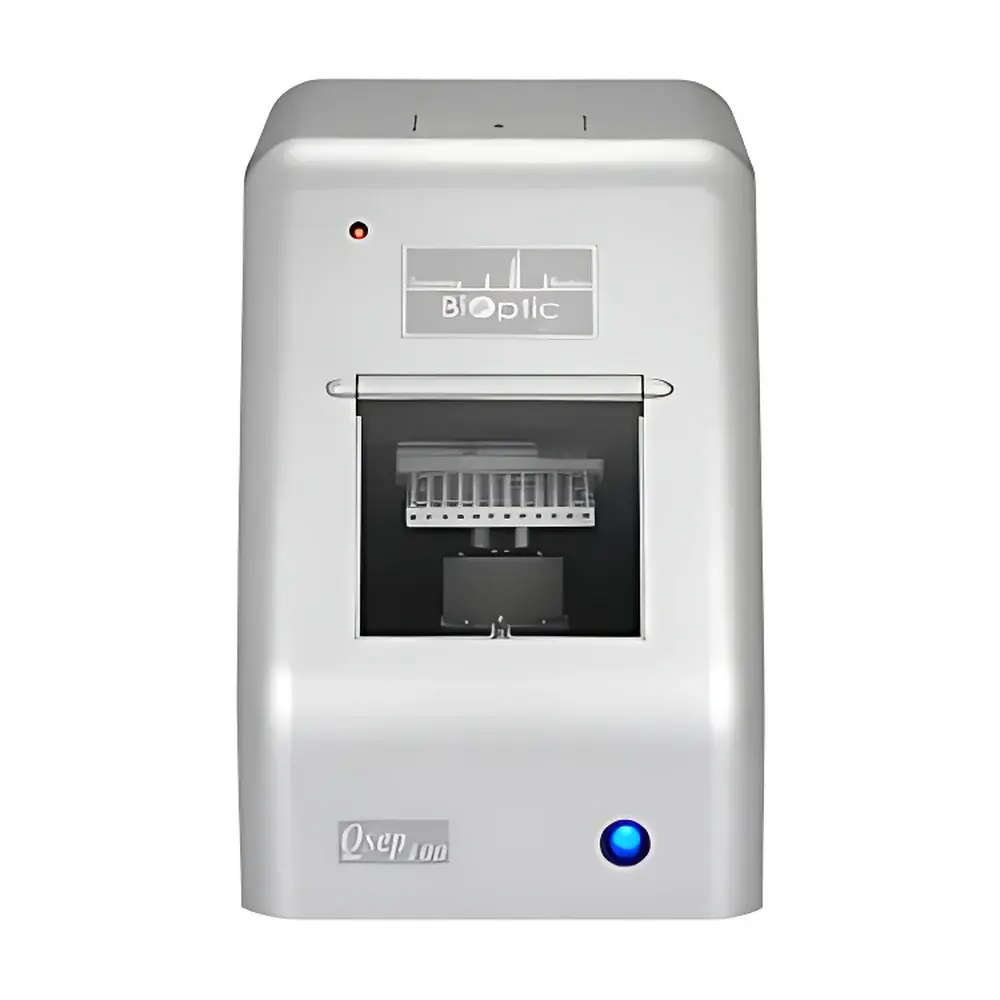
Bioptic Qsep100 Automated Nucleic Acid and Protein Analysis System
| Brand | Bioptic |
|---|---|
| Model | Qsep100 |
| Origin | Jiangsu, China |
| Instrument Type | Ultra-micro Nucleic Acid and Protein Analyzer |
| Sample Volume Requirement | 1 µL |
| Distribution Channel | Authorized Distributor (Non-Manufacturer) |
| Category | Benchtop Capillary Electrophoresis System |
Overview
The Bioptic Qsep100 Automated Nucleic Acid and Protein Analysis System is a benchtop capillary electrophoresis (CE)-based platform engineered for rapid, reproducible, and high-resolution analysis of nucleic acids and proteins. Unlike traditional slab-gel electrophoresis, the Qsep100 employs disposable polymer-based capillary arrays with integrated detection optics to deliver quantitative electropherogram data in under 3 minutes per sample. Its core measurement principle relies on size-based separation under an applied electric field, coupled with real-time UV absorbance detection at 260 nm (nucleic acids) and 280 nm (proteins), enabling simultaneous sizing, quantification, and integrity assessment. Designed for routine laboratory workflows—including QC of PCR products, plasmid preps, RNA integrity checks, and protein purity verification—the system eliminates manual gel pouring, staining, and imaging while maintaining analytical rigor comparable to certified CE methods referenced in ISO/IEC 17025-accredited environments.
Key Features
- Ultra-low sample consumption: Requires only 1 µL of undiluted sample—ideal for precious or low-yield isolates such as single-cell lysates or FFPE-derived nucleic acids.
- Automated workflow: Fully integrated sample loading, separation, detection, and data reporting without user intervention beyond initial plate setup.
- High-resolution separation: Resolves DNA fragments from 25 bp to 50 kb and RNA species from 5S to 28S rRNA with ≤10% CV for fragment sizing across runs.
- Disposable capillary cartridges: Pre-filled, factory-calibrated arrays eliminate carryover risk and reduce maintenance downtime; each cartridge supports up to 96 samples.
- Built-in UV-Vis spectrophotometric detection: Dual-wavelength (260/280 nm) absorbance quantification with dynamic range spanning 0.1–500 ng/µL for dsDNA and 0.05–200 mg/mL for BSA-equivalent proteins.
- Compact footprint: Occupies less than 0.25 m² of bench space and operates without external cooling or high-pressure gas sources.
Sample Compatibility & Compliance
The Qsep100 accepts a broad range of biological matrices including purified PCR amplicons, restriction digests, plasmid preps, total RNA, mRNA-enriched fractions, and denatured or native protein lysates. It supports standard molecular biology buffers (TAE, TBE, MOPS) and common denaturants (formaldehyde, glyoxal, urea). While not validated for clinical diagnostics under CLIA or IVD directives, the system complies with general laboratory equipment safety standards (IEC 61010-1) and supports GLP-aligned documentation practices via audit-trail-enabled software export. Raw electropherogram data and metadata are exportable in CSV and .qsep formats compatible with third-party analysis tools used in academic and industrial R&D settings.
Software & Data Management
The QsepView™ desktop application provides intuitive instrument control, real-time electropherogram visualization, and automated band-calling using adaptive peak detection algorithms. All analyses generate standardized reports containing fragment size, concentration, % distribution, and integrity metrics (e.g., RIN-equivalent scores for RNA). The software enforces role-based access control, electronic signature support, and full audit trail logging per FDA 21 CFR Part 11 requirements when deployed in regulated environments. Data backups are performed automatically to network drives or local SSDs, and raw files retain embedded calibration and run-condition metadata for traceability.
Applications
- Routine QC of cloning constructs and CRISPR editing outcomes
- Assessment of RNA integrity prior to library preparation for NGS
- Verification of siRNA/shRNA duplex formation and stability
- Fast screening of protein expression and purification fractions (e.g., His-tagged eluates)
- Monitoring degradation kinetics in accelerated stability studies
- Educational use in undergraduate molecular biology laboratories
FAQ
Does the Qsep100 require special buffer reagents or proprietary consumables?
Yes—the system operates exclusively with Bioptic-certified capillary cartridges and配套 separation matrices. These are supplied as sealed, ready-to-use kits with lot-specific calibration certificates.
Can the Qsep100 replace agarose or polyacrylamide gel electrophoresis in regulatory submissions?
It may be used as a supporting analytical method where CE-based characterization is scientifically justified; however, formal method validation per ICH Q2(R2) is required prior to inclusion in regulatory dossiers.
Is remote monitoring or integration with LIMS supported?
The QsepView software includes RESTful API endpoints for LIMS integration and supports scheduled remote status queries via secure SSH tunneling.
What is the typical maintenance interval for the optical detection module?
No routine optical alignment or lamp replacement is required; the solid-state UV-LED light source has a rated lifetime exceeding 10,000 hours.
How does the system handle viscous or particulate-containing samples?
Samples must be clarified by centrifugation (≥12,000 × g, 5 min) and filtered through 0.22 µm PVDF membranes prior to loading to prevent capillary clogging.