
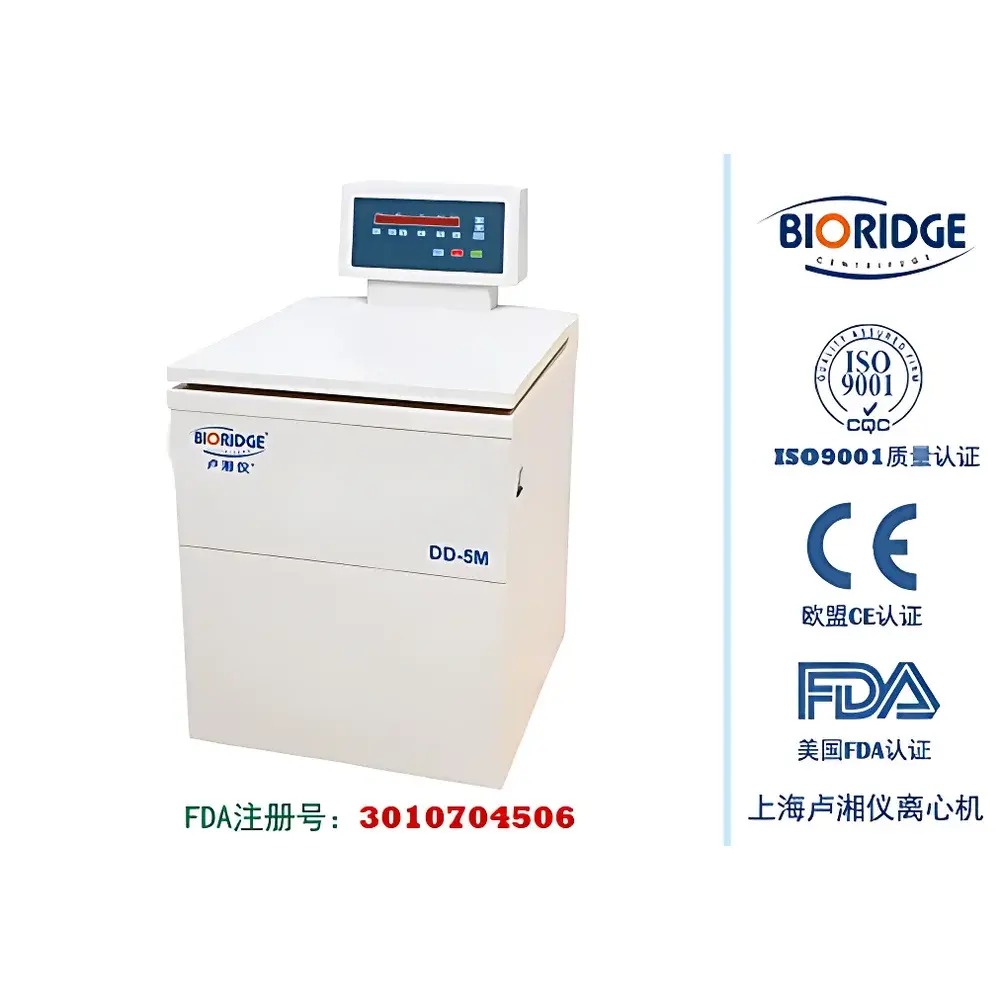
BIORIDGE DD-5M Floor-Standing Low-Speed Centrifuge
| Brand | BIORIDGE |
|---|---|
| Origin | Shanghai, China |
| Model | DD-5M |
| Instrument Type | Floor-standing centrifuge |
| Centrifuge Class | Low-speed centrifuge (max. 5000 rpm) |
| Max. Capacity | 4 × 750 mL |
| Max. Speed | 5000 rpm |
| Max. RCF | 3780 × g |
| Dimensions (L×W×H) | 650 mm × 710 mm × 1100 mm |
| Noise Level | <65 dB(A) |
| Power Supply | AC 220 V, 50 Hz, 20 A |
| Net Weight | 140 kg |
| Speed Accuracy | ±50 rpm |
| Timer Range | 1–99 min |
| Acceleration/Deceleration Profiles | 10 programmable ramp curves |
| Rotor Types | Horizontal swing-out rotors only |
| Compatible Sample Vessels | 7 mL × 37 × 4, 50 mL × 6 (with 15/20 mL adapters), 750 mL × 4, 500 mL × 4, 96-well microplate (×8 or ×4×2 configurations) |
Overview
The BIORIDGE DD-5M is a floor-standing, microprocessor-controlled low-speed centrifuge engineered for high-capacity, routine separation tasks in clinical laboratories, blood banks, bioprocessing facilities, and academic research settings. It operates on the principle of sedimentation under gravitational force enhancement—utilizing horizontal swing-out rotor geometry to generate reproducible relative centrifugal force (RCF) profiles across large-volume samples. With a maximum speed of 5000 rpm and a peak RCF of 3780 × g, the DD-5M is optimized for pelleting whole cells, large organelles (e.g., nuclei, mitochondria), and viral particles from clarified lysates or serum preparations—aligning with ISO 15189 and CLSI EP05-A3 guidelines for analytical precision in diagnostic centrifugation.
Key Features
- Brushless AC frequency-controlled motor delivering stable rotational dynamics, low mechanical vibration, and acoustic emission ≤65 dB(A) at full load—critical for shared laboratory environments.
- Intuitive 7-inch capacitive touch interface with real-time dual-unit display (rpm / RCF), enabling immediate parameter conversion without manual calculation or external reference tools.
- Programmable memory supporting up to 10 user-defined acceleration and deceleration ramp profiles—essential for preserving shear-sensitive biological matrices such as peripheral blood mononuclear cells (PBMCs) or exosome suspensions.
- Comprehensive safety architecture including electromagnetic door interlock, automatic lid lock detection, overspeed cutoff, imbalance sensing (±5 g mass differential threshold), and thermal monitoring with audible/visual fault alerts.
- Non-volatile parameter storage retains up to 10 preconfigured protocols—including time, speed, RCF, and ramp profiles—between power cycles, ensuring GLP-compliant workflow continuity.
Sample Compatibility & Compliance
The DD-5M accommodates a broad spectrum of primary sample containers via interchangeable horizontal rotors: standard conical tubes (7 mL, 15 mL, 20 mL, 50 mL), high-capacity bottles (500 mL and 750 mL), and standardized 96-well microplates (single or stacked configurations). All rotor assemblies are dynamically balanced per ISO 19438 and certified for continuous operation at rated speeds. The instrument complies with IEC 61010-1:2010 (Safety Requirements for Electrical Equipment for Measurement, Control, and Laboratory Use) and meets EMC standards per IEC 61326-1:2020. While not refrigerated, its ambient-temperature operation conforms to USP sterility testing requirements where thermal stability of test samples is maintained externally.
Software & Data Management
The DD-5M operates autonomously without PC dependency; however, all run logs—including start/stop timestamps, actual vs. set speed, final RCF, elapsed time, and fault codes—are retained in internal memory for audit trail reconstruction. Optional RS-232 or USB-C data export (via accessory module) enables integration into LIMS or ELN systems compliant with FDA 21 CFR Part 11 when paired with validated electronic signature workflows. No proprietary software installation is required—raw log files export as plain-text CSV for traceability and retrospective analysis.
Applications
- Routine blood component separation: erythrocyte sedimentation rate (ESR) assays, platelet-rich plasma (PRP) preparation, and buffy coat isolation per AABB Technical Manual Chapter 12.
- Cell culture harvest: scalable pelleting of adherent and suspension mammalian cell lines (e.g., CHO, HEK293) prior to lysis or cryopreservation.
- Virology workflows: concentration of enveloped and non-enveloped viruses (e.g., influenza A, adenovirus) from clarified tissue culture supernatants using low-shear deceleration profiles.
- Environmental microbiology: sedimentation of activated sludge flocs or biofilm fragments from wastewater effluent for downstream qPCR or metagenomic sequencing.
- Industrial QC: solid-liquid phase separation in pharmaceutical excipient slurries or vaccine adjuvant formulations prior to filtration validation.
FAQ
What is the maximum permissible imbalance tolerance for safe operation?
The DD-5M detects mass asymmetry exceeding ±5 g between opposing buckets and halts rotation immediately. This threshold is calibrated during factory acceptance testing per ISO 19438 Annex B.
Can the DD-5M be used for density gradient centrifugation?
No—the absence of refrigeration, precise temperature control, and fixed-angle rotor options limits its suitability for sucrose or iodixanol gradient applications requiring thermal stabilization and high angular momentum.
Is rotor NO.3 (750 mL × 4) autoclavable?
All aluminum swing-out rotors are rated for steam sterilization at 121 °C for 20 minutes; however, repeated autoclaving may affect anodized surface integrity—BIORIDGE recommends chemical disinfection (70% ethanol or 0.5% sodium hypochlorite) for routine decontamination.
Does the instrument support remote monitoring or network connectivity?
Standalone operation is standard; Ethernet or Wi-Fi modules are not integrated but can be added via third-party industrial IoT gateways compatible with Modbus RTU protocol.
What documentation is provided for regulatory audits?
Each unit ships with a Factory Calibration Certificate (traceable to NIM China), CE Declaration of Conformity, IEC 61010-1 Test Report, and a complete set of maintenance logs pre-populated with first-use verification data.



