
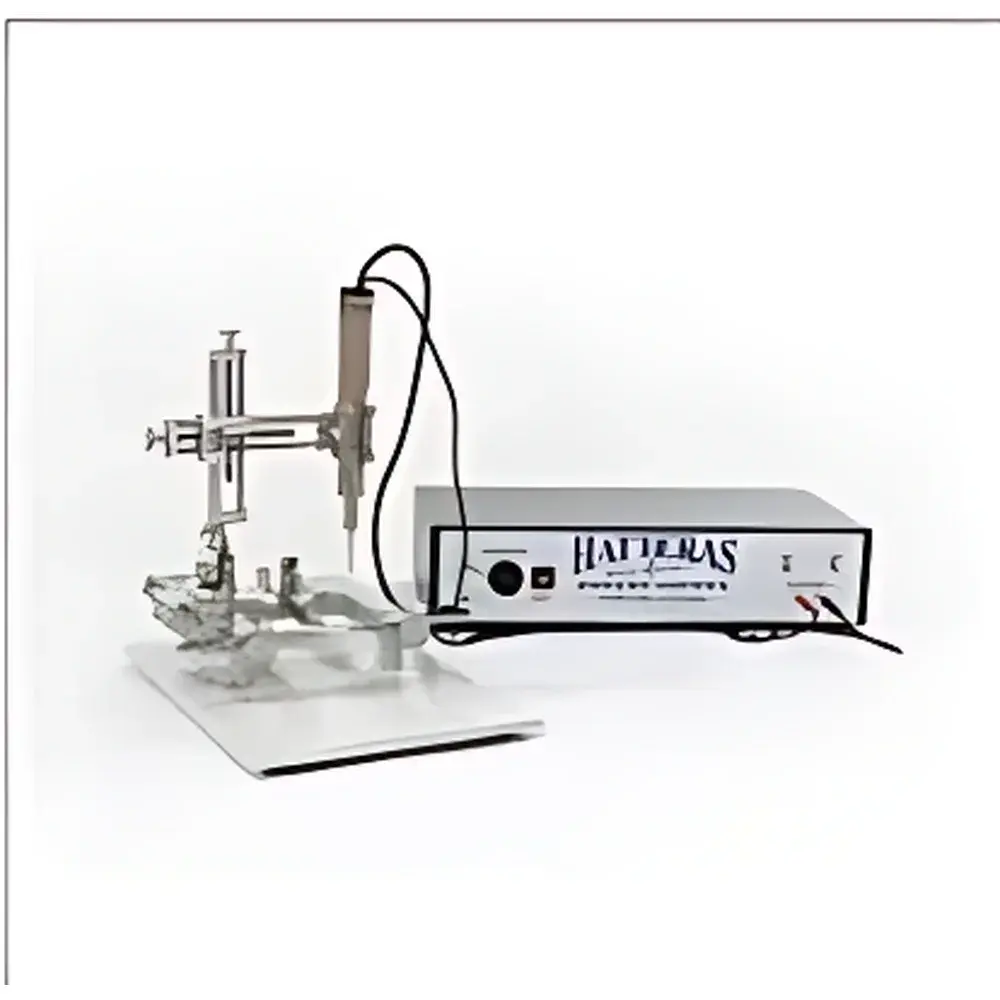
PinPoint Cranial Impactor for Traumatic Brain Injury Research
| Origin | USA |
|---|---|
| Manufacturer Type | Authorized Distributor |
| Origin Category | Imported |
| Model | PinPoint |
| Pricing | Available Upon Request |
Overview
The PinPoint Cranial Impactor is a precision-engineered, microprocessor-controlled impact device designed for reproducible and quantifiable induction of traumatic brain injury (TBI) and spinal cord injury (SCI) in preclinical rodent models. It operates on electromagnetic actuation principles, delivering controlled mechanical force via a linear motor-driven impactor arm. Unlike pneumatic or gravity-based systems, the PinPoint utilizes direct electromagnetic propulsion to achieve high-fidelity velocity control (0–3 m/s and 6 m/s selectable ranges), sub-millimeter depth resolution (0–5 mm adjustable), and millisecond-accurate dwell time—critical parameters for modeling biomechanically relevant injury severities. Its modular architecture integrates seamlessly with stereotaxic frames, enabling precise spatial registration relative to bregma or anatomical landmarks under surgical microscopy. The system adheres to established preclinical TBI modeling standards, supporting controlled cortical impact (CCI), fluid percussion injury (FPI)-adjacent protocols, and targeted spinal cord compression paradigms.
Key Features
- Electromagnetic linear actuation ensures repeatable velocity profiles without gas supply dependencies or mechanical wear associated with solenoid or pneumatic systems.
- Seven interchangeable impact tips (1.0, 1.5, 2.0, 2.5, 3.0, 4.0, and 5.0 mm diameter) fabricated from medical-grade stainless steel; custom tip geometries (flat, hemispherical, angled) available upon request for specialized biomechanical loading conditions.
- Real-time digital display with rotary encoder interface for intuitive setting of impact velocity, penetration depth (±0.05 mm resolution), and dwell time (1–500 ms range).
- Integrated contact sensor with 360° rotational capability enables angular alignment independent of stereotaxic frame orientation—essential for oblique impact trajectories mimicking rotational acceleration components of human TBI.
- Dual-mode operation: fixed-angle mounting via stereotaxic adapter or free-standing configuration using articulated support arm with lockable joints.
- Motor-isolated design—only the impactor arm moves during actuation, preserving motor longevity and minimizing vibration transmission to the surgical platform.
Sample Compatibility & Compliance
The PinPoint system is validated for use with adult and juvenile Sprague-Dawley, Wistar, and C57BL/6 mice and rats (20–300 g body weight). All hardware complies with IEC 61000-6-2 (electromagnetic immunity) and IEC 61000-6-4 (emission) standards. Software execution meets ALARA (As Low As Reasonably Achievable) principles for experimental animal welfare and supports documentation traceability required under AAALAC International accreditation guidelines. Data acquisition logs—including timestamped velocity curves, depth displacement profiles, and dwell duration—are exportable in CSV and MATLAB-compatible formats for GLP-compliant reporting.
Software & Data Management
PinPoint™ GUI software runs on Windows 10/11 (64-bit) and requires no additional runtime libraries. The interface provides point-and-click configuration of all operational parameters, real-time visualization of impact kinematics, and automated session logging with metadata tagging (operator ID, animal ID, date/time, protocol version). Each impact event generates a synchronized waveform file (.pnt) containing position vs. time, force derivative estimation (via calibrated load cell integration option), and trigger markers. Audit trails are retained locally with optional network share backup. The software supports FDA 21 CFR Part 11 compliance when deployed with institutional IT-managed domain authentication and electronic signature modules.
Applications
- Controlled cortical impact (CCI) modeling of focal TBI with tunable contusion volume and white matter shear strain.
- Spinal cord compression injury studies requiring consistent dorsoventral or lateral force application.
- Validation of neuroprotective therapeutics across graded injury severities (mild/moderate/severe).
- Mechanistic investigation of axonal injury kinetics using high-speed imaging synchronized with impact onset.
- Functional recovery assessment correlated with histopathological endpoints (e.g., Fluoro-Jade C staining, myelin basic protein immunohistochemistry).
- Multi-modal integration with electrophysiology rigs for evoked potential recording during impact-induced neural disruption.
FAQ
Is the PinPoint system compatible with third-party stereotaxic frames?
Yes—it includes standardized mounting brackets for Kopf, Stoelting, and David Kopf Instruments stereotaxic systems, with CAD drawings available for custom adapter fabrication.
Can impact force be directly measured, or is it derived from velocity and mass?
The base system reports kinematic parameters; optional integrated piezoresistive load cells (model LC-PIN-200N) enable direct force measurement up to 200 N with ±0.5% full-scale accuracy.
What sterilization methods are approved for impact tips?
Tips are autoclavable at 121°C, 15 psi for 20 minutes; ethylene oxide and hydrogen peroxide plasma sterilization are also validated.
Does the software support batch protocol deployment across multiple animals?
Yes—protocol templates can be saved, version-controlled, and loaded sequentially with automatic session ID incrementation and operator login tracking.
Is technical support available for protocol optimization and histology correlation?
Application scientists provide remote consultation for impact parameter selection aligned with specific injury phenotypes (e.g., edema vs. hemorrhage dominance) and recommended post-injury sampling timelines.




