
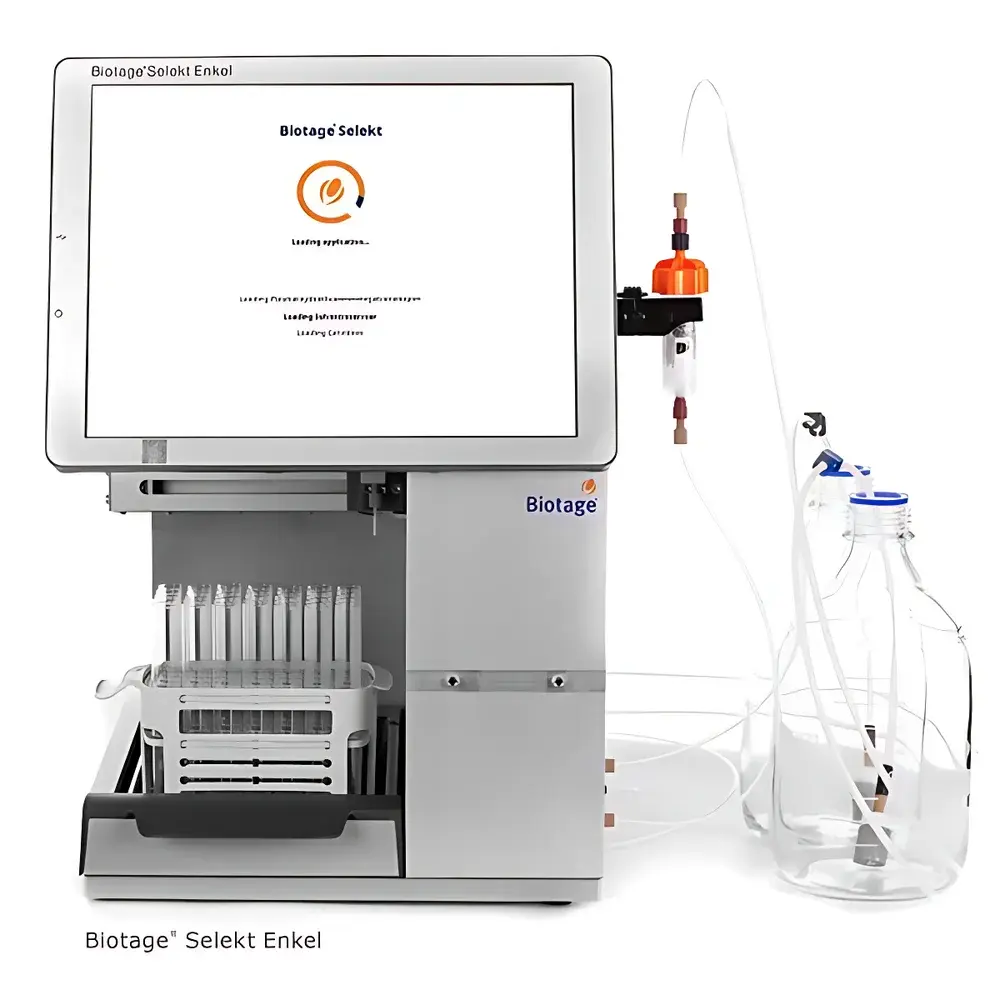
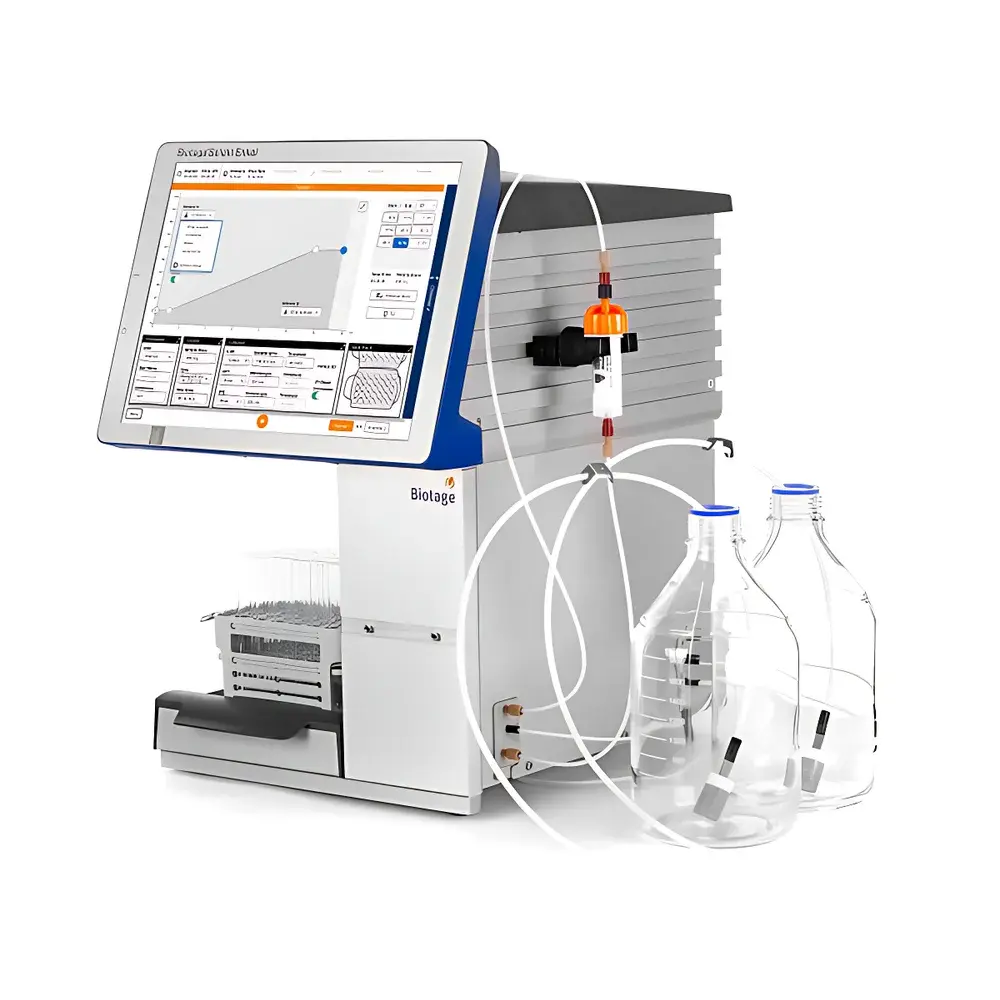
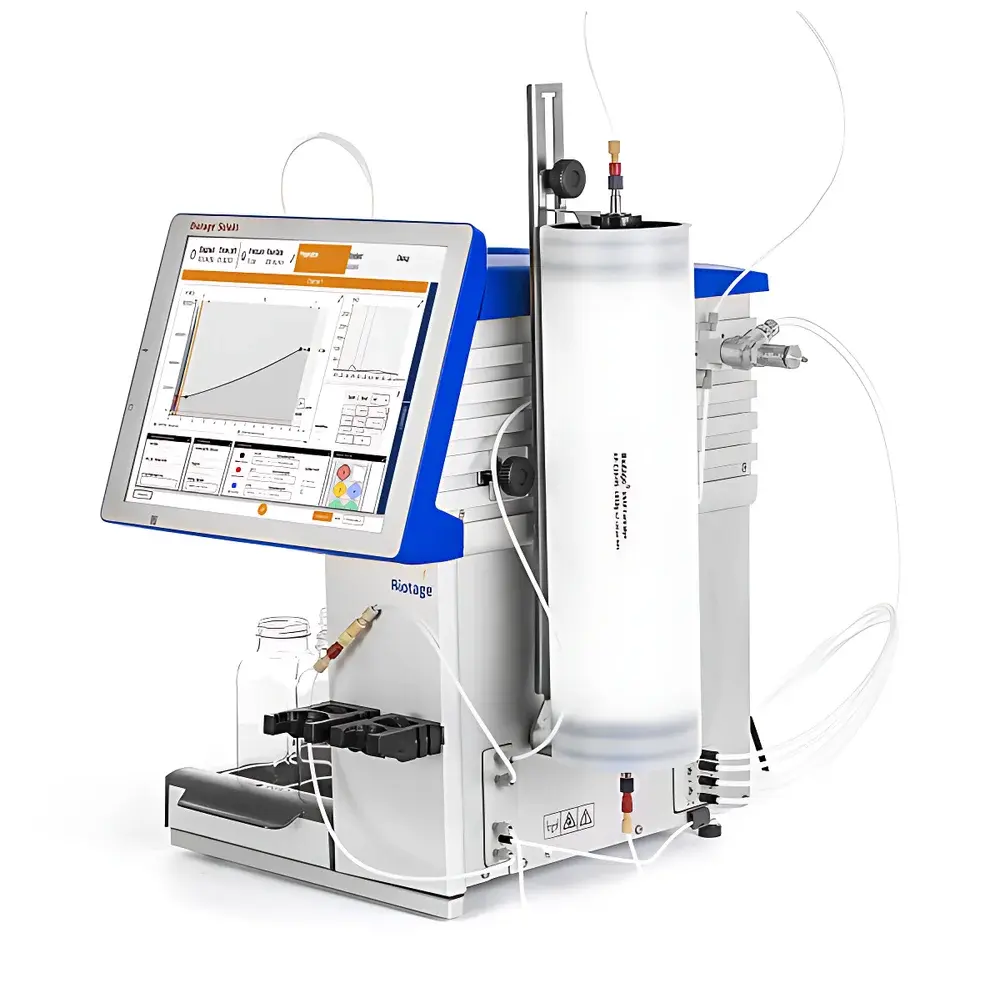
Biotage Selekt Enkel Medium-Pressure Preparative Liquid Chromatography System
| Brand | Biotage |
|---|---|
| Origin | Sweden |
| Model | Selekt Enkel |
| Application Level | Laboratory Grade |
| Instrument Type | Medium-to-Low Pressure Preparative LC |
| Flow Rate Range | 1–150 mL/min |
| Flow Accuracy | RSD ≤ 0.5% |
| Flow Precision | RSD ≤ 0.2% |
| Maximum Operating Pressure | 15 bar |
| Wavelength Range | 198–810 nm |
| Wavelength Repeatability | ±0.1 nm |
| Baseline Noise | ≤2×10⁻⁵ AU (peak-to-peak, methanol, 1 mL/min, 254 nm, 20 °C) |
| Data Acquisition Rate | 10 Hz |
Overview
The Biotage® Selekt Enkel is a dedicated medium-pressure preparative liquid chromatography (PLC) system engineered for high-efficiency flash purification of small- to medium-scale synthetic compounds in research and development laboratories. Built upon Biotage’s proven flash chromatography platform, the Selekt Enkel employs a dual-piston, pulse-free reciprocating pump architecture to deliver precise, reproducible solvent delivery across its full flow range (1–150 mL/min) at pressures up to 15 bar. Its core separation principle relies on normal-phase or reversed-phase liquid chromatography, with real-time UV/Vis detection enabling fraction-triggered collection based on absorbance thresholds or time windows. Designed for robustness and operational longevity, the system integrates thermally stabilized optics, low-dead-volume fluidics, and a sealed optical path to ensure signal stability under continuous operation—critical for method transfer and regulatory-compliant workflows.
Key Features
- Dual-solvent, single-channel configuration with integrated high-precision dual-piston pump—ensuring flow accuracy ≤0.5% RSD and repeatability ≤0.2% RSD across the entire operating range.
- UV/Vis detector with broad spectral coverage (198–810 nm), factory-calibrated wavelength accuracy (±0.1 nm), and low baseline noise (≤2×10⁻⁵ AU, peak-to-peak), supporting both fixed-wavelength and dual-wavelength monitoring.
- 15-inch capacitive touchscreen interface running a custom Linux-based OS—providing responsive, deterministic control, intuitive workflow navigation, and seamless English/Chinese language switching without system reboot.
- Intelligent fraction collection logic including automatic tube-switching pause, 2-column-volume (2CV) rapid column equilibration protocol, and programmable collection triggers (absorbance threshold, time window, or slope-based).
- Modular expansion architecture: supports optional upgrades such as full-spectrum UV scanning (190–810 nm), RFID-enabled fraction rack recognition, dual-collection bed configuration, and integration with Biotage DLV dry-load sample introduction modules.
- Energy-optimized design: compatible with high-efficiency Sfär™ silica columns that maintain resolution at elevated flow rates—reducing solvent consumption by up to 30% compared to conventional flash systems operating at equivalent loading capacity.
Sample Compatibility & Compliance
The Selekt Enkel accommodates standard flash cartridges (10 g to 200 g silica or bonded-phase media) and is validated for use with common organic solvents (hexane, ethyl acetate, methanol, acetonitrile, DCM) and aqueous buffers (pH 2–8). It meets mechanical and electrical safety requirements per IEC 61010-1:2010 and carries CE marking for laboratory instrumentation. While not certified for GMP production environments, the system supports GLP-aligned documentation practices through audit-trail-enabled software (optional with Selekt Control Suite v3.0+), including user login tracking, method versioning, and electronic signature support compliant with FDA 21 CFR Part 11 when deployed with validated IT infrastructure. All UV detector calibrations follow NIST-traceable procedures using holmium oxide and didymium reference filters.
Software & Data Management
Control and data acquisition are managed via Biotage Selekt Control Software—a native Linux application offering real-time chromatogram visualization, method editor with gradient programming (up to 8-step linear or step gradients), and automated report generation (PDF/CSV export). Raw detector data is stored in vendor-neutral .csv format with timestamped metadata (flow rate, pressure, lamp status, temperature). The software supports method locking, user permission levels (admin/operator/observer), and secure network deployment in multi-instrument lab networks. Optional cloud synchronization enables remote method backup and cross-site method sharing—subject to local data governance policies. All firmware updates are digitally signed and installed via USB or Ethernet, preserving configuration integrity during upgrade cycles.
Applications
- Routine purification of synthetic intermediates and final APIs in medicinal chemistry campaigns (≤200 mg scale).
- Isolation of natural product fractions from crude extracts using gradient elution protocols.
- Method scouting and optimization for downstream HPLC or SFC analysis—leveraging consistent retention behavior between flash and analytical conditions.
- Supporting parallel synthesis workflows where rapid turnaround (<30 min/run) and minimal operator intervention are required.
- Educational use in university teaching labs for chromatographic theory demonstration, including band broadening, resolution calculation, and solvent strength effects.
FAQ
What column sizes is the Selekt Enkel validated for?
The system is optimized for flash cartridges ranging from 10 g to 200 g, including standard Biotage Isolera™ and Sfär™ columns. Larger formats (e.g., 340 g) may be used with flow-rate derating and pressure monitoring.
Can the UV detector perform full-spectrum scans out of the box?
No—the base configuration supports dual fixed-wavelength detection (e.g., 220 nm + 254 nm). Full 198–810 nm scanning requires the optional UV-Scan upgrade module.
Is dry-load sample introduction supported natively?
Yes—integration with the Biotage DLV dry-load module is plug-and-play; no hardware modification is required. The system automatically detects DLV presence and adjusts method parameters accordingly.
Does the system comply with 21 CFR Part 11 requirements?
The hardware and firmware meet technical prerequisites; full compliance requires deployment of validated Selekt Control Suite v3.0+, enabled audit trail, electronic signatures, and documented IT infrastructure per organizational SOPs.
What maintenance intervals are recommended for routine operation?
Pump seals should be inspected every 6 months or after 500 hours of operation; UV lamp replacement is recommended every 2,000 hours; system performance verification (flow accuracy, wavelength calibration, baseline noise) is advised quarterly or per internal quality schedule.
Related Products





