
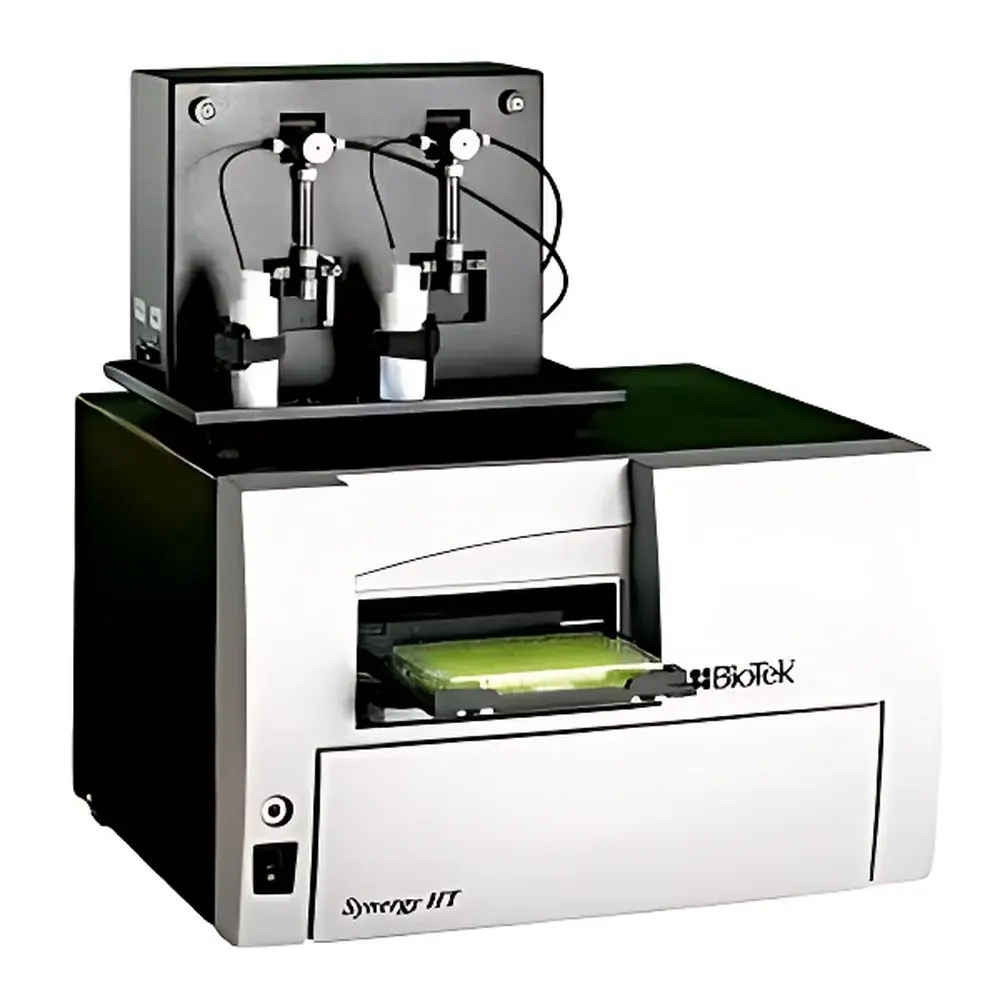
BioTek Synergy HT Multi-Mode Microplate Reader
| Brand | BioTek |
|---|---|
| Origin | USA |
| Model | Synergy HT |
| Detection Modes | Absorbance, Fluorescence Intensity, Time-Resolved Fluorescence, Luminescence |
| Wavelength Range (Abs) | 200–999 nm (1 nm increment) |
| Wavelength Range (Fluor) | 200–700 nm (optional to 900 nm) |
| Temperature Control | 4–50 °C |
| Plate Formats | 6–384-well, PCR plates, Take3™ micro-volume plates (2 µL samples) |
| Shaking | Yes |
| Software | Gen5™ |
| Automation-Compatible | Yes |
| Dispenser | Dual syringe pumps (5–1000 µL, 1 µL increment) |
| Dimensions | 40.6 × 38 × 25.4 cm |
| Weight | 18 kg |
Overview
The BioTek Synergy HT Multi-Mode Microplate Reader is an engineered platform for quantitative life science assays requiring high reproducibility, flexible detection modalities, and robust integration into laboratory workflows. Based on a modular optical architecture, it supports four core detection technologies—ultraviolet-visible absorbance (UV-Vis), fluorescence intensity (FI), time-resolved fluorescence (TRF), and luminescence—within a single compact footprint. Its measurement principles adhere to standardized photometric and photon-counting methodologies: absorbance relies on Beer-Lambert law compliance with monochromator-based wavelength selection; fluorescence employs dual excitation/emission pathways using interference filters and high-gain photomultiplier tubes (PMTs); TRF utilizes pulsed xenon flash lamp excitation with delayed acquisition to suppress short-lived background fluorescence; and luminescence leverages low-noise PMT detection optimized for transient or sustained light emission. Designed for kinetic and endpoint applications—including enzyme kinetics, cell viability, receptor-ligand binding, and reporter gene assays—the system delivers assay-ready data integrity under controlled thermal conditions enabled by its patented 4-Zone™ temperature regulation system.
Key Features
- 4-Zone™ independent temperature control (4–50 °C) ensures ±0.5 °C uniformity across the entire microplate surface—critical for extended kinetic assays and thermally sensitive cell-based measurements.
- Dual syringe-pump reagent dispensers enable precise, programmable addition of up to two reagents pre- or post-read, with volume range from 5 to 1000 µL in 1 µL increments and minimal dead volume (100 µL with wash capability).
- Monochromator-based UV-Vis detection provides continuous spectral scanning (200–999 nm, 1 nm step) with 2.4 nm bandwidth, supporting peak identification, spectral deconvolution, and pathlength correction for variable-height wells.
- Top- and bottom-reading fluorescence optics include auto-adjustable probe height and integrated plate-sensing logic to prevent physical contact during measurement—essential for fragile adherent cell assays and low-volume microplates.
- Full automation readiness via standard RS-232 serial interface and USB 2.0 connectivity; compatible with third-party robotic handlers and stacker systems without proprietary middleware.
- Take3™ micro-volume plate support enables direct quantification of nucleic acids and proteins from 2 µL samples—eliminating dilution requirements and reducing reagent consumption while maintaining traceable calibration against NIST-traceable standards.
Sample Compatibility & Compliance
The Synergy HT accommodates standard ANSI/SLAS-compliant microplates ranging from 6- to 384-well formats, including skirted, semi-skirted, and unskirted designs, as well as specialized vessels such as PCR plates and Terasaki plates. Its adjustable plate-height mechanism and optical focus algorithm ensure consistent signal capture regardless of well geometry or meniscus variation. For regulated environments, the system supports audit-trail-enabled operation when used with Gen5™ software configured in 21 CFR Part 11 compliant mode—including electronic signatures, user-level permissions, and immutable data logging. While not certified as GMP equipment per se, its hardware stability, calibration traceability, and software validation tools align with GLP and internal QC requirements outlined in ISO/IEC 17025 and ASTM E2577 for microplate-based assay instrumentation.
Software & Data Management
Gen5™ Microplate Reader Software serves as the unified control and analysis engine for the Synergy HT. It provides real-time instrument control, protocol scheduling, multi-mode assay configuration, and embedded statistical tools—including curve fitting (linear, quadratic, sigmoidal), Z’-factor calculation, %CV reporting, and outlier detection. Raw data files (.g5d) are structured XML-based archives containing metadata (instrument ID, date/time stamp, operator ID, protocol version), raw signal values, and environmental logs (temperature, humidity if monitored externally). Export options include CSV, Excel (.xlsx), PDF reports, and image-based heatmaps for spatial analysis. Gen5™ supports LIMS integration via ODBC drivers and offers optional API extensions for custom workflow orchestration in high-throughput screening (HTS) environments.
Applications
The Synergy HT is routinely deployed in academic, pharmaceutical, and contract research laboratories for applications demanding multimodal flexibility and assay robustness. These include ELISA and immunoassay development where absorbance at 450 nm and TRF-based competitive binding assays coexist on the same platform; cell proliferation and cytotoxicity profiling using resazurin reduction (fluorescence) and ATP bioluminescence endpoints; calcium flux assays employing ratiometric fluorescent dyes with rapid kinetic sampling; and epigenetic studies utilizing histone modification antibodies coupled with HTRF® or AlphaScreen® chemistries. Its ability to perform spatial scanning across individual wells also supports confluence assessment in primary neuronal cultures and colony formation assays without requiring external imaging hardware.
FAQ
Does the Synergy HT support kinetic measurements with simultaneous reagent injection?
Yes—its dual dispensers can be triggered at user-defined timepoints during kinetic runs, enabling stopped-flow-like protocols such as protease activity assays or GPCR second-messenger responses.
Can Gen5™ software generate FDA 21 CFR Part 11–compliant reports?
When properly configured with password-protected user roles, electronic signatures, and audit trail activation, Gen5™ meets functional requirements for Part 11 compliance; however, final validation remains the responsibility of the end-user organization.
Is the 4-Zone™ temperature control validated across all plate formats?
Thermal uniformity testing per BioTek Application Note AN-012 confirms ≤±0.5 °C deviation across 96- and 384-well plates at setpoints between 25 °C and 37 °C; performance at extremes (4 °C or 50 °C) may vary slightly depending on ambient conditions and plate cover type.
What maintenance is required for the xenon flash lamp and PMT detectors?
The SQ xenon flash lamp has a rated lifetime of ≥1×10⁹ flashes; PMTs require no routine replacement but benefit from annual dark-current verification using built-in diagnostics in Gen5™.
How does the system handle carryover between wells during dispensing?
Each dispenser includes an integrated wash cycle (air + liquid flush) prior to aspiration, and residual volume is minimized via positive-displacement syringes and low-retention tubing—validated to <0.1% cross-contamination in ATP standard recovery tests.



