
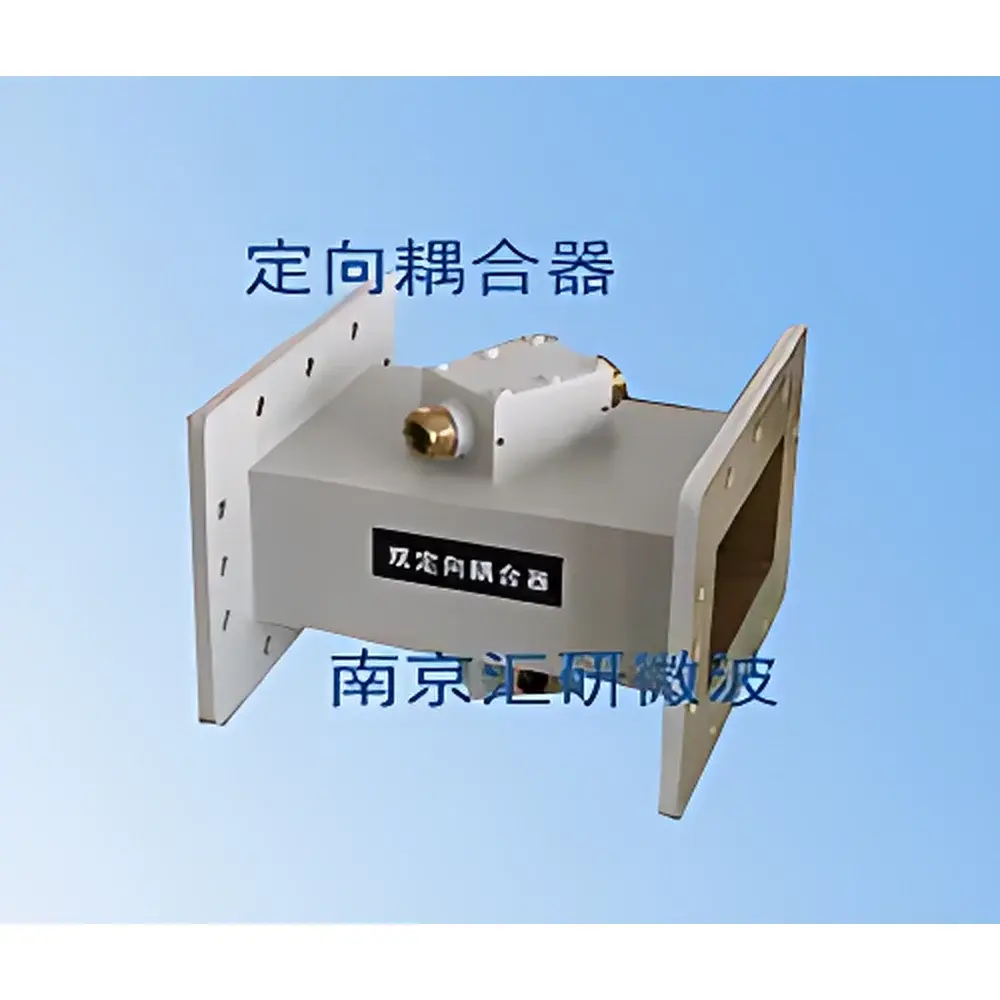
BJ26 & BJ22 Waveguide Directional Couplers by Huiyan
| Brand | Huiyan |
|---|---|
| Origin | Jiangsu, China |
| Manufacturer Type | Authorized Distributor |
| Product Origin | Domestic (China) |
| Model | BJ26, BJ22 |
| Price | Upon Request |
| Waveguide Standard | BJ26, BJ22 |
| Operating Frequency | 2.45 GHz |
| Coupling Factor | 50 ± 2 dB |
| Directivity | >20 dB |
| Coupled Port Interface | L16 coaxial connector |
| Coupled Line Specification | 7/3 coaxial cable |
| Housing Material | Copper and Aluminum |
Overview
The BJ26 and BJ22 waveguide directional couplers are precision passive microwave components engineered for high-isolation signal sampling in industrial, scientific, and defense-related 2.45 GHz systems—most commonly deployed in microwave heating, plasma generation, RF power monitoring, and magnetron-based instrumentation. These devices operate on the principle of evanescent field coupling between the main waveguide transmission line and an auxiliary coupled waveguide or coaxial branch, enabling non-intrusive extraction of a known fraction of forward-traveling RF power while maintaining minimal perturbation to the primary signal path. Designed to comply with standard rectangular waveguide dimensional specifications per IEC 60153-2 and MIL-STD-196E, the BJ26 and BJ22 variants support fundamental TE10 mode propagation with cutoff frequencies of approximately 2.08 GHz (BJ26) and 2.60 GHz (BJ22), ensuring stable single-mode operation across the nominal 2.45 GHz ISM band.
Key Features
- High directivity (>20 dB) achieved through optimized coupling aperture geometry and precision-machined waveguide alignment—critical for accurate forward/reflected power discrimination in reflection coefficient measurements.
- Stable coupling factor of 50 ± 2 dB over temperature range –10 °C to +60 °C, validated via traceable calibration against NIST-traceable power standards.
- Dual-material construction: oxygen-free copper main body for low-loss RF conduction; aluminum outer housing for mechanical rigidity, thermal dissipation, and EMI shielding.
- L16-type coaxial interface on the coupled port ensures compatibility with industry-standard 50 Ω RF test equipment—including spectrum analyzers, power meters, and VSWR bridges—without requiring impedance-matching adapters.
- Robust architecture with hermetically sealed flanges (per IEC 60130-9) and gold-plated contact surfaces to ensure long-term repeatability and corrosion resistance in high-humidity or chemically aggressive environments.
Sample Compatibility & Compliance
These couplers are designed exclusively for use with rectangular waveguides conforming to BJ26 (WR340, 86.36 × 43.18 mm) and BJ22 (WR284, 72.14 × 34.04 mm) dimensional standards. They are compatible with continuous-wave (CW) and pulsed RF sources operating at 2.45 GHz, including industrial magnetrons, solid-state amplifiers, and klystron-based transmitters. The device meets electromagnetic compatibility requirements per EN 55032 Class A and mechanical durability specifications outlined in IEC 60068-2 environmental testing standards. While not certified under FDA 21 CFR Part 11 or ISO 13485, its design supports integration into GLP-compliant RF process validation protocols when paired with calibrated measurement chains.
Software & Data Management
As a passive hardware component, the BJ26/BJ22 directional coupler does not incorporate embedded firmware, microcontrollers, or digital interfaces. It functions as a deterministic analog transducer—requiring external instrumentation for signal acquisition and analysis. When integrated into automated RF monitoring systems, it enables real-time power logging when connected to USB or GPIB-enabled power sensors (e.g., Keysight N1911A, Rohde & Schwarz NRP-Z series). Data traceability is maintained through instrument-level audit trails and calibration certificate linkage—not via the coupler itself. Users deploying these devices in regulated environments must document installation, calibration interval (recommended annually), and insertion loss verification per internal SOPs aligned with ISO/IEC 17025 guidelines.
Applications
- Real-time RF power feedback control in industrial microwave dryers and vulcanization systems.
- Reflected power detection for automatic load matching in plasma CVD and sputtering chambers.
- Calibration reference path in microwave network analyzer (VNA) test setups using waveguide-to-coaxial transitions.
- Safety interlock signaling in high-power magnetron installations where reflected power exceeds threshold limits.
- Research-grade field mapping in waveguide-fed antenna arrays and metamaterial characterization benches.
FAQ
What is the maximum average power rating for these couplers?
The BJ26 and BJ22 models are rated for up to 5 kW average power when operated within ambient temperature limits and with adequate forced-air or liquid cooling. Derating applies above 40 °C ambient.
Can this coupler be used at frequencies other than 2.45 GHz?
While functional near-band (e.g., 2.3–2.5 GHz), performance parameters—including coupling flatness and directivity—degrade outside the specified 2.45 GHz center frequency due to modal dispersion and aperture resonance effects.
Is flange type standardized?
Yes—both models feature CPR-137 (IEC 60153-2 compliant) flanges with 8 × M6 threaded holes and serrated contact surfaces for optimal waveguide joint integrity.
Does the manufacturer provide calibration certificates?
Huiyan offers optional factory calibration reports (traceable to national metrology institutes) upon request, including measured S-parameters, coupling factor, and directivity across the operational band.



