
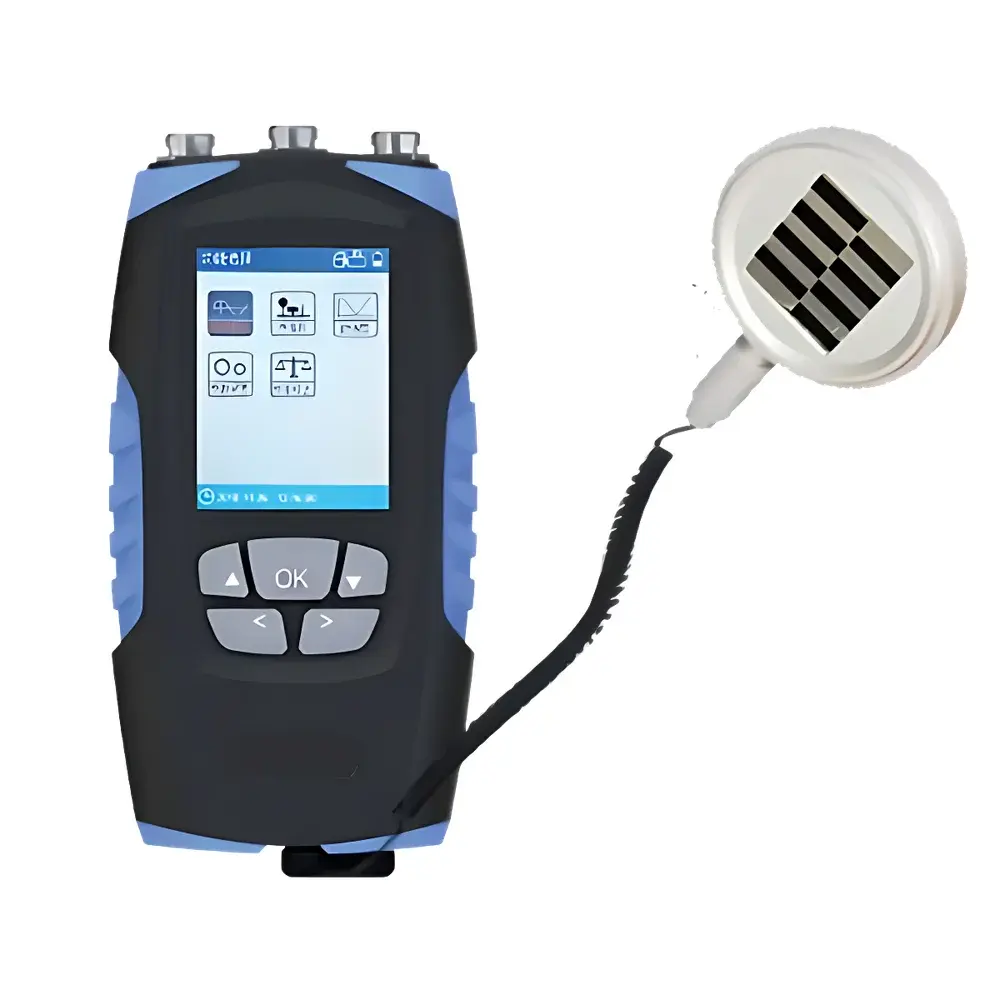
BJBY BY-2020-3 Indoor Thermal Comfort Analyzer
| Brand | BJBY |
|---|---|
| Origin | Beijing, China |
| Model | BY-2020-3 |
| Black Globe Temperature Sensor (2020-11) | Range 0–120°C, Accuracy ±0.5°C, Resolution 0.1°C, Stainless Steel Enclosure |
| Ambient Temperature & Humidity Sensor (2020-16) | Temp Range −20–120°C, Accuracy ±0.5°C |
| Anemometer (2020-21) | Range 0–10 m/s, Accuracy ±(0.05 + 0% of reading) for 0.05–2 m/s, ±(0.1 + 2% of reading) above 2 m/s, Resolution 0.01 m/s, RS485 Output |
| Display | 3.5-inch Color Touch LCD |
| Power | Internal 5000 mAh Li-ion Battery (≥96 h standby), DC5V/1A Micro USB Input |
| Data Storage | Removable SD Card, CSV Export |
| Communication | RS485, USB, Wi-Fi, Bluetooth (up to 20 BLE sensors), M12 6-pin Aviation Connectors (3 digital channels), K-type Thermocouple Inputs (2), Analog Inputs (2, 0–2 V, 0.01 mV resolution, ±0.5% accuracy) |
| Enclosure | ABS + TPU Overmold, IP30 Rating, 175 × 92 × 38 mm, 1/4″ Tripod Thread, Detachable Wrist Strap |
Overview
The BJBY BY-2020-3 Indoor Thermal Comfort Analyzer is a field-deployable, multi-sensor integrated instrument engineered for quantitative assessment of human thermal perception in built environments. It operates on the fundamental principles of steady-state heat balance modeling, implementing the ISO 7730 (identical to GB/T 18049–2000) standard methodology to compute two internationally recognized thermal comfort indices: Predicted Mean Vote (PMV) and Predicted Percentage of Dissatisfied (PPD). PMV quantifies the average thermal sensation of a large group of occupants on a seven-point scale (−3 = cold, 0 = neutral, +3 = hot), while PPD estimates the percentage of individuals likely to express thermal dissatisfaction under identical environmental conditions. The analyzer acquires real-time inputs from up to six concurrent physical parameters—air temperature, mean radiant temperature (via black globe), relative humidity, air velocity, metabolic rate (manually entered), and clothing insulation (clo)—to solve the Fanger energy-balance equation iteratively. Its architecture supports both direct sensor integration (digital RS485, analog voltage, thermocouple) and wireless expansion, enabling flexible deployment in offices, classrooms, hospitals, cleanrooms, and HVAC commissioning sites.
Key Features
- Integrated compliance with ISO 7730 and GB/T 18049–2000 for standardized PMV/PPD calculation
- Dual-mode input: automatic acquisition from calibrated digital sensors (black globe, ambient temp/RH, anemometer) plus manual entry of subject-specific variables (metabolic rate, clothing insulation)
- Real-time graphical display of PMV vs. PPD relationship curves on the 3.5-inch color touch LCD
- Modular sensor interface architecture: three 6-pin M12 aviation connectors (for digital sensors), two K-type thermocouple inputs, two 0–2 V analog channels (for heat flux, radiative heat, solar irradiance), and Bluetooth 5.0 for up to 20 BLE-enabled peripheral sensors
- Robust mechanical design: IP30-rated ABS/TPU overmolded housing, 1/4″ tripod mount, and detachable anti-slip wrist strap for field durability
- Extended operational autonomy: ≥96 hours of battery life (no active sensor load); supports continuous logging via micro-USB power input
- On-device data management: SD card storage with user-configurable sampling intervals (10 s to 90 min 59 s), CSV export capability, and timestamped metadata embedding
Sample Compatibility & Compliance
The BY-2020-3 is designed for use with a defined set of traceable, factory-calibrated sensors compliant with international metrological practices. Compatible probes include the stainless-steel encapsulated 50-mm black globe (model 2020-11), PT100-based wet-bulb sensor (2020-12), polymer-housed ambient温湿度 probe (2020-16), omnidirectional thermal-anemometer (2020-21), and radiation heat flux transducers (CO-A/B series). All sensor specifications—including uncertainty budgets, linearity, and thermal response time—are documented per ISO/IEC 17025-aligned calibration certificates. The device itself does not require third-party certification for ISO 7730 conformance; however, its algorithmic implementation has been verified against reference test cases published in Annex B of ISO 7730:2005. For GxP-regulated environments (e.g., pharmaceutical cleanrooms or clinical trial facilities), the optional Soft-DM PC software supports audit trail generation, electronic signatures, and 21 CFR Part 11-compliant data integrity controls when configured with password-protected user roles and immutable log files.
Software & Data Management
Data acquisition and post-processing are supported by Soft-DM, a Windows-based desktop application compatible with Windows 7 and later. Soft-DM enables synchronized multi-channel waveform visualization, automated PMV/PPD batch calculation across time-series datasets, statistical summary reporting (min/max/mean/std dev), and customizable export to CSV or Excel-compatible formats. The software incorporates GLP-aligned features including operator ID logging, method version tracking, and change history for all parameter modifications. Raw sensor readings are stored with embedded calibration coefficients and sensor serial numbers, ensuring full traceability. Firmware updates are delivered via signed binary packages to prevent unauthorized modification. All stored data retain UTC timestamps synchronized via NTP when Wi-Fi is enabled, supporting cross-site comparative analysis in multi-location building performance studies.
Applications
The BY-2020-3 serves as a primary measurement tool in HVAC system validation, LEED and BREEAM indoor environmental quality (IEQ) credit documentation, workplace ergonomics assessments, and academic research on occupant behavior and adaptive thermal models. It is routinely deployed during commissioning of variable-air-volume (VAV) systems to verify zone-level thermal neutrality, in hospital operating rooms to maintain ASHRAE Standard 170-compliant operative temperatures, and in educational facilities to correlate thermal conditions with cognitive performance metrics. Its portability and modular sensor support also make it suitable for transient monitoring—such as pop-up workspace evaluations or post-renovation occupancy surveys—where fixed-building automation systems lack granularity or accessibility.
FAQ
Does the BY-2020-3 meet ISO 7730 computational requirements out-of-the-box?
Yes—the onboard firmware implements the exact Fanger equations and iterative convergence logic specified in ISO 7730:2005 Annex A, using default physiological constants unless overridden by user-input metabolic rate or clothing insulation values.
Can the device calculate WBGT (Wet Bulb Globe Temperature)?
Yes—when connected to ambient temperature, natural wet-bulb, and black globe temperature sensors, the analyzer computes WBGT per ISO 7243 using the standard weighting formula (0.7 × natural wet-bulb + 0.2 × black globe + 0.1 × dry bulb).
Is calibration verification possible without sending the unit to a lab?
Field verification is supported via reference sensor comparison mode: users can connect a NIST-traceable reference thermometer/hygrometer to the analog or digital inputs and perform side-by-side drift checks against internal sensor outputs.
What is the maximum sampling interval for long-term unattended logging?
The device supports programmable intervals from 10 seconds to 90 minutes and 59 seconds; at 15-minute intervals with four active sensors, a 32 GB SD card provides >18 months of continuous storage.
Are sensor calibration certificates included with purchase?
Each certified sensor (e.g., 2020-11, 2020-16, 2020-21) ships with a manufacturer-issued calibration report stating measurement uncertainty, traceability to national standards (e.g., CNAS), and validity period—typically 12 months from date of issue.
Related Products







