
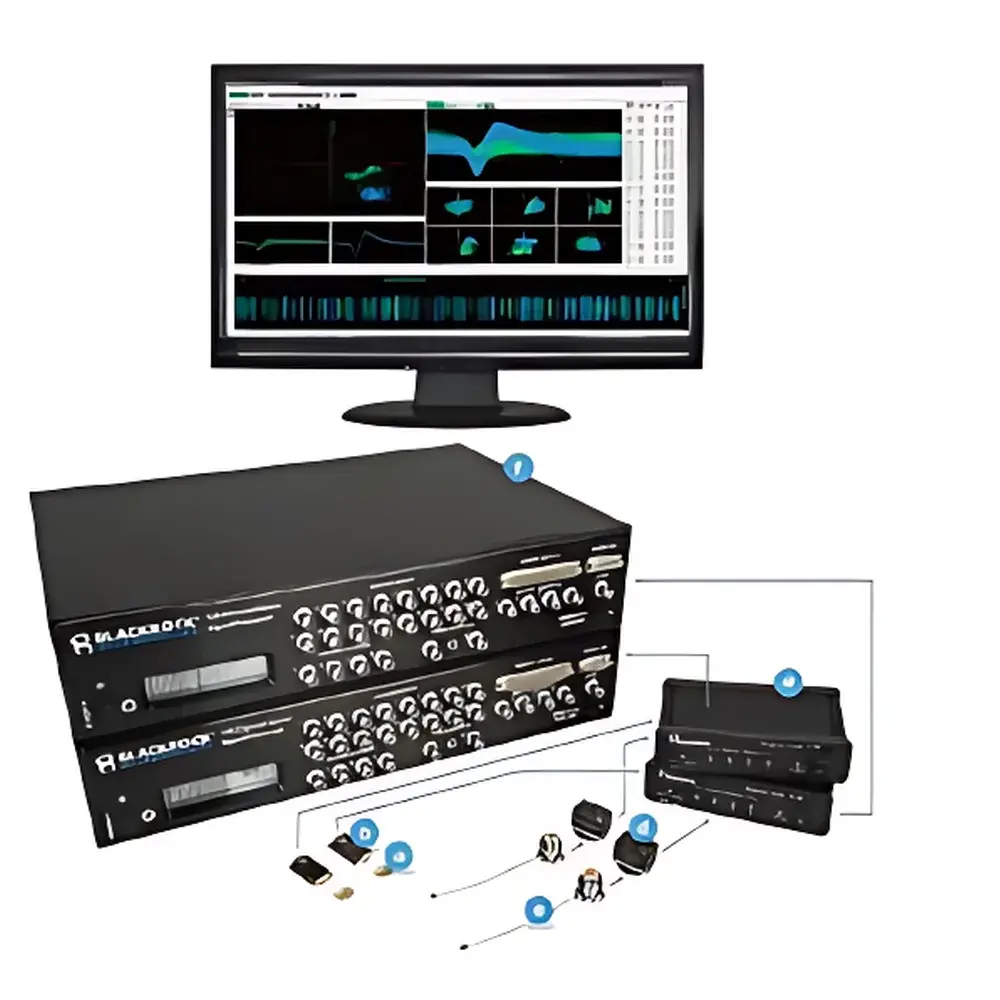
Blackrock Microsystems Cerebus Multi-Channel Neural Recording System
| Origin | USA |
|---|---|
| Manufacturer Type | Authorized Distributor |
| Origin Category | Imported |
| Model | Cerebus |
| Price Range | USD $14,000 – $72,000 |
Overview
The Blackrock Microsystems Cerebus Multi-Channel Neural Recording System is a high-fidelity, scalable electrophysiological data acquisition platform engineered for in vivo and in vitro neural signal acquisition across diverse experimental paradigms. Built upon a low-noise, high-bandwidth analog front-end architecture, the system employs differential amplification with >120 dB common-mode rejection ratio (CMRR) and input-referred noise < 1.0 µVrms to resolve sub-millisecond neuronal spiking and local field potentials (LFPs) with high fidelity. It supports continuous sampling at up to 120 kHz per channel (configurable at 30 kHz, 60 kHz, or 120 kHz) with 16-bit resolution, enabling simultaneous capture of action potentials, synaptic events, and oscillatory dynamics across broad frequency bands (0.01 Hz – 10 kHz). Designed for rigorous neuroscience research, Cerebus integrates seamlessly with chronically implanted microelectrode arrays—including Utah Slanted Electrode Arrays (USEAs), silicon probes, microwire bundles, and planar MEA substrates—as well as acute preparations such as brain slices and cultured neuronal networks. Its modular architecture supports both anesthetized and awake-behaving recordings in rodents, non-human primates, felines, avians, and other model species, providing longitudinal stability and reproducible signal quality under physiologically relevant conditions.
Key Features
- Scalable channel count: configurable from 8 to 1024 channels via fiber-optic-linked modules, minimizing electromagnetic interference and thermal noise in long-distance setups
- High-resolution temporal sampling: 16-bit ADC with selectable sampling rates up to 120 kHz per channel, optimized for spike sorting and LFP spectral analysis
- Integrated electrode impedance monitoring: real-time and offline impedance measurement (in vivo and in vitro), supporting quality control prior to and during recording sessions
- Flexible I/O synchronization: TTL-compatible digital inputs/outputs for precise alignment with behavioral triggers, optogenetic stimulation pulses, video frame timestamps, and external stimulus generators
- Multi-PC distributed control: parallel operation across multiple workstations enables large-scale experiments requiring synchronized acquisition from multiple anatomical regions or subjects
- Low-noise, compact hardware design: fanless enclosure with fiber-optic data transmission eliminates ground loops and RF coupling—critical for chronic implant studies and shielded environments
Sample Compatibility & Compliance
Cerebus is validated for use with a wide range of neural interfaces, including but not limited to: Utah Electrodes (96- and 100-channel variants), Michigan-style silicon probes, NeuroPort™ and CerePort™ connectors, MultiPort™ adaptors, ICS-96 headstages, and rodent-specific interface systems. It accommodates both high-impedance (>1 MΩ) and low-impedance (<100 kΩ) electrodes without signal degradation. The system supports ex vivo applications via compatibility with standard brain slice chambers (e.g., ACSF-perfused interface or submerged-type chambers) and commercial microelectrode array (MEA) plates (e.g., Axion Biosystems, Multichannel Systems). All firmware and acquisition software comply with GLP-aligned data integrity standards, including audit-trail logging, user-access controls, and timestamped metadata embedding—facilitating regulatory readiness for translational neuroengineering studies under FDA 21 CFR Part 11 and ISO/IEC 17025 frameworks where applicable.
Software & Data Management
The Cerebus ecosystem includes the CereLink acquisition engine and CereStudio post-processing suite. CereLink provides real-time visualization, threshold-based spike detection, and on-the-fly waveform extraction. It supports concurrent streaming to disk in open, documented binary formats (e.g., .ns6, .nev) compatible with MATLAB, Python (Neo, SpikeInterface), and commercial analysis platforms (Spike2, Plexon Offline Sorter). CereStudio implements multiple unsupervised and semi-supervised spike-sorting algorithms—including Hoops (manual clustering), Manual PCA, K-means PCA, and DBSCAN PCA—for both online and offline unit isolation. All sorting parameters, cluster assignments, and waveform metrics are stored in hierarchical HDF5 containers with embedded provenance metadata (electrode mapping, gain settings, filtering parameters, session timestamps). Export options include standardized NWB:N 2.0 format to ensure interoperability with the BRAIN Initiative Cell Types Database and INCF-supported repositories.
Applications
- Basic systems neuroscience: mapping functional connectivity, sensory coding, and network dynamics in awake, behaving animals
- Brain-computer interface (BCI) development: decoding motor intent, speech articulation, and cognitive states from multi-area cortical and subcortical recordings
- Epilepsy and neuropsychiatric disorder modeling: characterizing seizure onset zones, interictal spikes, and aberrant synchrony in chronic models
- Neuroprosthetics and closed-loop neuromodulation: integrating real-time spike detection with adaptive electrical or optogenetic stimulation protocols
- In vitro neuropharmacology: assessing drug-induced changes in network bursting, synaptic efficacy, and excitatory/inhibitory balance in primary cultures and organotypic slices
- Translational neuroengineering: validating intracortical microstimulation (ICMS) for somatosensory feedback and cortical control of peripheral muscle activation
FAQ
What species and preparation types are supported by the Cerebus system?
Cerebus supports in vivo recordings from rodents (mice, rats), non-human primates, cats, and birds under both anesthetized and freely moving conditions. It is also validated for ex vivo applications including acute brain slices and cultured neuronal networks on microelectrode arrays.
Does the system support real-time spike sorting during acquisition?
Yes—CereLink enables online spike detection and manual clustering (Hoops) with waveform preview and threshold adjustment. Fully automated online sorting (e.g., K-means PCA) is available via optional add-on modules with GPU-accelerated processing.
Is the data format compatible with third-party analysis tools?
All raw and sorted data are stored in vendor-neutral, well-documented formats (.ns6/.nev for Plexon compatibility; HDF5/NWB:N 2.0 exports), ensuring seamless integration with MATLAB, Python-based toolchains (SpikeInterface, Elephant), and commercial platforms such as Spike2 and NeuroExplorer.
How is system calibration and validation performed?
Each Cerebus unit undergoes factory calibration using NIST-traceable signal generators. Users can perform routine verification via built-in test signals and impedance check routines. Calibration logs and hardware configuration files are automatically embedded in dataset metadata.
What level of technical support and documentation is provided?
Blackrock Microsystems provides comprehensive installation support, application-specific protocol guidance, and access to a secure customer portal containing firmware updates, API documentation, SDKs (C/C++, Python), and peer-reviewed methodological white papers.





