
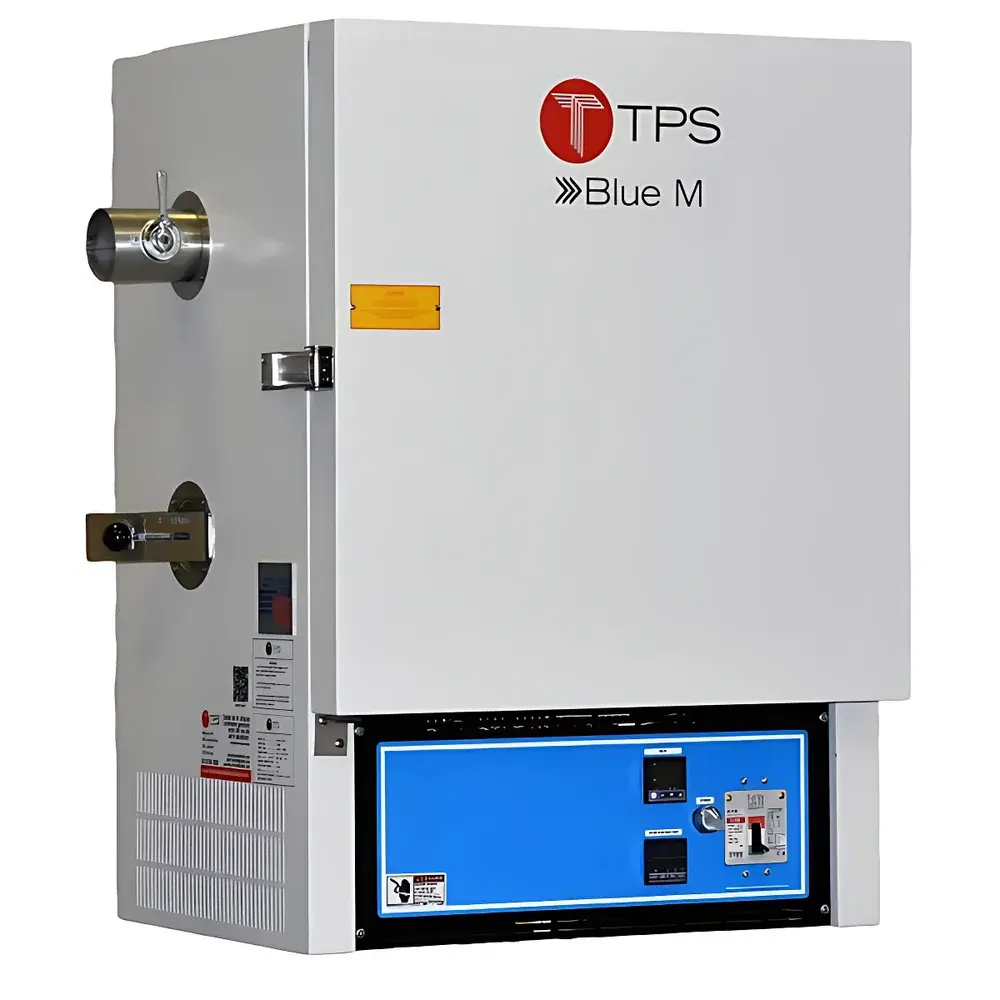
Blue M ESP 400 Series Mechanical Convection Oven
| Brand | Blue M |
|---|---|
| Origin | USA |
| Model | ESP 400 Series Mechanical Convection Oven |
| Temperature Range | Ambient +15°C to 260°C |
| Temperature Uniformity | ±1% of setpoint |
| Heating Method | Forced-air horizontal convection |
| Internal Dimensions | 480 × 380 × 450 mm |
| Chamber Volume | 2.8 ft³ (0.079 m³) |
| Warm-up Time to 260°C (no load, vents closed) | 20 min @ 240 VAC |
| Controller | RKC RF100 with enhanced PID and auto-tuning algorithm |
| Overtemperature Protection | Dual independent system (CB100L/CB900L FM-approved controller + Partlow 1161 upper-limit controller) |
| Construction | 304 stainless steel interior, fully welded |
| Insulation | Fiberglass, double-wall insulated door |
| Airflow | Unidirectional horizontal airflow via centrifugal blower |
| Adjustable | Inlet/exhaust dampers, 7-position nickel-plated wire shelving |
| Compliance | FM-approved components, meets UL 61010-1 and CSA C22.2 No. 61010-1 safety standards |
Overview
The Blue M ESP 400 Series Mechanical Convection Oven is an industrial-grade, horizontally ventilated benchtop or floor-standing oven engineered for precision thermal processing in research laboratories, quality control environments, and small-batch manufacturing settings. It operates on a unidirectional forced-air convection principle—air enters the chamber through a dedicated inlet, passes once over the heating elements and across the work area in a consistent horizontal path, then exits via a rear-mounted exhaust port. This single-pass airflow architecture eliminates recirculation-induced thermal stratification, enabling rapid thermal response, improved temperature stability, and high spatial uniformity across the entire working volume. Designed for applications requiring repeatable drying, curing, baking, stress-relieving, or pre-conditioning of materials—particularly where sample geometry or packaging restricts vertical airflow—the ESP 400 delivers reproducible results under controlled, documented conditions compliant with GLP and GMP frameworks.
Key Features
- Horizontal forced-air convection system with centrifugal blower ensures uniform heat distribution and minimizes thermal gradients across shelves
- RKC RF100 digital temperature controller featuring adaptive PID tuning, auto-setpoint optimization, and ±0.1°C resolution
- Dual-stage overtemperature protection: primary control via FM-approved CB100L/CB900L controller with independent sensor and power supply; secondary safeguard via Partlow 1161 upper-limit controller
- 7-position adjustable nickel-plated wire shelving accommodates varied sample configurations while maintaining optimal airflow clearance
- Fiberglass insulation and double-wall insulated door reduce external surface temperature and improve energy efficiency
- Full 304 stainless steel interior—fully welded, corrosion-resistant, and compatible with cleaning agents used in regulated environments
- Robust exterior construction using heavy-gauge cold-rolled steel with durable white epoxy powder coating for long-term chemical and abrasion resistance
- Front-panel LED display provides real-time readout of setpoint, process temperature, and alarm status; intuitive navigation for routine operation and calibration verification
Sample Compatibility & Compliance
The ESP 400 series supports a wide range of non-volatile and low-hazard samples—including polymer films, electronic assemblies, pharmaceutical excipients, coated substrates, and metal components—within its 260°C operational ceiling. Its horizontal airflow design is especially suited for flat, stacked, or tray-based configurations where vertical convection ovens risk uneven exposure or shadowing effects. The unit complies with UL 61010-1 and CSA C22.2 No. 61010-1 for electrical safety and incorporates FM-approved controllers meeting Class I, Division 2 hazardous location requirements for incidental solvent vapor exposure. While not intrinsically safe, its single-pass ventilation enables rapid purge of benign fumes during post-cure degassing or low-VOC drying cycles. Documentation packages—including factory test reports, calibration certificates (traceable to NIST), and component-level compliance statements—are available upon request to support ISO/IEC 17025, FDA 21 CFR Part 11, and internal audit readiness.
Software & Data Management
The ESP 400 operates as a standalone instrument with no embedded software stack; however, its analog and digital I/O interfaces (including 4–20 mA output and relay alarms) enable integration into centralized monitoring systems such as LabVIEW, DeltaV, or Siemens Desigo CC. Optional accessories—including Eagle Signal B856 digital process timers, Grasslin FM1D chart recorders, and Partlow 1160/1166 backup controllers—provide redundant time-stamped logging capabilities essential for SOP-driven workflows. All controllers support manual or automatic ramp-soak profiles, and the RKC RF100 retains up to 10 user-defined programs with password-protected access levels. Audit trail functionality is implemented at the system level when connected to validated data acquisition hardware, satisfying ALCOA+ principles for raw data integrity in regulated QC labs.
Applications
- Drying of moisture-sensitive powders and granules prior to tablet compression (pharmaceutical manufacturing)
- Curing of conformal coatings on printed circuit boards (PCBs) and semiconductor packaging substrates
- Thermal aging studies of elastomers, adhesives, and composite laminates per ASTM D573 and ISO 188
- Baking of ceramic green bodies and metallurgical pre-sintering steps
- Stabilization of reference standards and calibration artifacts in metrology labs
- Pre-heating of test specimens for tensile, impact, or hardness evaluation per ASTM E8/E23 protocols
- Low-temperature annealing of thin-film sensors and MEMS devices
FAQ
What is the standard temperature uniformity specification for the ESP 400 at 260°C?
At full-rated temperature, the ESP 400 achieves ±1% of setpoint uniformity across the working volume when operated with vents closed and shelves evenly loaded per manufacturer guidelines.
Can the oven be configured for continuous exhaust or inert gas purging?
Yes—adjustable inlet and exhaust dampers allow manual modulation of air exchange rate; optional nitrogen purge kits and exhaust duct adapters are available for controlled atmosphere operation.
Is the unit suitable for use in a Class 10,000 cleanroom environment?
While not certified for cleanroom use out-of-the-box, the fully welded 304 stainless steel interior and absence of internal gasketed seams minimize particle shedding; supplemental HEPA-filtered make-up air and static-dissipative finishes can be specified.
Does Blue M provide IQ/OQ documentation support?
Yes—validated installation and operational qualification templates, along with traceable calibration procedures and acceptance criteria aligned with USP , are supplied with optional validation packages.
What maintenance intervals are recommended for the blower motor and heating elements?
Annual inspection of blower bearings and resistor continuity is advised; preventive replacement of heating elements is recommended every 5 years under continuous operation at >200°C.



