
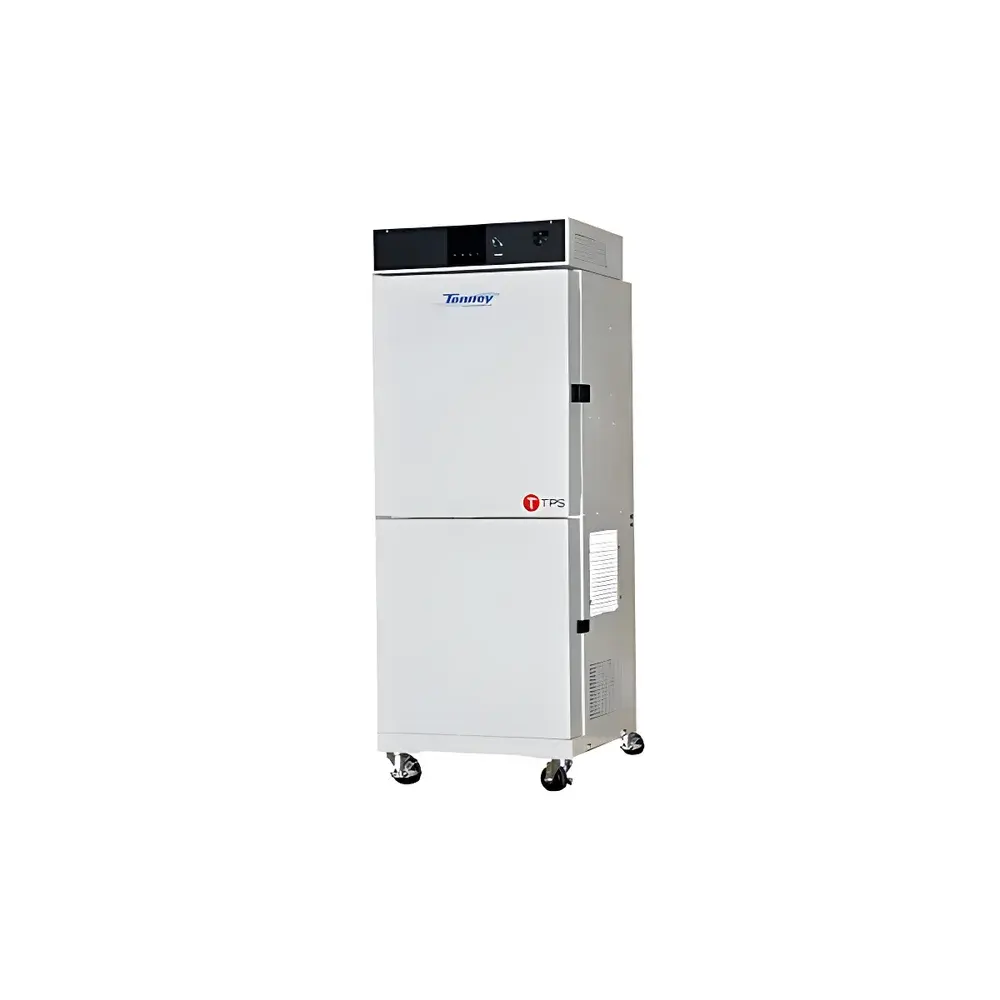
Blue M TENNEY T2 Temperature and Humidity Cycling Chamber
| Brand | Blue M |
|---|---|
| Origin | USA |
| Model | T2 |
| Temperature Range | −70 °C to +180 °C |
| Humidity Range | 20–95 % RH (at dry-bulb 20–85 °C, dew point ≥5 °C) |
| Temperature Uniformity | ±1.0 °C |
| Temperature Stability | ±0.5 °C |
| Temperature Deviation | ±1.0 °C |
| Internal Dimensions (W×H×D) | 1016 mm × 2057 mm × 2007 mm to 1626 mm × 2616 mm × 2515 mm |
| Refrigerant | Non-CFC, environmentally compliant |
Overview
The Blue M TENNEY T2 Temperature and Humidity Cycling Chamber is an engineered environmental test system designed for precise, repeatable simulation of thermal and hygrothermal stress profiles in compliance with international product qualification standards. Based on forced-air convection with vertical airflow modulation and dual-stage cascade refrigeration, the T2 chamber delivers high-fidelity control across a wide operational envelope—from deep freeze at −70 °C to high-temperature aging at +180 °C—while maintaining humidity capability between 20 % and 95 % RH within specified dry-bulb limits. Its architecture integrates thermodynamic stability with mechanical robustness: continuous-welded stainless steel interior walls ensure hermetic integrity and corrosion resistance; high-density polyurethane and fiberglass insulation minimize parasitic heat transfer; and platinum resistance temperature detectors (RTDs) coupled with capacitive humidity sensors provide metrologically traceable measurement feedback. The chamber is certified for use in laboratories operating under ISO/IEC 17025-accredited calibration protocols and supports audit-ready data generation required for GLP, GMP, and FDA 21 CFR Part 11 environments.
Key Features
- Vertical airflow circulation system optimized for uniform thermal distribution and minimal stratification
- Cascade refrigeration circuit using non-ozone-depleting refrigerants (R-404A/R-23 blend), compliant with current EPA SNAP and EU F-Gas regulations
- Continuous-welded 304 stainless steel interior with seamless corners and electropolished finish for long-term cleanliness and chemical resistance
- Watlow F4T Synergy Quattro touchscreen controller featuring 4.3″ color display, TRU-TUNE+ adaptive PID algorithm, and up to four independent control loops
- Integrated safety architecture including overtemperature cutoff, high-humidity shutoff, refrigerant pressure monitoring, and door interlock circuitry
- Modular I/O expansion supporting RS-232, RS-485, and Ethernet (Modbus TCP) for SCADA integration and remote supervision
- Optional heated and insulated viewing window (up to 6″ × 7″) eliminating condensation without manual wipers or external heating elements
- Configurable shelf system with 50 mm pitch, load-rated to 5 kg per shelf (max total cavity load: 23 kg)
Sample Compatibility & Compliance
The T2 chamber accommodates a broad spectrum of physical samples—from polymer components and printed circuit boards to aerospace composites and pharmaceutical packaging—without compromising test fidelity. Its internal geometry permits vertical loading of tall fixtures while maintaining unobstructed airflow paths. All standard configurations meet ASTM D3574 (flexible cellular materials), ISO 4892-2 (plastics exposure to artificial weathering), IEC 60068-2-1 (cold testing), IEC 60068-2-2 (dry heat), and IEC 60068-2-30 (damp heat cyclic) requirements. Optional NIST-traceable calibration services are available through Tenney Environmental’s ISO/IEC 17025 accredited laboratory. For regulated industries, optional Tempguard IV overtemperature protection and audit-trail-enabled data logging satisfy FDA 21 CFR Part 11 electronic record retention criteria.
Software & Data Management
Data acquisition and process oversight are managed via the Synergy Quattro controller’s embedded firmware, which logs timestamped temperature and humidity values at user-defined intervals (down to 1-second resolution). Trend visualization is supported directly on the front-panel display, and raw CSV exports are accessible via USB 2.0 host port or Ethernet interface. The controller stores up to 40 programmable thermal/hygrothermal profiles—including ramp-soak cycles, step transitions, and dwell sequences—with real-time clock synchronization and battery-backed memory. When integrated into enterprise lab networks, the unit supports Modbus TCP mapping for third-party LIMS or MES platforms. Optional Tempguard IV software extends functionality with alarm escalation, email/SMS notifications, and automated report generation aligned with ISO 17025 documentation templates.
Applications
- Accelerated aging of elastomers, adhesives, and sealants under combined thermal-humidity stress
- Qualification testing of automotive electronics per AEC-Q200 and SAE J2245
- Stability assessment of medical device packaging per ISO 11607-1
- Validation of solder paste shelf life and reflow profile robustness
- Material compatibility screening for lithium-ion battery enclosures
- Environmental stress screening (ESS) of avionics assemblies prior to HALT/HASS
- Moisture absorption/desorption kinetics studies in hygroscopic polymers
FAQ
What is the standard temperature and humidity range for the T2 chamber?
The base configuration operates from −70 °C to +180 °C and 20–95 % RH (within dry-bulb 20–85 °C, dew point ≥5 °C). Extended low-temperature options down to −75 °C are available upon request.
Does the T2 support regulatory-compliant data integrity?
Yes—when equipped with Tempguard IV software and Synergy Quattro firmware v3.2+, it provides electronic signatures, audit trails, and role-based access control meeting FDA 21 CFR Part 11 and EU Annex 11 requirements.
Can the chamber be integrated into a centralized lab automation network?
Absolutely—the built-in Ethernet (Modbus TCP) and RS-485 ports enable seamless integration with building management systems (BMS), SCADA platforms, and LIMS infrastructure.
Is NIST-traceable calibration included with purchase?
No—NIST-traceable calibration is an optional service provided by Tenney Environmental’s ISO/IEC 17025-accredited calibration lab. Certificates include as-found/as-left data and uncertainty budgets.
What maintenance intervals are recommended for optimal performance?
Compressor oil and filter replacement every 24 months; humidity sensor recalibration annually; condenser coil cleaning quarterly in dusty environments; full system verification per ISO 17025 every 12 months.
Related Products



