
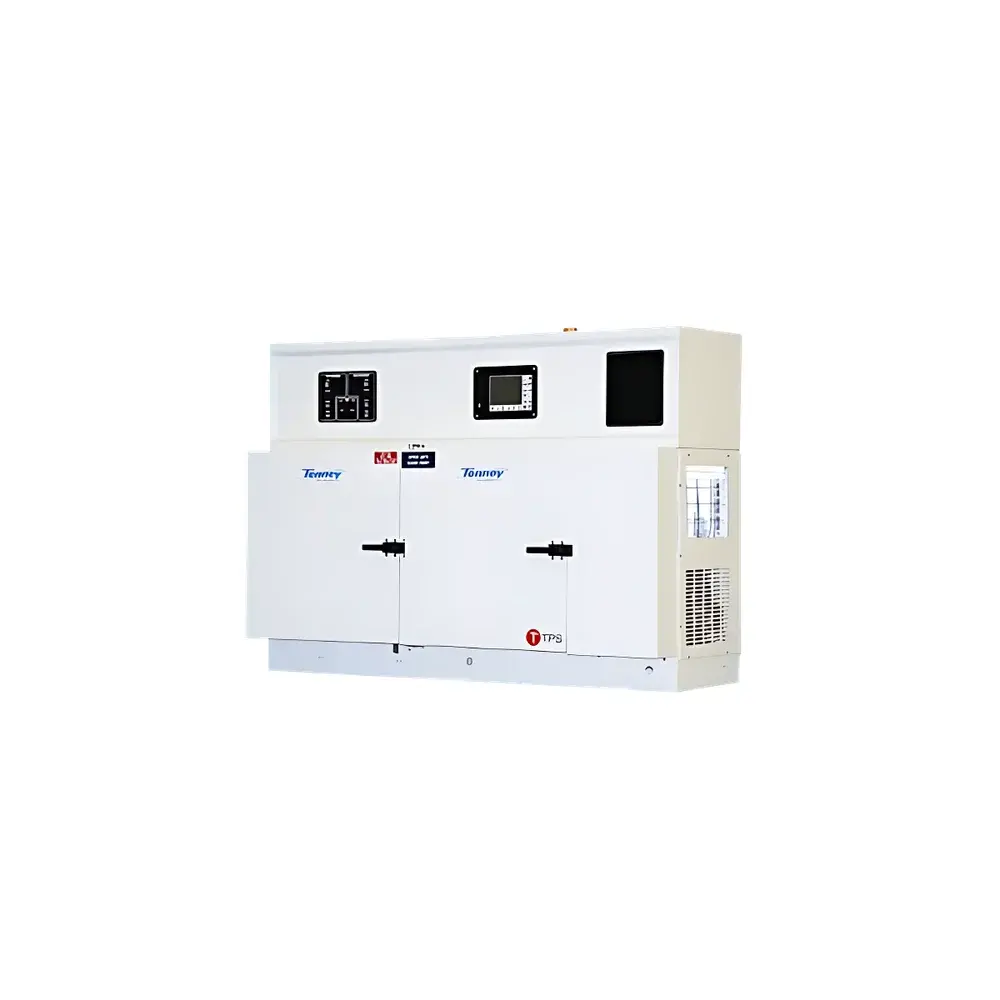
Blue M TENNEY TSJR Series Thermal Shock Primary Test Chamber
| [Brand | Blue M |
|---|---|
| Origin | USA |
| Model | TSJR |
| Temperature Range | -70°C to 180°C |
| Temperature Uniformity | ±1.0°C |
| Temperature Fluctuation | ±0.5°C |
| Temperature Deviation | ±1.0°C |
| Heating Rate | Ambient to 180°C (typical) |
| Internal Dimensions (W×H×D) | 1016 mm × 2057 mm × 2007 mm to 1626 mm × 2616 mm × 2515 mm |
| Construction | Continuously welded stainless steel interior |
| Refrigeration System | Dual-stage cascade with two hermetic reciprocating compressors |
| Heating System | Open-coil nickel-chromium wire heaters with ceramic insulation |
| Control System | Synergy Quattro touchscreen controller (320×240 color LCD), PID with auto-tuning, dual-channel capability |
| Compliance | Designed to support MIL-STD-202G thermal shock test protocols] |
Overview
The Blue M TENNEY TSJR Series Thermal Shock Primary Test Chamber is an engineered environmental stress screening (ESS) system designed for rigorous thermal shock and rapid temperature transition testing of electronic components, aerospace hardware, automotive modules, and high-reliability materials. Unlike single-zone thermal aging chambers, the TSJR employs a dual-chamber architecture—comprising independent hot and cold zones—to execute precise, repeatable, and accelerated thermal cycling per industry-standard shock profiles. The system operates on the principle of rapid specimen transfer between thermally isolated environments, enabling transitions from −65°C to +200°C in under 15 seconds (depending on load mass and configuration), thereby simulating real-world operational extremes encountered during launch, re-entry, or field deployment. Its structural integrity—built with continuously welded 304 stainless steel liners—and robust mechanical refrigeration ensure long-term stability, minimal thermal leakage, and compliance with foundational reliability test methodologies including MIL-STD-202G Method 107 and IEC 60068-2-14.
Key Features
- Dual independent thermal zones: Hot chamber (−65°C to +200°C) and cold chamber (−65°C to +200°C), each with dedicated heating and refrigeration circuits
- Motor-driven automated transfer mechanism with stainless steel wire mesh basket and electromagnetic brake for reproducible positioning and dwell control
- Vertical downward airflow design optimized for uniform thermal distribution and minimized stratification across large test volumes
- Synergy Quattro touchscreen controller featuring 320×240 color LCD interface, English-language programming prompts, real-time clock, and up to 999 programmable steps per profile
- Advanced PID control with auto-tuning and manual override capability—enabling dynamic compensation for variable thermal mass loading conditions
- Integrated safety monitoring: High/low pressure cutouts, compressor motor overload protection, overtemperature limiters (OTP TempGard), and dry-air purge systems per chamber
- Communication interfaces: RS-232 (standard), 10/100 Ethernet (TCP/IP), USB data logging port, and optional PCMCIA flash card slot for offline program storage and audit-trail-capable data export
- Configurable cooling augmentation: LN₂ or CO₂ boost options available for enhanced low-temperature ramp rates and extended sub-zero hold capabilities
Sample Compatibility & Compliance
The TSJR accommodates large-format test articles—including printed circuit board assemblies (PCBAs), avionics enclosures, battery packs, and composite structural components—within its scalable internal workspace (up to 1626 mm W × 2616 mm H × 2515 mm D). Each chamber includes a dedicated dry-air purge system to suppress condensation and oxidation during transitions, critical for moisture-sensitive devices. The chamber’s construction and control architecture support full traceability requirements under GLP and GMP frameworks; data logging functions record timestamped setpoints, actual temperatures, alarms, and system status—exportable in CSV format for FDA 21 CFR Part 11–compatible review. While not certified as a standalone validation instrument, the TSJR is routinely deployed in IQ/OQ/PQ protocols aligned with ISO/IEC 17025-accredited laboratories performing qualification testing per MIL-STD-810H, JEDEC JESD22-A104, and ASTM E1545.
Software & Data Management
The Synergy Quattro controller runs on Microsoft Windows CE embedded OS and supports local data retention via onboard flash memory and removable USB storage. All test programs—including multi-segment ramps, dwells, and cycling loops—are stored with version timestamps and user ID tagging. Remote monitoring and control are enabled through standard Ethernet connectivity using TCP/IP, allowing integration into centralized facility management systems or MES platforms. Audit trails include operator login events, parameter modifications, alarm acknowledgments, and calibration history logs—structured to meet basic 21 CFR Part 11 electronic record requirements when paired with organizational SOPs for electronic signature governance. Optional OEM-level firmware updates and diagnostic utilities are accessible via secure remote session tools compliant with industrial cybersecurity best practices (IEC 62443 Level 1).
Applications
- Thermal shock qualification of semiconductor packages and solder joint reliability per JEDEC JESD22-A104
- Environmental stress screening (ESS) of military-grade electronics per MIL-STD-202G and MIL-STD-883
- Accelerated aging studies of polymer-based seals, gaskets, and encapsulants under cyclic thermal loads
- Validation of thermal interface materials (TIMs) and phase-change thermal pads under repeated expansion/contraction cycles
- Pre-conditioning of lithium-ion battery modules prior to vibration or safety testing per UN 38.3 and UL 1642
- Material compatibility assessment for space-grade optics and infrared sensor housings exposed to orbital thermal gradients
FAQ
What standards does the TSJR comply with?
The TSJR is engineered to facilitate testing per MIL-STD-202G Method 107, MIL-STD-810H, IEC 60068-2-14, and JEDEC JESD22-A104. It supports full documentation workflows required for ISO/IEC 17025 laboratory accreditation but requires site-specific IQ/OQ validation for regulatory submissions.
Can the chamber be integrated into an automated test cell?
Yes—the TSJR provides discrete I/O signals (via Olympic I/O controller), Modbus TCP support over Ethernet, and RS-232 command-line protocol for seamless integration with PLC-based test sequencers and robotic handling systems.
Is LN₂ cooling mandatory for achieving −65°C?
No. The standard dual-stage cascade refrigeration system achieves −65°C without cryogen assistance. LN₂ or CO₂ augmentation is optional and intended for applications requiring faster cooldown rates or extended sub-zero dwell stability.
How is temperature uniformity verified and maintained?
Uniformity is validated using NIST-traceable Class A PT100 sensors at nine standardized locations per zone (per IEC 60068-3-5). The vertical airflow design, combined with continuous-welded stainless steel walls and insulated door seals, ensures sustained ±1.0°C uniformity across rated working volume.
What power configurations are supported?
Standard supply is 230 VAC / 3-phase / 60 Hz or 460 VAC / 3-phase / 60 Hz. Voltage and frequency variants can be configured at time of order; custom transformers or VFDs are available upon request for non-standard utility inputs.



